Church history from the 1st to the 2nd Coming of Jesus
The Christian church has always been trapped between the two most important events in human history (His story), which are the First Coming of Jesus to die for our sins, and the Second Coming of Jesus to catch up His Bride-church from off the earth. Then He will take her to Heaven for the Wedding Supper of the Lamb. The Second Coming is often called the Rapture.
The first Chapter of Revelation gives an overview of these 2000 years and emphasizes some key points of church history that can help us as guidelines as the Gospel of grace moved amongst the Gentiles.
The Great Pyramid of Giza in Egypt is the biggest precision monument ever built. Surprisingly, this Gospel in granite reveals the same prophecy of the First and Second Comings of Jesus.
The King's Chamber (shown in red) has an empty coffin to speak of the First Coming with the death and resurrection of Jesus.
The top of the Pyramid has no Capstone.
The great pyramid thus represents the church waiting for the Second Coming of Jesus, Who will be the Great Capstone of the church.

The main importance of the 2000 years between these two great events has not been the rise and fall of human empires. In God's eyes, the only importance of the last 2000 years has been establishing His church amongst the Gentile nations.
The church can be compared to a seed that has to be buried in the ground. The seed dies and rots, and then, miraculously in a way that Science cannot duplicate, leaves shoot up from the ground. This represents the Reformation started by Martin Luther. Then the tassels form, which produce the pollen that blows over the field. This represents the great missionary age. Then a husk forms to protect the seed that is developing in it. The husk represents the Pentecostal revival that started in 1906 in Los Angeles at Azusa Street.
The seed represents the restored Word that was revealed by the end-time Gentile prophet William Branham as he explained the mysteries of Scripture to us.
As the seed develops, the whole plant that represents the church systems, begins to dry up as they reject the King James Version of the Bible by claiming It is not the Absolute truth.
Then finally, seeds appear which are identical to the original seed that was planted.
The original seed was the beliefs of the apostles who wrote the New Testament.

Then, once the seeds have ripened, comes the harvest where the seeds are pulled off the plant.
The harvest rain or latter rain will see the Bride pulled off the world to meet the Lord in the air.
When the harvest is over, the farm beasts like oxen and cows eat up the dried-up plants that never went in the harvest. The final Pope will rule the world as the head of the beast religious system that will slaughter the foolish virgins in the three and a half years of great Tribulation.
During 2000 years, the church went through four basic stages as seven different church ages faced different conditions for the Christians to fight against. But there was one constant opposition throughout all seven church ages, and that was the Roman Catholic Church.
Stage 1.
This was the original seed that God established.
Church Age 1. The apostles established the truth between A.D. 33 and about A. D. 100 , when the last apostle, John, died. By that time, the apostle John had chosen the 27 Books of the New Testament, which, with the Old Testament, became the foundation of the early church. The term A.D. comes from the Latin " Anno Domini " and refers to the years after the birth of Jesus Christ.
After the death of John, ambitious humans promoted themselves as Bishops and claimed to be in charge of the church. By A.D. 170, a church hierarchy had been established with a Bishop entrenched as the head of the church. Church Councils now insisted on deciding what people could and could not believe.
Submission of the congregation to the rule of a single man grew the church in numbers and wealth. Still, this unscriptural cure was in itself a sickness that would finally ruin the church as they increasingly criticized the King James Bible.
Church Age 2. In their attempts to combat error, the church became careless. Error is like the weeds of the field -- it will always be present. With good intentions, the churches established a man to be the head of each church. This was an efficient business model for church growth but a disaster for the spreading of Bible truth. This looked efficient, but it just introduced another error which was the human leadership of the church. To keep all these church leaders in line, each city elected a Bishop to be in charge of all the churches in a city. When this Bishop was a godly man like Irenaeus, this did not seem to be a bad idea. But not many men were of his calibre.
The human leaders, or Bishops, began to bind their churches to their own opinions.
God used a series of vicious persecutions by the Roman Empire to scatter the Christians and thus minimize the damage caused by these human leaders.
Stage 2.
This stage involved the killing of Bible truth at the Council of Nicaea in A.D. 325. Having accepted an unscriptural Trinity, the church would add numerous more unscriptural doctrines such as Christmas, 25 December, Good Friday, God the Son, God the Holy Ghost, Second Person of the Godhead, etc.
This saw the death of the original seed truths of the New Testament under the flood of these unscriptural ideas until the truth was buried under the dirt of the Roman Catholic church in the Dark Ages.
Church Age 3. Politics entered the church with Constantine as the Roman emperor in A.D. 312. He used the Council of Nicaea to dictate official church doctrine and establish a centralized church organization in Rome. He aimed to make the Bishop of Rome a strong yes-man of his in the Western Roman empire while he went East to Constantinople.

Loaded with Constantine’s money, the bishop of Rome could buy his way to power over other churches by giving them money when they needed it.
Paganism entered the church. Adopting pagan customs and giving them Christian names made the Roman Catholic Church more acceptable to the pagans. Ishtar eggs and Ishtar bunnies became Easter eggs and Easter bunnies. Around A.D. 350 the Bishop of Rome, Julius I, copied the sun god's birthday on 25 December as the Son of God's birthday. By A.D. 382 the bishop of Rome, Damasus, was called Pontiff (the high priest of the Babylonian mysteries) by the Roman Emperor Theodosius. Truth became buried under layers of pagan tradition.
Think about the date 25 December, the sun god’s birthday that became Christ's mass or Christmas. The decorated pagan tree that Jeremiah Chapter 10 told us not to copy became the church’s Christmas tree. Church people degenerated into superstition. They began making the sign of the cross which was a copy of the pagan T that stood for Tammuz (another name for Nimrod). They introduced the rosary, shrines, relics, and pagan statues that were used as idols were simply renamed after saints. They introduced praying to Mary and the dead saints for help.
The two biggest disasters were the church accepting Trinity at the Council of Nicaea in A.D. 325 and accepting Bishops as the head of the church. This led them to accept the succession of Popes that were the only men who had the power to use the keys of Saint Peter to open the door to Heaven. You could only get Peter to open the Door for you if you obeyed the Pope. The Popes could then make up any other unscriptural doctrine that suited them.
Church Age 4. By the year A.D. 606, the Pope or bishop of Rome declared himself to be the Universal Bishop. He now claimed to be the Big Boss Bishop with authority over all the Bishops in the world.
Tens of millions of dissenters were killed by the Roman Catholic Church, which did its best to keep people away from the Bible. Europe became spiritually cold, dark, and dirty. The corruption and evil in the Roman church were sickening.
These Dark Ages were the dirt that the original seed of the apostolic truth was buried in, out of sight.
But the blood of tens of millions of martyrs would nourish that rotten soil so that the Seed of God's Word would germinate in the Reformation.
Stage 3.
God begins to restore Life back into the church.
Church Age 5. Around 1520, new leaves began to shoot up out of the blood-drenched soil as the Reformers, led by the brave Martin Luther in Germany, began to restore the truth of salvation by faith in the sacrifice of Jesus. John Knox, John Calvin, Zwingli, Melanchthon, and other reformers sprouted up like green leaves.
After the death of Luther, the Protestant movement began to splinter into a multitude of different denominational camps. Church-goers began to give their devotion to their human leaders instead of the Bible.
Human leadership again crept in, devoted to competitive Christianity. "My church is better than yours".
Denominations built protective doctrinal walls around themselves.
Christianity degenerated into Churchianity.
Church Age 6. Around 1750 John Wesley in England started a movement based on holiness and outreach to the sinners outside the church. This laid the foundation for the great missionary age led by William Carey as the first missionary to India in 1793. His example inspired tens of thousands to enter the mission fields as they scattered the Life-giving pollen of salvation and holiness around the world. This golden century of outreach enabled Christians to develop a vision beyond their denominational barriers.
The mission fields were tough and harsh and dangerous. But God raised up a fantastic spiritual army of tough and determined people whose memories still live on as inspiring legends today.
These missionaries were simply incredible.
Satan got badly whipped in that century of selfless missionary devotion and sacrifice. But a wounded Devil is dangerous.
The Devil licked his wounds and prepared for the last round of his titanic battle against God to gain control of the minds of men and women.
Stage 4.
The Bride must be fully restored to the Spirit and Truth of the apostolic fathers of the New Testament.
This has to happen in a gifted but dark age.
Church Age 7. Starting in Wales in 1904 and in 1906 at Azusa Street in Los Angeles, the Pentecostal movement restored the baptism of the Holy Ghost and the supernatural gifts. It started as a free movement, but by 1917 Pentecost denominated, and the fires died down.
In the late 1940s, William Branham and Oral Roberts gave Pentecost a welcome boost, and the revival fires lit up again.
But this age, thanks to an explosion of scientific knowledge and technology, became incredibly wealthy.
Sadly, the spiritual renewal was ruined by wealth and carnal materialism. The prosperity doctrine unleashed human greed, a commodity that is never nice, nor does it achieve anything worthwhile. Give a greedy person something, and it acts like adding wood to a fire. The flames of greed burn even more intensely. They never have enough.
In this modern nervous age that loves luxury, but is plagued with instability, uncertainty, nervous tension, stress, violence, and barbarity, the people are so self-obsessed and self-seeking that they cannot hear the Voice of Jesus as He calls to them from outside their church door.
The Bible is the Voice of God that tells us the thoughts of God in our dark and dangerous age. But we prefer not to listen because this is the age of "people's rights" where everybody just wants to do their own thing.
The Bible does not speak of the church in Laodicea (the church in the end time circumstances), it speaks of the church of the Laodiceans. Laodicea means "People's Rights". So the people in the churches today demand the right to serve God the way that they want to.
They are not concerned with being Scriptural.
63-0630 THE THIRD EXODUS
... for they can hear plainly the God's Voice, calling, through His Word ... Listen to the Bible, the Voice of God calling to you in this day.
This is the ultimate tragedy of the age.
The leaders of the church have effectively removed Christ, Who is the Word of God, from the people in the church.
This is the final poisoned fruit that started as Nicolaitanism in the first church age, the elevation of a holy man above the church.
The first church age believers hated this, but by the third church age, they had accepted it.
REVELATION 2:6 But this thou hast, that thou hatest the deeds of the Nicolaitans, which I also hate.
By the third church age, the church held or accepted the elevated church leaders that God still hated.
REVELATION 2:15 So hast thou also them that hold the doctrine of the Nicolaitans, which thing I hate.
This is just what the scribes and Pharisees, the religious leaders of the Jews, had achieved when Jesus first came to earth.
So the Bride individuals who seek Truth have to be restored back to the same New Testament beliefs of the apostles.
They have to find Truth outside their churches where they fellowship. Like the missionaries, they are going to have to be brave and determined if they want to achieve this. But some will, in fear and trembling, search out their own salvation from the oncoming storms of judgement that will sweep the world in the 3.5 years of great Tribulation.
PHILIPPIANS 2:12 Wherefore, my beloved, as ye have always obeyed, not as in my presence only, but now much more in my absence, work out your own salvation with fear and trembling.
Before great tribulation sweeps the world, the Bride must be restored to the first church. At harvest time, the final or last seed to ripen looks exactly the same as the first seed that was planted. Then the last seed will be pulled off the dried-up church plant in the latter rain harvest, as God catches her up to the Heavenly Wedding Supper of the Lamb.

The Bride goes to the Feast while the rest of the world will go to the Beast in Great Tribulation. The Bride will eat; the rest will be eaten or destroyed by the ferocious man of sin, the final Pope, and his demon-controlled hordes.
Chapter 1 in the Book of Revelation is a brief introduction to the seven church ages.
We get more background about the seven church ages from the 7 parables of the kingdom of Heaven in Matthew Chapter 13.
MARK 4:11 And he said unto them (His disciples), Unto you it is given to know the mystery of the kingdom of God: but unto them that are without, all these things are done in parables:
:12 That seeing they may see, and not perceive; and hearing they may hear, and not understand; lest at any time they should be converted, and their sins should be forgiven them.
Jesus gave the apostles an insight into the mystery of the unfolding history of the church. The Jews would be rejected from God’s plan when they crucified their Messiah. God would then turn to the Gentiles. This was a mystery that the Jews did not understand.
But then, the truth that the apostles used to establish the early church would be lost as human leadership and human traditions took over the Gentile church. Then finally, in the end, in the seventh church age, the mystery of the history of the church ages would be made known by the prophet messenger to the seventh church age. This would enable the end-time believers (the children) to be restored back to the understanding that the apostles (the fathers) once had.
REVELATION 10: 7 But in the days of the voice of the seventh angel the mystery of God should be finished as He has declared unto His servants the prophets.
The mystery (singular) of God is that William Branham had to reveal the Bible mysteries (plural) of God in order to restore the last church back to the beliefs of the first church age.
ROMANS 11:25 For I would not, brethren, that ye should be ignorant of this mystery, lest ye should be wise in your own conceits; that blindness in part is happened to Israel, until the fulness of the Gentiles be come in.
The Jews were blinded to the truth that a Man, Jesus, could be God.
The church today is blinded to the truth that the fullness of the Godhead dwells in the Man Jesus, making Jesus Lord God Almighty.
COLOSSIANS 2:9 For in him [Jesus] dwelleth all the fulness of the Godhead bodily.
But the church as a whole would reject the idea of returning to the beliefs of the apostles. Jesus, the Word, would be locked out of the church in the last church age. Then God would catch up the true church to Heaven and turn His attention to the Jews.
ROMANS 16:25 Now to him that is of power to stablish you according to my gospel, and the preaching of Jesus Christ, according to the revelation of the mystery, which was kept secret since the world began,
Apostle Paul established the mystery of the Gospel. The basis of Christianity was laid down by Paul. We have to return to his beliefs.
EPHESIANS 2:6 And hath raised us up together, and made us sit together in heavenly places in Christ Jesus:
:7 That in the ages to come he might shew the exceeding riches of his grace in his kindness toward us through Christ Jesus.
There are "ages to come" says, Paul.
He was aware of the seven church ages and gave us that clue by writing about the ages in verse 7.
But each age had to fit into a certain pattern.
I PETER 2:5 Ye also, as lively stones, are built up a spiritual house, an holy priesthood, to offer up spiritual sacrifices, acceptable to God by Jesus Christ.
Each Christian is a living stone in God’s great spiritual Temple that spans 2000 years. Each Christian is part of the priesthood. The fivefold ministry is not an Aaronic priesthood that stands between a man and God. All believers are part of the priesthood. Thus all believers are equal. No human is elevated above the rest.
GALATIANS 1:8 But though we, or an angel from heaven, preach any other gospel unto you than that which we have preached unto you, let him be accursed.
:9 As we said before, so say I now again, If any man preach any other gospel unto you than that ye have received, let him be accursed.
"Again". Why does apostle Paul say this twice?
Repetition means emphasis.
Those Christians in the first church age had to listen to him as he wrote down half of the Books in the New Testament. No apostle, not even Paul himself, can change what is written.
The Bible is supreme. Man can only preach what is in the Bible.
II THESSALONIANS 2:3 Let no man deceive you by any means: for that day shall not come, except there come a falling away first, and that man of sin be revealed, the son of perdition;
Then the truth would be lost and buried in the Dark Ages and only in the last church age would Christians be restored back to Paul’s teachings.
So the second time he is warning us in this last age of the Laodiceans who demand the right to serve God in any way that suits them. If they want gay rights, they claim that God does not mind.
If they want a pastor to be head of the church, which never happened in the New Testament, then they claim the right to do this.
If they want the unscriptural Christmas on the unscriptural 25 December then they demand the right to celebrate this pagan feast.
We had better believe what apostle Paul said or else we will be accursed.
If we disagree with Paul then we are in big trouble.
The future great Tribulation is moving in like a tsunami and our only way of escape is by getting back to what apostle Paul taught.
William Branham also has to line up with apostle Paul’s teachings.
I CORINTHIANS 3:9 For we are labourers together with God: ye are God's husbandry, ye are God's building.
:10 According to the grace of God which is given unto me, as a wise masterbuilder, I have laid the foundation, and another buildeth thereon.
But let every man take heed how he buildeth thereupon.
:11 For other foundation can no man lay than that is laid, which is Jesus Christ.
Each Christian is a living stone in God’s great temple that will be built over 2000 years.
But whatever you build for God, make sure you are building on the foundation that apostle Paul built.
We build "together" with Paul. Do not think up your own bright ideas. Just get back to what apostle Paul said.
ROMANS 16:25 Now to him that is of power to stablish you according to my gospel, and the preaching of Jesus Christ, according to the revelation of the mystery, which was kept secret since the world began,
Apostle Paul’s Gospel was the foundation for the church ages which were to follow.
This was a great mystery that was hidden from the Jews. Then the church also lost this knowledge as they followed human leaders. So the doctrine of the church ages became lost to the Gentiles until it was finally restored back in the last or seventh church age.
EPHESIANS 1:9 Having made known unto us the mystery of his will, according to his good pleasure which he hath purposed in himself:
God has allowed the history of His church to unfold in a way that humans find mysterious. God’s Will is very different from our will.
EPHESIANS 3:3 How that by revelation he made known unto me the mystery; (as I wrote afore in few words,
:4 Whereby, when ye read, ye may understand my knowledge in the mystery of Christ)
:5 Which in other ages was not made known unto the sons of men, as it is now revealed unto his holy apostles and prophets by the Spirit;
"Other ages".
What were these other ages? The Israelites (or Jews) had gone through 7 ages in their history.
First Jewish age.
The Jews had also gone through seven church ages, starting with Abraham, who "left his first love" when he claimed that Sarah was only his sister and not his wife. Then he produced Ishmael with the Egyptian woman Hagar. From her came the Muslims and today's Middle East crisis.
To the church of Ephesus.
REVELATION 2:4 Nevertheless I have somewhat against thee, because thou hast left thy first love.
Second Jewish age.
Joseph was put in prison to represent the second church age.
To the church of Smyrna.
REVELATION 2:10 Fear none of those things which thou shalt suffer: behold, the devil shall cast some of you into prison,
Third Jewish age.
Balaam opposed Moses in the third Jewish age.
To the church of Pergamos.
REVELATION 2:14 But I have a few things against thee, because thou hast there them that hold the doctrine of Balaam,
Fourth Jewish age.
Jezebel opposed Elijah. Ahab and Jezebel represented the Dark Ages of Jewish history.
To the church of Thyatira.
REVELATION 2:20 Notwithstanding I have a few things against thee, because thou sufferest that woman Jezebel, which calleth herself a prophetess, to teach and to seduce my servants to commit fornication, and to eat things sacrificed unto idols.
Fifth Jewish age.
Ezra brought back the Temple treasure to symbolize that Martin Luther restored the treasure of salvation by faith alone in Jesus.
Sixth Jewish age.
Nehemiah rebuilt the wall around Jerusalem in 52 days. Gates were built where the streets met the wall. The gates were the open doors for the city.
John Wesley's holiness and outreach led to the Missionary age. Brotherly love towards the unsaved heathen was the strong wall and protective wall of Christianity. Wesley received the Holy Ghost in 1738 and preached for 52 years.
The missionary age was like an open door that spread the Word of God around the world.
To the church of Philadelphia.
REVELATION 3:8 I know thy works: behold, I have set before thee an open door,
Seventh Jewish age Finally John the Baptist came in the last or seventh age of the Jews to introduce Jesus Who died outside the camp of Jewish establishment-religion, as their rejected King. The Jewish religious leaders, the scribes and Pharisees, blinded the people to their Messiah.
To the church of the Laodiceans.
REVELATION 3:14 And unto the angel of the church of the Laodiceans write;
REVELATION 3:20 Behold, I stand at the door, and knock:
Jesus, as the rejected Word of God, stands outside the church. Churches do not want the revealed mysteries.
REVELATION 3:17 ... and knowest not that thou art wretched, and miserable, and poor, and blind,
But throughout Jewish history, the idea of a Gentile church stretching over 2000 years was a complete mystery to them.
The idea of the last church becoming the same as the first church is a complete mystery to the last-age Christians.
EPHESIANS 5:32 This is a great mystery: but I speak concerning Christ and the church.
COLOSSIANS 2:2 That their hearts might be comforted, being knit together in love, and unto all riches of the full assurance of understanding, to the acknowledgement of the mystery of God, and of the Father, and of Christ;
"The mystery of God, and of the Father" makes little sense because the Father is God. It is difficult to find any difference between "God" and the "Father".
However, we can first speak of "the mystery of God" being 2000 years of church history with the original apostolic truth being lost and then restored by William Branham in the last age.
Then we can speak of "the mystery of the Father, and of Christ" as a second issue. The mystery of the Godhead.
The Godhead is a major mystery.
I TIMOTHY 3:16 And without controversy great is the mystery of godliness: God was manifest in the flesh,
Somehow Jesus is both Man and God. This is not easy to understand. The church would lose sight of Jesus being Almighty God.
The Father is the supernatural Spirit. Christ is the Man that the fullness of God's Spirit indwelled.
COLOSSIANS 2:9 For in him dwelleth all the fulness of the Godhead bodily.
Irony - The Jews could not believe that Almighty God could be a Man, Jesus.
The church today cannot believe that the Man Jesus can be Almighty God. They only see Him as the Son of God.
But natural light is also a mystery. It behaves like a particle that can only move in one direction at a time (like a bullet) but also behaves like a wave that can move in all directions at once (like dropping a stone into a pool of water and watching the ripples move outwards in all directions). Not easy to understand, but it happens anyway.
When scientists think of light as a wave then they do not think of it as a particle at the same time.
So if you think of Jesus as a Man, do not try to puzzle out how He can be God at the same time. When you think of Jesus as God, do not try to understand how He can be a Man simultaneously.
II THESSALONIANS 2:7 For the mystery of iniquity doth already work: only he who now letteth will let, until he be taken out of the way.
"Let" means prevent. Religious deception started in the church right at the beginning. This deception is so subtle that it would fool most churchgoers. Very few will properly expose church error.
God combats this evil until He leaves the earth at the end of the seventh church age. Then humanity is in deep trouble. The Devil will go unchecked on his final rampage into the 3.5 years of great Tribulation.
EPHESIANS 1:10 That in the dispensation of the fulness of times he might gather together in one all things in Christ, both which are in heaven, and which are on earth; even in him:
God wants to gather the last age and the first age into the same set of beliefs.
GALATIANS 1:11 But I certify you, brethren, that the gospel which was preached of me is not after man.
:12 For I neither received it of man, neither was I taught it, but by the revelation of Jesus Christ.
No man can add anything to the Bible. No man can change the Bible. The Book of Revelation lays out the whole history of the Gospel through the different conditions of each age. Satan kept throwing up different problems, and God somehow got His believers to overcome them in the face of very different tactics and circumstances that confronted them at different times.
I PETER 1:13 Wherefore gird up the loins of your mind, be sober, and hope to the end for the grace that is to be brought unto you at the revelation of Jesus Christ;
I PETER 1:17 And if ye call on the Father, who without respect of persons judgeth according to every man's work, pass the time of your sojourning here in fear:
If we grasp the revelation of Jesus Christ, we will understand Who He is. He is both a Man on the outside and God on the inside. We must realize the great danger of being fooled in our day, and our total dependence on God’s grace as He alone can open our eyes. That awareness will make us fear Him. We will not seek our own selfish greed and desire for recognition.
The Revelation of Jesus must put the emphasis on Jesus
The revelation of Jesus Christ puts the emphasis on Jesus. Not on some great man.
REVELATION 1: 1 The Revelation of Jesus Christ, which God gave unto him, to shew unto his servants things which must shortly come to pass; and he sent and signified it by his angel unto his servant John:
This first Chapter starts with a focus on Jesus. If we do not have a revelation of Who He is, then we will take our eyes off Him and start focusing on some man.
"Things will shortly come to pass" -- which will later be known as the church's history.
A day with God is as a thousand years.
II PETER 3:8 But, beloved, be not ignorant of this one thing, that one day is with the Lord as a thousand years, and a thousand years as one day.
Thus, God sees the 2000 years of church history as just two days long.
So everything in church history is going to happen soon. Either today or tomorrow from God's viewpoint.
Different challenges unexpectedly confront Christians.
Stay with the Bible, not your own ideas, as you confront the enemy. Your own ideas on how to combat error will merely be another error of human opinion that enters the church.
2000 years of church history is just today and tomorrow as far as God is concerned. So, very shortly, because tomorrow is the day after today, Jesus says to John that He will come.
REVELATION 1:2 Who bare record of the word of God, and of the testimony of Jesus Christ, and of all things that he saw.
Stay with the Bible as it is the Word of God. The testimony of Jesus means that you do things His way, not your own way. His way is always written in the Bible.
We are only blessed if we keep the written Word
REVELATION 1:3 Blessed is he that readeth, and they that hear the words of this prophecy, and keep those things which are written therein: for the time is at hand.
We read the Bible, not some man’s opinion.
You are only blessed when you hear someone read with understanding what is written in the Bible. That person who reads must be able to explain the Bible mysteries.
Only once you have understood the Bible verses can you stay with what is written.
"Readeth" means to read with understanding.
If you do not understand what is read, then it is meaningless and is not a blessing to you.
DANIEL 12:10 Many shall be purified, and made white, and tried; but the wicked shall do wickedly: and none of the wicked shall understand; but the wise shall understand.
Only the wise virgins are able to understand the revelation of the Bible mysteries.
The rest read the Bible without understanding much of it. That is why they seldom read the Bible.
Keep God’s Word. Do not change it to suit yourself. Truth does not always suit our human convenience and comfort. Nor will truth fit in with our human opinions.
"He that readeth".
"He" is singular. Only one man, the seventh angel, will be able to read the mysteries of Scripture with insight and understanding.
We, in turn, must listen to this voice of the seventh angel to understand the Scripture.
Nowhere in the New Testament were we promised the Voice of God. That is a trap of deception.
REVELATION 1:4 John to the seven churches which are in Asia: Grace be unto you, and peace, from him which is, and which was, and which is to come; and from the seven Spirits which are before his throne;
This Book of Revelation is mainly addressed to the seventh church age. The first church age had the truth from the apostles. Their test was to believe the New Testament and be ready to die for what they believed. In A.D. 64 the Roman emperor Nero launched the first vicious persecution against Christians. Roman emperors killed three million Christians in the first 250 years of the church's history. They faced death as their major enemy.
Then the truth got lost, and during the Dark Ages. People basically had no clue what the symbols in the Bible meant. In the last age, the symbols would be revealed. Thus John is effectively writing to the Christians of the last church age. Only they could actually understand his symbols once William Branham had revealed them.
Consider the First Seal. A mystery rider on a white religious horse with a bow and no arrow. Deception. Strange symbols.

Then in March 1963 brother Branham revealed the mystery of these symbols in the "Revelation of the Seven Seals".

The mystery rider is that antichrist spirit in the succession of the Popes who claim that Saint Peter will only open the door to Heaven for you if you are in obedience to the Pope. That succession of Popes looks like the Trail of the Serpent that is awaiting its head, the final Pope who will be the man of sin.
God’s grace is critical if we are to learn the Truth. Only He can help Christians. We need inner peace from God in our hostile and deceiving surroundings. The battle is His. We must learn to submit to His will.
Seven represents completion. Seven days complete a week. Seven dominant colours are in a rainbow. Seven dominant notes are in music "Doh, ray, me, fah, soh, lah, tee".
Then you start with the next "doh".
Seven churches are all that God needs to convey the complete plan of church history.
He chooses Asia. This begins and ends with an A. The first and the last letter are the same.
The last church age must be the same as the first church age.
Asia is Gentile territory. This is a hint that the future church (at the time of writing the Book of Revelation) will be mainly Gentiles.
"Which is" (our present tense seventh church age), "which was" (past tense. The first church age was past tense to every other age. Every church age only served God in so far as they were restored back to the first church age), "which is to come" (the future. Jesus "is to come" when the last age Christians have fully restored to the first age Christians. These are the wise virgins, the only end-time group with a great future, free from great Tribulation).
He can say "is" because all these events happen in two days. Today and tomorrow from God's perspective.
The Bible keeps updating itself to apply to each age. Thus we can read the Bible as if it applies to us now. The Bible is present tense as God reveals to each age just what that age needs to know for that age.
"Which is to come". It is right here. From God's perspective, the future is tomorrow.
The seven spirits. God gives different attributes of His Spirit to each age to combat the challenges of that age. So each age seems different from the others because different attributes of God are manifest in each age. Our seventh age wallows in wealth, but the spread of the wrong doctrine is so subtle that we need a good understanding of the Bible to withstand error. In the Dark Ages of the fourth age, they had little truth, partly because Bibles were banned, but needed huge courage to be burnt at the stake and not deny the bit of truth that they had. So God manifested His Holy Spirit in seven different ways to sustain each age through its different problems.
For instance, a woman can be the wife of a man, the daughter of her mother, the mother of her daughter, a friend of her neighbours, a colleague at her work, a helper at a charity, and a rescuer of animals in distress. She behaves in completely different ways, depending on who she is with. But she is still one woman with seven different ways of manifesting the spirit that is within her. "My husband tells me what to do", says the wife but, "I tell my daughter what to do". Nevertheless, it is the same woman.
Washed from sin in His Blood
REVELATION 1:5 And from Jesus Christ, who is the faithful witness, and the first begotten of the dead, and the prince of the kings of the earth. Unto him that loved us, and washed us from our sins in his own blood,
There is only one faithful witness that can be trusted in the changing circumstances of church history, and that is Jesus, the Word.
He was the first one to be resurrected in a new immortal body. The last church age ends with the resurrection of the New Testament dead saints. So the Bible gives us all the clues we need to be ready for the resurrection.
The prince takes over from the king.
Jesus is the prince of all the kings on earth because, when He returns, He will take over from every king as they fade off the scene and He sets up His kingdom on earth.
Jesus loves us and is struggling to get us to believe the truth so that He can save us from great Tribulation that is coming.
There is only one way to get saved from hell. Confess our sins and have them washed clean in the Blood of Jesus. That saves us from hell. That was a crucial doctrine running through the church ages.
But the last church has a further problem because it ends in Great Tribulation, and we need to be saved from that fate also, even though we are already saved from hell. That is what the restoration of the first church age beliefs is all about. Only their beliefs will save us from great Tribulation.
PHILIPPIANS 2:12 ... work out your own salvation with fear and trembling.
Works cannot save us from hell. But Scriptural works will save us from the coming Tribulation.
Saved Christians are priests with no man above them
REVELATION 1:6 And hath made us kings and priests unto God and his Father; to him be glory and dominion for ever and ever. Amen.
We will rule with Christ in the millennium as kings on earth. Every member of the Bride is also part of the priesthood.
There is no Aaronic priesthood of a fivefold ministry that is elevated up between God and man.
As kings and priests, we have no humans above us.
Thus the church has to be run as a brotherhood that is based on equality.
Not an elevated priest, or reverend. Nor an elevated Bishop, nor an elevated Pastor with the people being in submission to him.
Every saved Christian is a priest. No priest is above another priest. The only person who is above a priest is the High Priest, Jesus.
Priests and pastors love the praise of people and a position of pre-eminence.
They love the power that they have over people. It feeds their ego and self-importance.
All leaders love power and money.
Especially their power to take our money.
But glory and dominion over people only belong to Jesus.
Praising man is the first step down the wrong path.
Relying on a man establishes us on the wrong path.
REVELATION 1:7 Behold, he cometh with clouds; and every eye shall see him, and they also which pierced him: and all kindreds of the earth shall wail because of him. Even so, Amen.
His Coming will be with clouds, plural. Clouds of glory will be seen with His physical body.
He will not come AS a cloud.
When every eye sees Him, that is His third Coming when He returns for Armageddon at the end of great Tribulation. All the sleeping virgins were killed in the 3.5 years of great Tribulation. The 144000 Jews have also been killed and resurrected. Only the beast, the final Pope, and those who serve him, by killing off those who refused to submit to the beast, are left. That is why everyone is wailing. They then know they will have to answer for their crimes and murders.
"Even so". That is the way it has to be.
The Scriptural Bride will escape great Tribulation. The rest of the saved Christians are the foolish virgins that were fooled by wrong ideas like Trinity, Christmas, Good Friday, a 7-year Tribulation, the 1963 Cloud was the mighty Angel of Revelation Chapter 10, William Branham is the Voice of God, etc, will be slaughtered in great Tribulation.
ACTS 1:9 And when he had spoken these things, while they beheld, he was taken up; and a cloud received him out of their sight.
He went up with a cloud. He did not go as a cloud.
:11 Which also said, Ye men of Galilee, why stand ye gazing up into heaven? this same Jesus, which is taken up from you into heaven, shall so come in like manner as ye have seen him go into heaven.
He will come with a cloud. He will not come as a cloud.
The supernatural cloud of 28 February 1963 was not the coming of the Lord.
The cloud never came down. It stayed at an incredible height of about 27 miles but was only visible for 28 minutes after sunset. Besides, there were two clouds.

The above photograph was taken from Winslow in Arizona which was in the path of the approaching clouds that moved from West to East. The clouds appeared at Flagstaff 200 miles north of Sunset Peak for 28 minutes after sunset. Eight days later, the 7 angels that formed the main cloud appeared to brother Branham at Sunset Peak. They formed no cloud that day but commissioned him to reveal the Seven Seals of Revelation Chapter 6.

The smaller cloud was a smoke cloud to fulfill Peter's prophecy.
ACTS 2:19 And I will shew wonders in heaven above, and signs in the earth beneath; blood, and fire, and vapour of smoke:
Water vapour makes a rain cloud. So, smoke vapour makes a smoke cloud.
Thus, a high-altitude smoke cloud from an exploded rocket is needed to fulfill this prophecy.
The main big supernatural cloud is the sign of the Son of man in the heaven.
MATTHEW 24:30 And then shall appear the sign of the Son of man in heaven:
65-0718 TRYING TO DO GOD A SERVICE WITHOUT BEING THE WILL OF GOD
And then in that great observatory, so that the world will be without, they're still wondering what happened. In Tucson, them big observatories took the picture of it up there; still wondering what happened. What is it? They still put in the paper, "Does anybody know anything about what, how it could have happen?" There is no fog up there, there's no air, there's no moisture; thirty miles high in the air. Oh, my!
"There shall be signs in the heaven above. And when these things take place, earthquakes in divers places, then shall appear the sign in the heaven, of the Son of man."
The way the church began is the way the church must end
The harvested seed is the same as the planted seed.
REVELATION 1:8 I am Alpha and Omega, the beginning and the ending, saith the Lord, which is, and which was, and which is to come, the Almighty.
Alpha is the beginning of the Greek alphabet. Omega is the ending or last letter of the alphabet.
He stresses the first and the last, by mentioning them twice. Why?
Mentioning twice means emphasis.
He wants the last church age to end up believing exactly what the first church age believed.
The seed that is planted in the beginning is identical to the seed that is harvested in the end.
So Jesus warns us -- If we are not exactly like the early church, we will not be in the harvest when He pulls His Bride off the earth.
"Which is". Present tense. The seventh church age.
"Which was". Past tense. The first church age.
Another warning -- In our present age, we must go back to what the church was in the first age. When we are identical to them, only then will He be able to fulfill His plan, which means He "is to come" to take His Bride Home to Heaven. This is future tense. So the restored Bride has a great future.
But look at the succession of Popes.
REVELATION 17: 8 ... when they behold the beast that was, and is not, and yet is.
A Pope was ruling. He is not when he dies. Yet is when they elect a new Pope. The succession of Popes is the longest line of rulers in the Western world.
The real beast is that antichrist spirit that jumps from one Pope to the next Pope.
But notice: "was" is past tense. "is not" is present tense. "yet is" is present tense.
So the succession of Popes is described by words in the present tense and the past tense.
That tells us that there is no future tense. In other words, there is no future for the Roman Catholic church.
The home of the Popes, the Vatican city, which is mystery Babylon, is to be destroyed by a nuclear bomb.
REVELATION 18:9 And the kings of the earth, who have committed fornication and lived deliciously with her, shall bewail her, and lament for her, when they shall see the smoke of her burning,
: 10 Standing afar off for the fear of her torment, saying, Alas, alas, that great city Babylon, that mighty city! for in one hour is thy judgment come.
Why do they lament from far away? Why not get in and put the fire out?
It is a nuclear inferno that cannot be put out because all the deadly radiation will kill nearby people. No one wants to get close to a nuclear bomb explosion.
REVELATION 1:8 I am Alpha and Omega, the beginning and the ending, saith the Lord, which is, and which was, and which is to come, the Almighty.
"The Almighty". Jesus is Almighty God. No one can be compared to Him.
Never try to elevate a man to be equal with God.
The Almighty God has got one major concern that He repeats. The beginning and the ending. Why is His focus on the first (Alpha) and the last (Omega)? He expects them to be the same, just like planted and harvested seeds.
If you believe you must elevate a man, it just shows that you have absolutely no idea Who God is. God is like the sun. Man is like a star. The brightest star fades away when the sun comes into view.
REVELATION 1:9 I John, who also am your brother, and companion in tribulation, and in the kingdom and patience of Jesus Christ, was in the isle that is called Patmos, for the word of God, and for the testimony of Jesus Christ.
Consider the human lust for church leadership. "Call me Pastor. I am above you, and you must be submissive to me."
Look what John says, "I am your brother". This great apostle does not try to intimidate us with his rank and title.
He was one of the select twelve. He can claim that rank of the apostle. But he does not.
People who stress their leadership titles have caused so much damage to the church over the ages.
The human leadership of the church has been a major disaster. So this great apostle sets the example, "I am your brother". You are equal to me. There is no Aaronic priesthood with ministries above the people. Elevating a man is Nicolaitanism. That is a bad space to be in. God hates it.
"Companion in tribulation". The church has so many tribulations to endure. Tens of millions of martyrs will pay the price for their faith. Christianity is not for sissies. John does not offer you a bed of roses. He offers you tribulation. Ask the thousands of missionaries who struggled and died on the mission fields. Not the TV evangelists and megachurch pastors in their luxury homes. They are missing something.
If you have an easy and prosperous Christian life, be careful. Maybe you are no threat to the Devil, which is why he leaves you in peace.

Patmos was an island prison for the scum of the Roman empire. John was unjustly banished to Patmos first by Nero, the worst of Roman emperors, between A.D. 64 to 68. Nero died in A.D. 68, and all political prisoners were released after the death of the emperor who had imprisoned them. Then Domitian, who ruled from 81 to 96 as emperor, banished John again to Patmos during his reign of terror. John was finally released when Domitian died. Historians claim that John went to Ephesus, the nearest city to Patmos. John was the only man then alive who was spiritual enough to complete the final compiling of the 27 New Testament Books as he was the only apostle left. Thus John was the last man who could get that depth of guidance from God. John knew God when God was on earth as a Man, called Jesus.
John was imprisoned because of his stand for the Bible.
This will be our final test too. Can you stand for the Bible when all around you are standing on quotes of some man?
The Day of the Lord is great Tribulation time.
REVELATION 1:10 I was in the Spirit on the Lord's day, and heard behind me a great voice, as of a trumpet,
The Lord’s day is great Tribulation time, not a day of the week.
ISAIAH 13:6 Howl ye; for the day of the LORD is at hand; it shall come as a destruction from the Almighty.
:9 Behold, the day of the LORD cometh, cruel both with wrath and fierce anger, to lay the land desolate: and he shall destroy the sinners thereof out of it.
AMOS 5:20 Shall not the day of the LORD be darkness, and not light? even very dark, and no brightness in it?
JEREMIAH 46:10 For this is the day of the Lord GOD of hosts, a day of vengeance, that he may avenge him of his adversaries: and the sword shall devour, and it shall be satiate and made drunk with their blood: for the Lord GOD of hosts hath a sacrifice in the north country by the river Euphrates.
The Russian hordes. Russia is north of Israel. The king of the north, the Great Bear, will finally be destroyed in great Tribulation.
In 2022 Russia displayed her cruel nature with her ruthless invasion of Ukraine when the Russians just destroyed the cities and their civilians.
The way the church began is the way the church must end
REVELATION 1:11 Saying, I am Alpha and Omega, the first and the last: and, What thou seest, write in a book, and send it unto the seven churches which are in Asia; unto Ephesus, and unto Smyrna, and unto Pergamos, and unto Thyatira, and unto Sardis, and unto Philadelphia, and unto Laodicea.
Alpha is the first word of the Greek alphabet, and Omega is the last.
Jesus emphasizes the first and last again. This must be a very important fact.
The last age must be restored to the first age.
This restoration of the last age back to the first age is far more important than we realize.
Even the word "ASIA" is significant. The last letter is "A" which is the same as the first letter "A".
The seven red dots indicate the seven churches in Asia. Rome is marked with a green dot.

These seven cities lay on a postal road. God describes their characteristics and thereby sends a message, not just down this postal road to describe the condition of these seven churches but also down the "postal road of time" or the "pipeline of time," as He describes the events that will unfold during the future church ages.
The Devil is defeated by time as he cannot see the future.
God prophesies about the future to show His control over time. Prophecy is what makes the Bible unique. This is the stamp of God.

The postal road from Ephesus (1) to Laodicea (7) is shown on the above map as well as the two rivers that are in that area.
Now comes some real power. God made the characteristics of each city to match the characteristics of a future church age. And those future church ages would unfold in the same order as what the cities were on the postal road.
This indicates the incredible control of human events that God has.
A pattern begins to unfold.
The road moves up away from Ephesus (1) until it gets to the political capital Pergamos (3) then it does a drastic turn. This is the third church age where the emperor Constantine forced politics and paganism into the Roman Catholic church. With all the money and the magnificent Lateran palace that Constantine gave to the bishop of Rome, the Roman bishop became the powerful head of a centralized church. This Roman Catholic church was the only Roman organization that survived the breakup of the Roman Empire that the barbarian invasions had caused.
Then followed the famine, plague, chaos, and the religious murder of the Dark Ages. The Popes also encouraged the murderous crusades into Palestine to kill the Muslims. There were flickering lights of revival like the Albigenses in southern France, the Waldenses in the Alps, and Jan Hus of Bohemia that the Roman Catholic church suppressed and opposed.
Then the church began to return back to the same level as Ephesus with the Reformation of Martin Luther (5) and the missionary age of John Wesley (6) and the Pentecostal revival of the Holy Spirit that started the church age of the Laodiceans in 1904 in Wales and 1906 at Los Angeles (7).
Finally, the church needed a revival of Scriptural Truth. A prophet, Elijah, was needed to restore us back to the teachings of the apostolic fathers where it had all begun. This man was William Branham in America.
But the church tradition of having a one-man human head as pastor sidelined the movement.
Then followed an obsession for these elevated pastors to be the interpreters of quotes that placed future events into the past. The great Cloud of 1963 became the Coming of the Lord and the descent of the mighty Angel of Revelation 10, Who will perform the resurrection of the dead.
Instead of using the prophet's quotes to gain a deeper understanding of the Bible, pastors spliced the quotes to produce doctrines that removed people from the Bible. They developed doctrines that the first church age never believed.
Brother Branham’s image in the eyes of "Message believers" changed from being a prophet who was the "voice of the seventh angel." He became regarded as infallible, and his quotes, which are uplifted to Deity as the "Voice of God," can replace Scripture where necessary.
He became more than a man, as they claimed that he was the appearing of "The Son of Man".
The enforced "worship" of an image of the prophet Daniel began in the first Gentile kingdom of Babylon.
Subtle infusions of the Babylonian mysteries into revealed Bible truths have reduced Message believers to this same delusion that their prophet is the Absolute, with his quotes standing in the place of the Word of God.
(VICARIVS FILII DEI means "In place of the Son of God". This is 666, the number of the mark of the beast. These Message believers are in dangerous territory.
In Latin V = 5, I = 1, C = 100, L = 50, D = 500 ). The other Roman letters have no number values.
No one can replace Jesus or stand in His place.
REVELATION 3:14 And unto the angel of the church of the Laodiceans write; Notice, the 7th church is "the church of the Laodiceans." The Laodiceans make up their own church. They make up their own beliefs. They do not stay with Scripture. They are too impressed with their own cleverness.
So there is a final mystery to the seven church ages.
The need for individuals to come out of the Message groups that have built up unscriptural interpretations from selected quotes.
The need for a group of elders to replace a dominating pastor as the ones who feed the local flock.
No Scripture says that the tithes belong to the pastor.
No Scripture says the pastor is the head of the church.
No New Testament Scripture says that we have to meet in "church" buildings or tabernacles.
Historians can find no evidence of a building that was used as a church before the year A.D. 220.
Early believers met in houses. So this is a safe New Testament example to be restored.
The COVID-19 pandemic of 2020 saw Zoom video communications improve, and now individuals and families in their houses can communicate and fellowship with other individuals who are thousands of kilometers apart.
ROMANS 16:3 Greet Priscilla and Aquila my helpers in Christ Jesus:
:5 Likewise greet the church that is in their house.
I CORINTHIANS 16:19 The churches of Asia salute you. Aquila and Priscilla salute you much in the Lord, with the church that is in their house.
ACTS 8:3 As for Saul, he made havock of the church, entering into every house, and haling men and women committed them to prison.
COLOSSIANS 4:15 Salute the brethren which are in Laodicea, and Nymphas, and the church which is in his house.
The last move is just for individuals who can escape from the church of the Laodiceans (7) with all their personal opinions and "group think" back to the church of Ephesus (1) that the apostles established. We must be fully restored to the first church, free from the errors caused by splicing selected quotes together. Free from the domination of one-man human leadership.
The first four candlesticks represent the truth of the first church age getting lost in the fourth church age. Moving away from the first church age was EVIL.

Then God began a restoration of truth. EVIL was reversed and became LIVE, moving towards the first church age.

It is vital to note that it does not stop at age 7. Age 7 has to return to the first church age.
REVELATION 3:14 And unto the angel of the church of the Laodiceans write
:20 Behold, I stand at the door, and knock: if any man hear my voice, and open the door, I will come in to him, and will sup with him, and he with me.
Jesus stands outside the door of all the man-made Laodicean churches. He mentions no exceptions.
This includes Message churches, in all their varieties.
He appeals only to individuals.
We can have only one goal today: somehow, we have to get back to the church of Ephesus where the church ages started. We must only do and believe what is written in the New Testament.
Even the names of the cities can be given meanings that tell the same unfolding story of events.
REVELATION 1:11 ...What thou seest, write in a book, and send it unto the seven churches which are in Asia; unto Ephesus, and unto Smyrna, and unto Pergamos, and unto Thyatira, and unto Sardis, and unto Philadelphia, and unto Laodicea.
"Unto Ephesus (relaxed, aimed at), and unto Smyrna (bitterness, death), and unto Pergamos (thoroughly married), and unto Thyatira (dominating woman), and unto Sardis (escaped ones), and unto Philadelphia (brotherly love), and unto the church of the Laodiceans (peoples’ rights. People have the right to make up their own beliefs and their own way of serving God)".
The first church age, thanks to Paul and the apostles, had the truth, but after the apostles died, believers became relaxed. They aimed at being Scriptural but became less vigilant and more careless about the odd unscriptural human ideas that kept creeping in. As this human leadership established control over the church, God raised up persecution which scattered them into small groups to minimize human domination of the church. Three million Christians died in the Roman Empire from these fierce and bitter persecutions. Bitterness and death were the Christians’ companions as the Roman Empire tried to stamp them out.
The Roman emperor Constantine stopped the killing in A.D. 312 at the cost of forcing the church to marry thoroughly into his brand of political control. He also forced the church to get thoroughly married into pagan traditions so that pagans would feel at home in the church. The Nicaean Council of A.D. 325 forced the church to accept the unscriptural Good Friday named after the goddess Freya and the pagan Trinity of One-God-in-three-Persons, Who has no name. You cannot find one name for three persons.
If Jesus died on Friday and rose on Sunday, He could only spend two nights in the tomb, not three. But who cares about being Scriptural? Freya was the fish goddess who was worshipped by eating fish on a Friday. So we will continue to eat fish on a Friday.
MATTHEW 12:39 But he answered and said unto them, An evil and adulterous generation seeketh after a sign; and there shall no sign be given to it, but the sign of the prophet Jonas:
:40 For as Jonas was three days and three nights in the whale's belly; so shall the Son of man be three days and three nights in the heart of the earth.
The crucifixion and resurrection of Jesus was the sign that God gave to show the First Coming of Jesus.
History repeats.
The King James Version of the Bible is the Word of God. But Jesus is the Word of God. So the King James Bible tells us the thoughts of Jesus. By rejecting certain King James Bible verses and changing other King James Bible verses, the modern-day preachers are effectively crucifying Christ afresh. They are destroying His thoughts, and thus, they effectively destroy His influence. This is the major sign that the Second Coming of Jesus is approaching. As brother Branham revealed the mysteries of Scripture to show the Son of man (Jesus) walking through the pages of the King James Bible, the churches responded by pushing the King James Bible outside their churches.
Around A.D. 350, Pope Julius I claimed that 25 December, the birthday of the sun god, was also the birthday of Jesus with its unscriptural "Merry Christmas" which is now the biggest church festival of the year.
Move the "n" in Santa to the end of the word and you get Satan. Church-goers are easily fooled.
In AD 382, Pope Damasus became the Pontiff or High Priest of the Babylonian Mysteries, and Roman Catholicism became Mystery Babylon. Then the Roman Empire disintegrated under the barbarian invasions, and the Roman Pope rose to power as the barbarians depended on him to anoint their kings, which saved these kings from assassination. A man could only be a legitimate king if he was anointed or crowned by the Pope. So the barbarian kings defended the Roman Catholic Church, which consequently rose to power and ended up dominating Europe. A woman symbolizes a church. The true church is called the Bride of Christ.
Thus the Catholic church was the dominating woman of the Dark Ages.
Then came the Reformation as Martin Luther in Germany led the escaped ones who rejected the clutches of Catholicism, and joined the Protestant movement.
Then John Wesley started an outreach movement to save those outside the church. This led to the great missionary age, where the brotherly love of the missionaries for their pagan brethren took them overseas to labour and die in their great efforts to save the heathen.
Then came our nervous and uncertain modern age with its two awful world wars, amazing technological advancements, and incredible production of goods and wealth.
Free-thinking in the universities has claimed to have "proved" the theories of Evolution and the Big Bang which destroyed faith in the Bible. Taking their eyes off God, people became obsessed with their own rights and their entitlement to live in sin and demand gay rights as they pursue their greed and selfishness.
People’s rights made people demand the right to choose their own lifestyle and their own beliefs by being able to join whichever church they want to attend out of the more than 45000 different varieties or types of churches and denominations now available. Now people even demand the right to choose their own gender.
Christians insist on their own right to elevate, uplift, and follow the pastor of their own choice. Their own right to interpret brother Branham's quotes and call this their Absolute. Thus very few will actually seek to be restored to the original teachings of the apostles as written in the New Testament.
Sadly, a gifted but dark age, blinded by wealth and human brilliance, locks the Word of God Who is their true Head, outside their church door.
Inside the church is another head, the pastor.
But inside is darkness because the Light stands outside.
JOHN 3:19 And this is the condemnation, that light is come into the world, and men loved darkness rather than light, because their deeds were evil.
On such a world, the 3.5 years of great Tribulation will burst like a horrific tsunami and earthquake.
REVELATION 1:12 And I turned to see the voice that spake with me. And being turned, I saw seven golden candlesticks;
REVELATION 1:20 ….and the seven candlesticks which thou sawest are the seven churches.
"I turned."
We are never where God wants us to be. We are never looking in the direction where God wants us to look.
We think we are clever, but we are not.
When God speaks, it is from behind us. We always move in the wrong direction but do not know we are wrong. We have hardened ourselves against any correction from outside our church, forgetting that Christ stands outside our church. So we ignore Him. He is the Bible we seldom read as the modern-day obsession joins up selected quotes that say what we want to hear. What we wish to be true. Our delusions fool us because we love not the truth of the written Bible.
II THESSALONIANS 2:10 And with all deceivableness of unrighteousness in them that perish; because they received not the love of the truth, that they might be saved.
:11 And for this cause God shall send them strong delusion, that they should believe a lie:
To see the Voice that spoke, John had to turn around.
Turning around and going the other way is symbolic of repentance.
The key to spiritual success is endless repentance.
We have far more errors than we realize.
But then our age is blind, and we do not know that. We think we are bright.
ISAIAH 55:9 For as the heavens are higher than the earth, so are my ways higher than your ways, and my thoughts than your thoughts.
Whenever God reveals something from the Bible, then it will be different from what we thought.
So we must be endlessly repentant of our own way of thinking because our thinking just cannot reach the level of God’s thinking.
LUKE 17:10 So likewise ye, when ye shall have done all those things which are commanded you, say, We are unprofitable servants: we have done that which was our duty to do.
An unprofitable business makes more losses than gains.
Since the Bible says we are all unprofitable servants, it means that however hard we try, we do more wrong than right. We have many wrong beliefs that we have picked up from books, TV programs, YouTube videos, pastors, social media, other people, as well as our own so-called "bright" revelations.
So, thinking that we are very clever, we are actually an endless loss to God.
Only His grace can sustain us, not our works or our bright ideas.
REVELATION 1:13 And in the midst of the seven candlesticks one like unto the Son of man, clothed with a garment down to the foot, and girt about the paps with a golden girdle.

The seven candlesticks represent the seven church ages.
Only one Person is visible. Jesus. No man is seen with Him. No man can in any way compare with Him.
Apostle John did not see Paul, nor William Branham.
John, the great apostle, and prophet, fell down as dead when he saw Jesus.
We Christians must learn to elevate Jesus way above any other person. Jesus is in the midst of His people during these seven ages. Whatever Christians have to go through, Jesus is there to help them endure their trials.
Jesus is the only Person Who is present in all seven ages.
Each man, however spiritual, could only be present for a portion of one church age.
Thus no human can compare with Jesus Christ.
John sees 7 church ages but only the central candlestick, representing the first church age, holds Christ Who is the full Word of God.
The presence of Jesus in the central or first church age must totally dominate all 7 church ages.

Only the central candlestick, representing the first church age, has the full truth.
The Ancient of Days has hair white like wool
REVELATION 1:14 His head and his hairs were white like wool, as white as snow; and his eyes were as a flame of fire;
The white woolen wig of a judge. Grey speaks of age, but white speaks of wisdom. We are not to judge one another, only Jesus has the wisdom to do this.
JOHN 5:22 For the Father judgeth no man, but hath committed all judgment unto the Son:
Jesus will judge us as a Man, not as God. As a fellow Man, He understands us.
JOHN 12:48 He that rejecteth me, and receiveth not my words, hath one that judgeth him: the word that I have spoken, the same shall judge him in the last day.
We will be judged by what is written in the Bible.
His eyes glow with fire. His judgements will be hard. His eyes look right through people to discern their thoughts and motives. If we do not stay strictly with Scripture, we will be in deep trouble.
Only one sentence will pass the Judgement seat: "It is written…".
If it is not written in the Bible, leave it alone.
REVELATION 1:15 And his feet like unto fine brass, as if they burned in a furnace; and his voice as the sound of many waters.
Feet like brass.
DEUTERONOMY 28:15 But it shall come to pass, if thou wilt not hearken unto the voice of the LORD thy God, to observe to do all his commandments and his statutes which I command thee this day; that all these curses shall come upon thee, and overtake thee:
:23 And thy heaven that is over thy head shall be brass, and the earth that is under thee shall be iron.
Brass is hard and is a symbol of judgement. He Himself suffered frightful agonies of death to establish the truth. The fiery trials of His faith were as if He had walked through the fires of hell on our behalf as He suffered for our sins and carried our sins through hellfire to dump them on the Devil. Yet His voice is life-giving like the soothing sound of waters to those who believe His Word. But His voice sounds like the oncoming storms of judgement to those who do not believe.
REVELATION 1:16 And he had in his right hand seven stars: and out of his mouth went a sharp two edged sword: and his countenance was as the sun shineth in his strength.
EPHESIANS 6:17 …and the sword of the Spirit, which is the word of God:
The Word of God is the sword wherewith we fight, not against people in the flesh to kill them physically, but rather to kill the ideas that Satan has put into their minds.
It is a war of words, truth versus error.
A two-edged sword that cuts out our own sin even as it cuts out the sin of others. The truth blends the cutting edge of the Old Testament with the cutting edge of the New Testament. Both Testaments have to merge together if we are to claim that we have the truth.
His face is like the sun, dazzling in its brightness. Jesus is the Word of God, and we cannot argue with Him. His brightness, His wisdom, and His example just so far outshines any human efforts. Our man-made lights only illuminate a small area.
The sun lightens up the whole world as it spins on its axis.
And sunlight is free.
The King James Version Bible is free from copyright, except possibly in the United Kingdom.
Anyone else can copy it. This makes sense as nobody can copyright God’s Word. The other Bible versions are copyrighted as they are man’s opinions. So God’s Word freely illuminates everyone, just like the sun. Man’s bright lights are like his bright religious ideas -- they are just limited puddles of light that last until the sunlight of God's Word rises.
The King James Bible is the River of Life. Do not misinterpret a puddle of quotes and call that Truth.
The last church must also be dominated by the Bible
REVELATION 1:13 And in the midst of the seven candlesticks one like unto the Son of man, clothed with a garment down to the foot, and girt about the paps with a golden girdle.
Jesus is the Word of God. Thus, the Bible is the central support of the 7 church ages.
REVELATION 1:17 And when I saw him, I fell at his feet as dead.
And he laid his right hand upon me, saying unto me, Fear not; I am the first and the last:
Again the emphatic repetition that the first and last must be the same, because the whole purpose of the 7 church ages is for the original Seed Word of the apostles to be planted and die in the Dark Ages and be resurrected up and restored. The last Seed to be harvested is just like the planted Seed of the apostles.
John was a very spiritual man who could see such great revelations and visions.
Yet, in the presence of Jesus, the great prophet and apostle John became nothing.
Only as we die to self and self-importance, can our lives elevate Jesus and make Him the focus of our attention.
We must decrease so that Jesus can increase.
If we truly come into the presence of Jesus, then we will just die to ourselves and our own opinions.
His right hand symbolizes power.
MATTHEW 26:64 Jesus saith unto him, Thou hast said: nevertheless I say unto you, Hereafter shall ye see the Son of man sitting on the right hand of power, and coming in the clouds of heaven.
The power of God becomes more and more effective as we succeed more and more in dying to ourselves.
We are so obsessed with our own ideas and traditions that our efforts to serve God are unprofitable to Him.
If we die to ourselves, God can use us to achieve His will, because we cannot comprehend God’s will in our own wisdom. To serve God, He has to be able to push us in directions that we do not want to go in.
That is why we fail when we choose the church that we do like. That is our will, not His will.
"I am the first and the last" -- Once again, this emphasis.
The first church age had the truth. The truth then got lost. Only in the last church age will the Bride be restored back to the first church age's teachings.
We must have no clever doctrines of our own.
We must not rely on a plausible interpretation of quotes that produce ideas that the first church never believed.
We must not follow some man.
All we can do, if we are to please God, is to follow the teachings and example of the New Testament, and make sure that we add no "clever" trimmings to what they believed.
We think we are bright. We think that our interpretations of quotes are clever. But we fool ourselves.
Our wisdom is like a flickering candle. You cannot compare a candle with the sun.
Only Jesus is bright like the sun.
Only the Bible should be our illumination.
The church must also die and be resurrected like Jesus
REVELATION 1:18 I am he that liveth, and was dead; and, behold, I am alive for evermore, Amen; and have the keys of hell and of death.
Again Jesus stresses that He is alive in His last church age, and refers back to His death and then His resurrection, which launched the first church age.
Thus He wants the last church to be like the first church because the truth established in the first church age will never change, as it will be forevermore the way Paul and the apostles preached it in the power of the resurrection.
We have to get back to their example and teachings.
Our modern interpretations, if the first church did not preach them, are simply wrong.
Jesus went down to the regions of the lost and defeated the Devil, stripping him of his authority over death and hell. Since then, no Christian can die unless Jesus grants permission. Christians do not have to fear death, as it only happens if God permits it, and then that death is in the will of God.
The third and fourth church ages would see the Christian church plunge into the abyss of religious deception, pagan traditions, and political involvement, which are guaranteed to produce spiritual death.
But Jesus has the keys of death and hell, so when all seemed lost in the Dark Ages, He would unlock the doors of human knowledge that would lead to the Renaissance of learning, the skill of printing, and then the courage of the Reformation to return to Biblical salvation by grace through faith that finally ended the Dark Ages.
Justification by faith launched the fifth church age. This was the first step toward restoring the church back to the New Testament model of the apostles.
The strength of Christianity lies in the extent that it has returned to the first church.
REVELATION 1:19 Write the things which thou hast seen, and the things which are, and the things which shall be hereafter;
John must write down what he saw in these visions, which describe "the things that are," the present state of the seven churches, and the amazing way in which the characteristics of these seven churches will reveal the history of the seven church ages "which shall be hereafter," as the 2000 years of church history unfolds.
Already he could see how the characteristics of the Ephesian church were describing the first church age. He could see how human leadership was infiltrating the early church, and leading the people away from the apostles' doctrines.
III JOHN 1:9 I wrote unto the church: but Diotrephes, who loveth to have the preeminence among them, receiveth us not.
:10 Wherefore, if I come, I will remember his deeds which he doeth, prating against us [the apostles] with malicious words: and not content therewith, neither doth he himself receive the brethren, and forbiddeth them that would, and casteth them out of the church.
This early church leader dominated his church, rejected the Scriptures that the apostles wrote, and threw people out of the church when they disagreed with him.
John was giving us an insight into the way that human leadership would govern the church. It was not a pretty picture.
Yet John knew that the first church had the truth, for those who wanted to follow the truth.
John introduces himself as an elder.
Elders, plural, not a dominating pastor, are to run the church.
John did not refer to his rank as an apostle. He tries to stress the equality of brotherhood. Not the Nicolaitanism of elevating a human leader above the congregation.
The word "pastor" only appears once in the New Testament and is condemned six times in the Old Testament.
JEREMIAH 23:1 Woe be unto the pastors that destroy and scatter the sheep of my pasture! saith the LORD.
:2 Therefore thus saith the LORD God of Israel against the pastors that feed my people; Ye have scattered my flock, and driven them away, and have not visited them: behold, I will visit upon you the evil of your doings, saith the LORD.
This is not a good track record for Pastors.
John does not write as an apostle or prophet. He desires no title other than "elder."
A group of elders should run each local assembly.
III JOHN 1:1 The elder unto the wellbeloved Gaius, whom I love in the truth.
:4 I have no greater joy than to hear that my children walk in truth.
" My children."
Those who followed the teachings of the apostles, because only the New Testament writers had the authority to write down the Word of God.
John made the final selection of Books that would make up the New Testament. After the deaths of all the other apostles and New Testament writers, John was the last apostle left on earth. This towering spiritual figure could move with amazing authority between our physical dimensions of space and time and the much higher but hidden dimensions of the spiritual realms of Heaven. He alone was close enough to Jesus, having been trained by Jesus, to have sufficient inspiration to make these critical choices. He was gifted with a unique discernment to choose the right eight authors of the New Testament. Matthew, Mark, Luke, John, Paul, Peter, James and Jude. Since that time, no one else could add anything to the Bible.
Our souls depend on his choice of New Testament Books. But John chose well.
MICAH 5:5 And this man shall be the peace, when the Assyrian shall come into our land: and when he shall tread in our palaces, then shall we raise against him seven shepherds, and eight principal men.
The evil and bloodthirsty kingdom of Assyria symbolizes the Devil.
Once the church accepted human leadership, it was just a matter of time before the wrong men rose to power in the church and good men became corrupted by the love of power and wealth.
Satan would rise high in the church world with its exorbitant wealth and palatial buildings.
In AD 312, emperor Constantine gave the beautiful Lateran Palace on the Caelian Hill to the Roman Bishop. It still remains the official headquarters of the Roman Catholic Church. Then in the 1500s, the Vatican was established in Rome with its vast and beautiful buildings. The Roman Catholic Church thus set the pace with its palaces for its top leaders.
Protestants would not be slow to follow this example of luxurious buildings for their human leaders.
But Satan would soon trample around inside those same buildings and make himself at home. Satan loves fancy buildings. Pastors often have the best house and the best car in the church (and a reserved parking spot). The Devil loves ostentatious wealth.
But God would raise up eight principal men to stand for truth.
These were the eight men who wrote the New Testament. Matthew, Mark, Luke, and John wrote the Gospels. Luke wrote the Book of Acts. Paul wrote from Romans to Hebrews. James, Peter, Jude. And then that same John wrote his last three books and the Revelation of Jesus Christ.
Then God organized for seven angels to come down at different times in history, during the seven church ages, to guide the thinking of seven men so that each one could act as a guide or messenger to his church age. Paul was helped to write his New Testament books. The other six would each be helped by the specific angel for his age, knowingly or unknowingly, as they worked hard to steer the church back towards the beliefs of the New Testament. An angel is a messenger from Heaven. Because these men were under this angelic help and guidance, God referred to these men as messengers from God and thus also called them angels, because they brought the message of the will of God for their church age to the people.
So there would be an ongoing battle between human leadership in the church that loved being important and created its own beliefs and traditions, and the true believers who died to themselves, never wanting to be anything in this world. True Christians were content to simply follow the truth as laid down by the apostles.
In the end the mysteries are revealed
REVELATION 1:20 The mystery of the seven stars which thou sawest in my right hand, and the seven golden candlesticks.
The seven stars are the angels of the seven churches: and the seven candlesticks which thou sawest are the seven churches.
Finally, God reveals the meaning of the candlestick. It refers to the 7 churches that describe the 7 church ages that were to come.
EPHESIANS 2:7 That in the ages to come
The first human messenger to the first age was Paul, and he was received as an angel by the people, despite having some physical infirmity. Maybe his eyes were damaged by looking at the Holy Spirit that shone as a dazzling Light on his way to Damascus.
GALATIANS 4:13 Ye know how through infirmity of the flesh I preached the gospel unto you at the first.
And my temptation which was in my flesh ye despised not, nor rejected; but received me as an angel of God, even as Christ Jesus.
God also called each great man of each age, an angel. A messenger. A star. A burning light with the truth for that day.
Then the seven candlesticks represent the seven church ages, with each candlestick representing a church age.
Let us follow the church history by using the seven-branched candlestick of the Jews:

On the Day of Pentecost tongues of supernatural Fire lit the first church age.
This was God’s best church, as described in the Book of Acts. This was the only guaranteed church.
God started His church the way He wanted it.
Now He wants it the way that He started it.
Then the standards declined as human leadership took over in the second church age. The original spiritual light of the Gospel dimmed as human opinions and traditions entered the church.
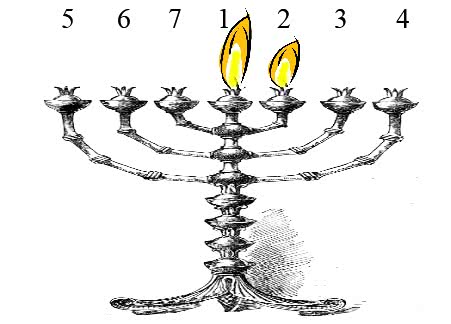
Then Roman emperor Constantine introduced politics and pagan ideas into the church. So the light dimmed further in the third church age, especially after they believed in the unscriptural word Trinity. A centralized organization under the Pope (an unscriptural word) developed.

Then brutal politics with mass murder sustained the church in the fourth church age. The Roman Catholic Church clawed its way to power over Europe that had disintegrated during the barbarian invasions.
Hardly any truth remained as the Bible was banned.
The evil in the church was the fact that they had moved far away from the New Testament beliefs of the first church age.

But then God began a restoration back to the New Testament.
JOEL 2:25 And I will restore to you the years that the locust hath eaten, the cankerworm, and the caterpiller, and the palmerworm, my great army which I sent among you.
There will be three church ages of restoration to restore what the enemy had chewed away.
The 7th age would see two steps of restoration. First, the Pentecostal restoration of spiritual gifts. Then brother Branham restoring the understanding of the revealed Word.
Each stage of the Reformation brought back deeper truth.
EVIL was moving away from the first church age.
Luther restored salvation by faith in church age 5.
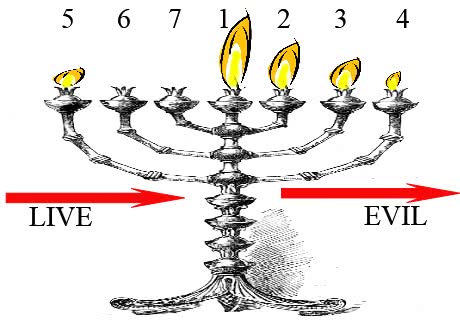
Wesley restored holiness and outreach in church age 6.

"LIVE" is the opposite to "EVIL". Spell EVIL from right to left and you get LIVE.
The secret behind the word "live" is the desire to get right back to the original faith of the apostles.
Pentecost restored the gifts of the Spirit in church age 7.

But that was not enough. Jesus said we need Spirit and Truth.
JOHN 4:24 God is a Spirit: and they that worship him must worship him in spirit and in truth.
Then in the seventh church age, we also need to be restored back to the original Bible beliefs of the New Testament church. The seventh age must merge back into the first church age.
Thus there were two phases to the seventh church age.
Pentecostal power and the revelation of the Bible mysteries.
The seed that is harvested always looks identical to the seed that was planted.

These doctrines will run deep as they are traced through many Scriptures.
Look how Ezekiel described the restoration as walking through four different depths of water.
Life-giving water is an obvious symbol of God's Word. God wants us to get an increasingly deeper understanding of His Word.
EZEKIEL 47: 3 And when the man that had the line in his hand went forth eastward, he measured a thousand cubits, and he brought me through the waters; the waters were to the ankles.
:4 Again he measured a thousand, and brought me through the waters; the waters were to the knees.
Again he measured a thousand, and brought me through; the waters were to the loins.
:5 Afterward he measured a thousand; and it was a river that I could not pass over: for the waters were risen, waters to swim in, a river that could not be passed over.
At each stage of restoration, there was an increasing depth of Bible revelation that unfolded.
The last stage was a very deep insight into the Bible.
1. Justification. 2. Sanctification 3. Holy Ghost baptism is life. 4. Restoration of truth.
Ezekiel also saw a valley of dry bones.
It would take four steps to make them live. Sinews. Flesh. Skin. Breath EZEKIEL 37: 3 And he said unto me, Son of man, can these bones live?
6: And I will lay sinews upon you, and will bring up flesh upon you, and cover you with skin, and put breath in you, and ye shall live; and ye shall know that I am the LORD.
Only then will the restoration of God’s Word be complete as the 7th age returns to the first church age.

Thus the seven-branched candlestick, with its central candlestick being the first church age, tells us the history of how the church was ignited by the Holy Spirit and then fell away from the truth.
Then God started a Reformation under Luther that will ultimately restore the Bride back to that full New Testament truth.
