Elohim ( First, YHWH is a proper noun, the personal name of Israel's deity. Second, Elohim is a common noun, used to refer to deity. Elohim is actually a plural noun (indicated by the /im/ as in cherubim and seraphim).
Ish ( Ish is the Hebrew word for “husband” in Hosea 2:16. In the New Testament, Jesus is presented as the bridegroom and the church as His bride. Key Scripture. Hosea 2:16, 19-20: “In that day, declares the Lord, you will call me my husband; you will no longer call me my master.)
Yahweh Yireh ( the Lord will provide; [Jehovah Jireh] means the Lord will provide. When Abraham went up the mountain to sacrifice his son, he made this faith-filled statement: “God Himself will provide a lamb”. And Yahweh Yireh did provide!
Yahweh Nissi (( Jehovah-Nissi (more properly Yahweh-Nissi) means “the Lord is our banner” in Hebrew. The name Jehovah-Nissi appears only once in the Bible, in Exodus 17:15. Moses, after the children of Israel defeated the Amalekites, built an altar and named it Jehovah-Nissi.
The background of the name Jehovah-Nissi involves the Israelites’ wandering in the desert after leaving their bondage in Egypt. Along the way, they were attacked by the Amalekites, a powerful and warlike group of nomads. As the battle commenced, Moses stood on the top of a hill where he could see the armies below him. He held in his hand the “rod of God”—the same rod with which he had struck a rock to bring forth water for the people in the desert (Exodus 17:5–6).
The battle was an unusual one: “As long as Moses held up his hands, the Israelites were winning, but whenever he lowered his hands, the Amalekites were winning” (Exodus 17:11). As Moses’ arms grew weary, they had to be supported by his brother, Aaron, and a man named Hur. At sunset, Israel defeated the Amalekites (verses 12–13). After the battle, Moses built an altar and named it Jehovah-Nissi, “the Lord is my banner.”
The strange way in which the battle was won left no doubt as to who was responsible for the victory. Only as the rod of God was held aloft did the Israelites prevail. The battle was not won by military might or superior battle plans; it was won by the power of God. “The battle is the Lord’s” (1 Samuel 17:47).
The hands and rod of Moses were held up in the same way that soldiers hold up their flags in the time of battle. As these flags bear the insignia of their country, the soldiers are said to fight under that banner. The Israelites fought under the direction of God, Jehovah-Nissi. It was under the Lord’s banner and with His aid they fought, and in His name and strength they conquered.
It is safe to assume that, as Moses held up the rod of God, he was praying for the success of the Israelite troops below him. Moses’ lifting up of the rod can thus be seen as a picture of intercessory prayer. “The prayer of a righteous person is powerful and effective” (James 5:16). Moses’ weariness, evidenced by the lowering of his hands, illustrates the truth that “the spirit is willing, but the flesh is weak” (Mark 14:38). The naming of the altar Jehovah-Nissi is a reminder to believers of every era that we can only be victorious as we honor the name of the Lord and rally to Him as our Banner.)The Hebrew name for God Jehovah Nissi is translated I Am is My Banner. The root of the word nissi means raised, displayed, and prominent. Originally, a nissi was a pole or a standard, but it didn't hold fabric like our flag poles. Instead, it held a wooden or metal emblem on its end. )
EI Roi ( The God who sees it all, Genesis 16:13. Hagar gave this name to the LORD who spoke to her: “You are the God who sees me,” for she said, “I have now seen the One who sees me.” In this verse, Hagar, who felt invisible and abandoned, encountered the living God. In her distress, she experienced a profound truth—God sees her. He not only observed her situation but cared deeply about her pain, her future, and her heart. This phrase, “The God Who Sees Me,” is translated as “El Roi” in Hebrew.)
Yahweh Shammah (Jehovah is there; Jehovah-shammah is a Christian transliteration of the Hebrew יְהוָה שָׁמָּה (Yahweh šāmmāh) meaning "Jehovah is there", the name given to the city in Ezekiel's vision in Ezekiel 48:35. These are the final words of the Book of Ezekiel. The first word of the phrase is the tetragrammaton יהוה. Shammah is derived from the Hebrew word sham, which can be translated as "there." Jehovah Shammah is a symbolic name for the earthly Jerusalem. The name indicates that God has not abandoned Jerusalem, leaving it in ruins, but that there will be a restoration.)
EI Shaddai (The word שדי (teat) is often coupled with the word אל (mighty, strong) creating the phrase אל שדי (el shaddai) literally meaning the “mighty teat,” hence we can see the translator's reluctance to literally translate this phrase in this manner and instead using the more sanitized “God Almighty.”
Meaning of El Shaddai – Hebrew Insights into God’s Name
And when Abram was ninety-nine years old and the LORD appeared to Abram, and he said to him, I am El Shaddai, walk before me, and be perfect (Genesis 17:1)
At a Glance: Understanding El Shaddai
- Translation Challenges:
- Translating ancient Hebrew into English is complex due to cultural and linguistic differences.
- Translators' personal beliefs can influence interpretation.
- Comparing Jewish and Christian translations can reveal different underlying assumptions.
- Literal vs. Interpretive Translation:
- Literal translations may lack clarity without cultural context.
- Translators often add explanatory phrases to help English readers.
- Biblical examples (like Genesis 17:1) show how translation choices shape understanding.
- Understanding "El Shaddai":
- El = "mighty" or "strong."
- Shaddai is likely related to shad, meaning "teat" or "breast."
- The phrase may emphasize God's nurturing and sustaining role.
- Traditional rendering as "God Almighty" reflects theological preference more than linguistic evidence.
Challenges in Biblical Translation: Understanding the Translator's Influence
Before examining the word shaddai, let us take a moment to discuss some of the problems with Biblical translations.
The Translator's Role in Shaping Bible Translations
There are many factors that go into a translation which are invisible and unknown to the reader of a translation. Most Bible readers assume that the English translation of the Bible is an equivalent representation of the original text. Because of the vast difference between the ancient Hebrews' language and our own, as well as the differences in the two cultures, an exact translation is impossible.
The difficult job of the translator is to bridge the gap between the languages and cultures. Since the Hebrew text can be translated many different ways, the translator’s personal beliefs will often dictate how the text will be translated. A translation of the Biblical text is a translator’s interpretation of the original text based on his own theology and doctrine. The reader is then forced to use the translators understanding of the text as his foundation for the text.
Why Exact Translation of Ancient Texts is Impossible
For this reason, readers will often compare translations, but are usually limited to Christian translations. I always recommend including a “Jewish” translation when comparing texts, as this will give a translation from a different perspective. Yes, it will be biased toward the Jewish faith, but Christian translations are biased toward the Christian faith as well. A comparison of the two translations can help to discover the bias of each.
Lost Meanings and Difficult Hebrew Phrases
The translator’s task is compounded by the presence of words and phrases whose original meanings have been lost. In these cases the translator will attempt to interpret the words and phrases as best as possible based on the context of the word and the translators opinion of what the author was attempting to convey. When the reader of the translation comes across the translator’s attempts at translating the difficult text, the reader makes the assumption that the translator has accurately translated the text.
Understanding the Impact of Translator Interpretations
The following passage will give an adequate example of some of the difficulties the translators face when attempting to convert the text into understandable English rendering.
“Make a roof for it and finish the ark to within 18 inches of the top. Put a door in the side of the ark and make lower, middle and upper decks.” Genesis 6:16 (NIV)
The above translation seems very clear, concise and understandable. The reader would have no problem understanding the meaning of the text and assumes that this translation adequately represents the original text. Behind this translation lies the Hebrew, which must be a translator’s nightmare. Below is a literal rendering of the same verse according to the Hebrew.
“A light you do to an ark and to a cubit you complete it from to over it and a door of the ark in its side you put unders twenty and thirty you do.”
This is not an isolated case, but occurs continually throughout the Biblical texts. In order to assist the English reader, the translator has supplied words, phrases and even whole sentences to enable the reader to understand the text. The reader is rarely aware of the difficulties in translating a certain passage and assumes that the translator has accurately translated the text.
The Translator’s Influence: A Real-World Example
To demonstrate how a Translator's interpretation of a text can influence the readers understanding of the text, let us examine two passages from the New International Version.
- Let the land produce living creatures. — Genesis 1:24
- And the man became a living being. — Genesis 2:7
From these passages the reader could conclude that animals are classified as “creatures” and humans as “beings” (The KJV uses the word “soul” here). When the Hebrew text is uncovered, we find that the above “interpretation” would never have occurred as we find that the phrase “living creature” in the first verse and the phrase “living being” in the second verse is two different translations of the same Hebrew phrase nephesh chayah. Because of the translator’s opinion that there is a difference between men and animals, the translation of these verses reflects the translator’s opinions. The reader, not knowing the Hebrew background to the passages, is forced to base his interpretation on the translator’s personal opinion.
What Does “Shaddai” Really Mean in the Bible?
In the previous chapter we have discussed the meaning of the word אל (el), as found in אל שדי (el shaddai), and will now focus on the word שדי (shaddai). Most Bible translations translate this word as “Almighty.” Many times a translator will not translate a Hebrew word literally because the literal meaning would mean nothing to the Western mind and in some cases would actually be offensive to the Western reader. Such is the case with the word שדי (shaddai). The use of the word “Almighty” by the translator is his attempt at translating the text in a manner that will both make sense to the Western reader as well as retain some of the meaning of the original Hebrew word.
The Root of Shaddai: A Closer Look at shad
The parent root for this word is שד (shad). The original pictograph for this word is 
 . The (sh) is a picture of the two front teeth and has the meaning of “sharp,” “press” (as from chewing) as well as “two.” The (d) is a picture of a tent door with a meaning of “hang” or “dangle” as the door is hung or dangles down from the top of the tent.
The Meaning Behind the Pictographs: “Two Danglers”
The combined meanings of the and would be “two danglers.” The goat was a very common animal within the herds of the Hebrews. It produces milk within the udder and is extracted by the goat kid by squeezing and sucking on the two teats dangling below the udder. The function of these teats is to provide all the necessary nourishment for the kids, as they would die without it.
A Maternal Image of God: Shaddai as Nourisher
The Hebrew word שדי (shaddai) also has the meaning of a “teat.” Just as the goat provides nourishment to its kids through the milk, God nourishes his children through his milk and provides all the necessities of life. This imagery can be seen in the following passage:
“And I will come down to snatch them [Israel] from the hand of the Egyptians and to bring them up from that land to a good and wide land to a land flowing with milk and honey.” Exodus 3:8
From “Mighty Teat” to “God Almighty”: Why Translators Change the Meaning
The word שדי (teat) is often coupled with the word אל (mighty, strong) creating the phrase אל שדי (el shaddai) literally meaning the “mighty teat,” hence we can see the translator's reluctance to literally translate this phrase in this manner and instead using the more sanitized “God Almighty.”
Understanding the Maternal Nature of God in Hebrew Thought
The idea of God being characterized as having teats does not sit well in our Western culture. We are familiar with identifying with God as a father, but not as a mother.
The Hebrew Word for “Mother” and Its Deeper Meaning
The Hebrew word for mother is אם (em) or 
 in the ancient pictographic script. The ox head meaning “strength” combined with the picture for “water” () forms the word meaning “strong water.” Animal’s hides were placed in a pot of boiling water. As the hide boiled, a thick sticky substance formed at the surface of the water and was removed and used as glue, a binding liquid or “strong water.” The mother of the family is the “one who binds the family together.”
God as the Glue of the Universe
God can be seen as the “glue” that holds the whole universe together. This is more than a figurative statement but also very scientific. All matter is composed of atoms, which consist of protons with a positive charge and electrons with a negative charge. The protons are packed together in the nucleus, the center of the atom, while the electrons orbit the nucleus. Since each proton has a positive charge, each proton should repel the others causing the protons to fly apart, but for some unknown reason, they do not. This phenomenon is called “nucleic bonding.” God literally “binds” the entire universe together.
The Image of God Includes Both Male and Female
“male and female he created them.” Genesis 1:27 (NIV)
This passage states that man was created as male and female and also that man was created in the image of God. God has the characteristics of both male and female and these characteristics were put in man, the male characteristics were placed in men while the feminine characteristics were placed in women. When a man and a woman come together, they unite these characteristics as one, now a perfect representation of God.
“and they shall become one flesh.” Genesis 2:24 (NIV)
God as El Shaddai: The Life-Giving Nourisher
God promised the nation of Israel that he would bring them into a “land flowing with milk and honey.” God as the אל שדי (el shaddai), the mighty teat, will supply his children with his life sustaining milk.
Yahweh Shalom (the Lord is Peace; One of God's names in the Bible is Yahweh-Shalom, which means the Lord is Peace. The Hebrew word for peace, shalom, means wholeness in all of life, completeness, welfare, safety. God is our source of all of these blessings. Judges 6.24 ; The title Jehovah Shalom occurs only once in the Bible, in Judges 6.24: “Then Gideon built an altar there to the Lord and called it, The Lord Is Peace”. The English phrase, “The Lord is Peace”, translates the Hebrew, Jehovah Shalom.)
Yahweh Rophe (The Lord Who Heals, Yahweh Rophe; The LORD is our healer. He heals hearts, minds, and bodies. He heals marriages, broken friendships, and divided families. The Lord is in the healing, restoring, rebuilding business. That’s why He is such a good God. Have you experienced the Healer? I have. The Lord is close to the brokenhearted and saves those crushed in Spirit. Psalm 34:18.
Meditate on this verse day and night. Say it over and over. This verse holds an amazing promise and a special nugget that ties our healing and “salvation” together.
[be alert: This word study will blow your mind.]
Word Study- Yasa
“Save” was translated from Yasa. It means “to be open, wide, or free”. Of course the further implications of this word are safety and defense. But the heart of the word means freedom!
But God freed me when He healed my crushed spirit.
The Lord will Fight Your Battles to bring Healing
On this painful crushed-spirit journey, I came across an old post about God fighting your battles. We want to control. We want to fight for what’s right, but sometimes- most of the time, we need to let God win the battle.
This preaches! Amen? We know the powerful stories in the Bible where God fought for the armies of Israel. We remember how he would throw the enemy into confusion to slaughter themselves even before Israel arrived to the battle. It was freakin’ amazing! BUT I sat reading my own post the other day wondering what does it really mean for God to fight our 21st century battles? What does that look like today? I knew I was in the middle of a battle, but I didn’t know how God would get the victory to heal my heart.
Yahweh Rophe Heals Through Prayer, Worship, and Trust
Please pray for my marriage. Can’t text or talk.
And that’s all they got.
And they went to battle on their knees.
I wish I could say I was praying too, but I just couldn’t. I hurt too bad.
But I was able to turn my favorite worship playlist on, and I worshiped. Worship and prayer must come before the victorious healing because the battle we fight is not on this planet.

The Battle for Our Healing is Fought in the Heavenlies
Remember, the battle we fight is not against flesh and blood. Ephesians tells us our struggle is a spiritual one. We fight powers of darkness and “spiritual forces of evil in the heavenly realms.” When we pray for our healing or someone else’s, whether physical or emotional, keep in mind who the real enemy is. It’s not the person who hurt you. That’s not a ‘get out of jail free card’, but it helps us in the fight for healing. Hurt people hurt people. We live in a fallen world where disease and death still have their reign.
But God.
But Yahweh Rophe, the healer can and will heal.
Yahweh Rophe Heals Bitter Waters
God introduced Himself as Yahweh Rophe, the LORD who heals, in Exodus 15. The Israelites had just escaped from slavery, walked on dry ground as God held back the sea, and witnessed Pharaoh’s army drown in the very waters they had passed through safely. Yet, they really didn’t understand the goodness of God. When they were thirsty and the water was not drinkable because it was bitter, they grumbled and whined, but God made the water drinkable, and he gave them this very important promise:
He said, “If you listen carefully to the Lord your God and do what is right in his eyes, if you pay attention to his commands and keep all his decrees, I will not bring on you any of the diseases I brought on the Egyptians, for I am the Lord, who heals you.” Then they came to Elim, where there were twelve springs and seventy palm trees, and they camped there near the water.
Exodus 15:26-27
He’s a healing God. He healed the waters, and then he led them to twelve springs and seventy palm trees! A place of beautiful abundance. They just needed to trust and obey.
Yaweh Rophe healed my bitter waters too. As quickly as he healed the woman with the issue of blood, (one of my favorite stories in the Bible) Jesus healed my crushed spirit. I can’t explain it anymore than the bleeding woman could explain her healing. Her bleeding had stopped. She just knew. And Jesus did too.
Just as that woman experienced new freedom in her healing, I was freed too. The grief, fear, and bitterness disappeared in only a way the Healer’s amazing grace can do.
Yahweh Rophe ; The LORD Who Heals
Bible Reading Plan
Day 1: Exodus 15:26-27
Day 2: Mark 10:52-11:1-10
Day 3: 2 Kings 20:4-5
Day 4: Jeremiah 17:14
Day 5: Jeremiah 30: 17
Day 6: Jeremiah 33:6
Day 7: Hosea 6:1
Day 8: Hosea 14:4
Day 9: Isaiah 53:4-5
Day 10: Acts 10:38
Day 11: Luke 4:18-19
Day 12: Matthew 17: 15-16
Day 13: Matthew 17: 17-18
Day 14: Matthew 8: 1-3
Day 15: Psalm 103:5
Day 16: Luke 8:50
Day 17: Psalm 147: 1-6
Day 18: Mark 3:5
Day 19: Mark 6:4
Day 20: Acts 9:34
Day 21: 1 Cor. 12:8-9
Day 22: Matt. 9:32-34
Day 23: Matt. 10:1
Day 24: Matt. 15:25-28
Day 25: Matt. 20:34
Day 26: Mark 5:15
Day 27: Mark 5:27-29
Day 28: Malachi 4:2
Day 29: Ezekiel 47:12
Day 30: Rev. 21: 3-4
Beloved,
I’m so glad you joined me. Healing is a hard thing. Some have experienced answered prayers for healing, and it’s wonderful! Yet, I’m sure all of us have experienced the disappointment of an unhealed body, whether it’s our own or a loved one’s. Some of us have cried out for mental healing and not witnessed a restored mind. Wherever you find yourself on this journey with YHWH Rophe, the Lord who heals, I pray this month of scriptures will strengthen your faith and fortify your resolve in prayer. Keep crying out to the Healer. He is still in the healing business.
Day 1: Exodus 15:26-27
He said, “If you will listen carefully to the voice of the Lord your God and do what is right in his sight, obeying his commands and keeping all his decrees, then I will not make you suffer any of the diseases I sent on the Egyptians; for I am the Lord who heals you.” Then they came to Elim, where there were twelve springs and seventy palm trees, and they camped there near the water.
• This scripture teaches us so much. The people had just been freed from slavery, walked on dry ground as God held back the sea, and witnessed Pharaoh’s army drown in the very waters they passed safely through. Yet, they really didn’t understand the goodness of God. The first problem they faced caused them to grumble and whine, but God made the water drinkable, and He gave them this very important promise. He’s a healing God. He can heal the waters. He can heal their problems. Then he led them to twelve springs and seventy palm trees—a place of beautiful abundance. They just needed to trust and obey. What problem do you need to trust God to heal for you? What bitter waters need sweetening?
Day 2: Mark 10:52 -11: 1-10 (Palm Sunday reading)
And Jesus said to him, “Go, for your faith has healed you.” Instantly the man could see, and he followed Jesus down the road. [And then Jesus entered Jerusalem on a donkey.]
Many people carpeted the road with their clothing, while others spread out green palm branches which they had cut in the fields. Those who were ahead and those behind shouted, “Please! Deliver us!” “Blessed is he who comes in the name of Adonai!” “Blessed is the coming Kingdom of our father David!” and, “You in the highest heaven! Please! Deliver us!” (Mark 11:8-10 Complete Jewish Bible)
• Jesus healed this man in Jericho, and with his new sight, he followed Jesus down the road. I wonder if he followed Jesus all the way to Jerusalem where he worshiped the Healer with the crowd waving palm branches. They were crying for a physical savior, just as he had begged for physical healing, but Jesus was so much more. He would provide a way for soul-healing for all who trusted Him. Ask the Lord if you have been praying for anything that is less-than what He wants to give you. Pray for eternal vision into that situation.
Day 3: 2 Kings 20:4-5
Before Isaiah had left the middle court, the word of the Lord came to him: “Go back and tell Hezekiah, the ruler of my people, ‘This is what the Lord, the God of your father David, says: I have heard your prayer and seen your tears; I will heal you. On the third day from now you will go up to the temple of the Lord.”
• I love the heart of God in this scripture. He is the same Healer today who hears our prayers and sees our tears. Hold onto this. Keep praying. Write your prayer for healing and trust His goodness in the outcome.
Day 4: Jeremiah 17:14
Heal me, Lord, and I will be healed; save me and I will be saved, for you are the one I praise.
• In the daily “Amidah” of the Jewish Prayer Book, this scripture is translated in the plural as “Heal us, O LORD, and let us be healed.” (Notes: 1. Adele Berlin, Marc Zvi Brettler; The Jewish Study Bible, Oxford University Press, New York, 2004, p. 960) This is powerful, and perhaps the better translation considering the context which is Jeremiah’s lament against Israel. It’s good for us to pray as a people of God, and it’s good to realize that our healing will come out of our praise. Write a corporate prayer of praise today.
Day 5: Jeremiah 30:17
But I will restore you to health and heal your wounds,’ declares the Lord, ‘because you are called an outcast, Zion for whom no one cares.’
• The Healer has a heart for the outcast, the ones no one cares for. Write about that today.
Day 6: Jeremiah 33:6
“’I am going to bring her relief and healing. I will heal them and reveal to them abundance of true favor.’” (Jewish Study Bible)
• Jeremiah wrote this in prison. Despite his chains, and despite Israel and Judah’s rebellion against the LORD, the Healer promised relief and healing. But my favorite part is the promise of abundance of true favor. Sit with the Healer today and talk with Him about what the abundance of true favor is. Write down what you hear. Listen.
Day 7: Hosea 6:1
“Come, let us return to the the Lord. He has torn us to pieces but he will heal us; he has injured us but he will bind up our wounds.
• “Return” is the Hebrew word sub (shoob). This is a very important word. It means to repent. It means to turn back or return to God. They returned to the one who had “torn us to pieces” and “injured” us because they knew their sin (places they’ve failed God) and they trusted He desired to bind up their wounds and heal. Do you need to sub to God? Write a prayer of repentance (all of us can do this no matter what our relationship is with God—none of us are perfect yet.
Day 8: Hosea 14:4
“I will heal their waywardness and love them freely, for my anger has turned away from them.”
• This is so beautiful. Sit in the heart of the Healer today. Write your thoughts.
Day 9: Isaiah 53: 4-5 (Easter Sunday)
Surely he took up our pain and bore our suffering, yet we considered him punished by God, stricken by him, and afflicted. But he was pierced for our transgressions, he was crushed for our iniquities; the punishment that brought us peace was on him, and by his wounds we are healed.
• The perfect Lamb of God died in the place of Adam and Eve who were told they would die when they ate the forbidden fruit. He took our punishment, man’s punishment, for our peace with God. And His torn body made a way for all of our heart wounds to be healed. What heart wound do you need healed today? Don’t spend one more day with it. The price He paid was too great for us to live wounded. Write a prayer for complete healing. It might involve repentance or forgiveness. Let Him show you. Let Him heal you.
Day 10: Acts 10:38
You know what has happened throughout the province of Judea, beginning in Galilee after the baptism that John preached— how God anointed Jesus of Nazareth with the Holy Spirit and power, and how he went around doing good and healing all who were under the power of the devil, because God was with him.
• If you ever doubt God desires to heal us, just read all the gospels and every. Single. Healing. Jesus, the incarnate God, healed all who asked. This is God’s heart. I don’t know why some are not healed, but I know because of Jesus’s time on this earth, that healing is the Father’s heart. Write your thoughts.
Day 11: Luke 4: 18-19
“The Spirit of the Lord is on me, because he has anointed me to proclaim good news to the poor. He has sent me to proclaim freedom for the prisoners and recovery of sight for the blind, to set the oppressed free, to proclaim the year of the Lord’s favor.”
• All eyes were on Jesus. The One, for whom these words were written hundreds of years before, read them with power and authority. The world would never be the same because the favor of God sent His only Son to die for us. It indeed was the year of the Lord’s favor. Write a prayer of thanksgiving.
Day 12: Matthew 17:15-16
“Lord, have mercy on my son,” he said. “He has seizures and is suffering greatly. He often falls into the fire or into the water. I brought him to your disciples, but they could not heal him.”
• They tried, but the disciples could not heal this boy. But that didn’t stop his father from kneeling before Jesus and begging for help. “Mercy” is eleeo in the Greek. This word means compassionthat alleviates suffering and relieves affliction. It’s active mercy that not only forgives but heals. Do you need to ask for eleeo for yourself or someone else? Write your prayer incorporating this ancient word and then read it out loud crying out for Jesus’s healing mercy.
Day 13: Matthew 17:17-18
“You unbelieving and perverse generation,” Jesus replied, “how long shall I stay with you? How long shall I put up with you? Bring the boy here to me.” Jesus rebuked the demon, and it came out of the boy, and he was healed at that moment.
• Jesus knew His time was coming to a close. A few verses down He tells them He will soon die. Maybe Jesus’s frustration was because He knew His time was limited, and they weren’t getting it. He did not want to leave this world without people who could help carry on the healing He’d started. Pray for greater faith to see people healed because of our prayers.
Day 14: Matthew 8:1-3
When Jesus came down from the mountainside, large crowds followed him. A man with leprosy came and knelt before him and said, “Lord, if you are willing, you can make me clean.” Jesus reached out his hand and touched the man. “I am willing,” he said. “Be clean!” Immediately he was cleansed of his leprosy.
• I love how Jesus touched the untouchable. One touch of the Healer immediately healed the leper. Jesus said, “I’m willing.” What is He telling you today about a prayer for healing?
Day 15: Psalm 103:1-5
Praise the Lord, my soul; all my inmost being, praise his holy name. Praise the Lord, my soul, and forget not all his benefits—who forgives all your sins and heals all your diseases, who redeems your life from the pit and crowns you with love and compassion, who satisfies your desires with good things so that your youth is renewed like the eagle’s.
• When life is going well it’s easy to praise, but when your heart hurts, and you’re in the middle of a battle, it can be hard to praise. Sometimes you have to talk your soul into it. Use this scripture as a template for a prayer of praise today. Rewrite it in your own words.
Day 16: Luke 8:50
Hearing this, Jesus said to Jairus, “Don’t be afraid; just believe, and she will be healed.”
• On His way to Jairus’s home, another person in need of healing slowed their walk. She had been bleeding for twelve years, and she just wanted to touch the tassel on His prayer shawl. What happened next was a miracle. She was healed while Jairus’s daughter died. But Jesus wasn’t finished yet. When the servants told them the daughter was dead, He told Jairus not to be afraid, just to believe. When they arrived at the house, He told the people the young girl was only sleeping. We can learn so much from this story. What appears to be dead in your life? Or what seems to have gotten in the way of your healing? Can you trust that the Healer is not finished? He is not late. Journal your thoughts.
Day 17: Psalm 147:1-6
Praise the Lord. How good it is to sing praises to our God, how pleasant and fitting to praise him! The Lord builds up Jerusalem; he gathers the exiles of Israel. He heals the brokenhearted and binds up their wounds. He determines the number of the stars and calls them each by name. Great is our Lord and mighty in power; his understanding has no limit. The Lord sustains the humble but casts the wicked to the ground.
• What speaks the loudest to you in these verses?
Day 18: Mark 3:5 (1-6)
He looked around at them (the Pharisees) in anger and, deeply distressed at their stubborn hearts, said to the man, “Stretch out your hand.” He stretched it out, and his hand was completely restored.
• Their hearts were stubborn. Write a prayer asking for the Healer to reveal any stubborn places in your heart—any places where you place religion over compassion.
Day 19: Mark 6:4
Jesus said to them, “A prophet is not without honor except in his own town, among his relatives and in his own home.” He could not do any miracles there, except lay his hands on a few sick people and heal them. He was amazed at their lack of faith.
• This is one of the saddest scriptures to me. Why is it that the people who should know our hearts the best, are the ones who can’t receive what we have to give? If you’ve experienced this, write a letter to Jesus today—the Healer who experienced this same phenomenon.
Day 20: Acts 9:34
“Aeneas,” Peter said to him, “Jesus Christ heals you. Get up and roll up your mat.” Immediately Aeneas got up.
Day 21: 1 Corinthians 12:8-9
To one there is given through the Spirit a message of wisdom, to another a message of knowledge by means of the same Spirit, to another faith by the same Spirit, to another gifts of healing by that one Spirit,
Day 22: Matthew 9:32-34
While they were going out, a man who was demon-possessed and could not talk was brought to Jesus. And when the demon was driven out, the man who had been mute spoke. The crowd was amazed and said, “Nothing like this has ever been seen in Israel.” But the Pharisees said, “It is by the prince of demons that he drives out demons.”
Day 23: Matthew 10:1
Jesus called his twelve disciples to him and gave them authority to drive out impure spirits and to heal every disease and sickness.
Day 24: Matthew 15:25-28
The woman came and knelt before him. “Lord, help me!” she said. He replied, “It is not right to take the children’s bread and toss it to the dogs.” “Yes it is, Lord,” she said. “Even the dogs eat the crumbs that fall from their master’s table.” Then Jesus said to her, “Woman, you have great faith! Your request is granted.” And her daughter was healed at that moment.
• She was a Canaanite woman. Jesus refused to heal her daughter at first, but she recanted. She didn’t say she deserved healing or blame Jesus for not being fair, she simply said, “I’ll take anything you’ll give, even a crumb, because that’s all we need from a powerful Healing-God.” She understood the bounty and goodness of the Jewish God despite her lack of knowledge and family blood-line. Hallelujah! Pray for such great faith and reverent tenacity.
Day 25: Matthew 20:34
Jesus had compassion on them and touched their eyes. Immediately they received their sight and followed him.
• He healed because He had compassion. Journal your thoughts today about his great compassion.
Day 26: Mark 5:15
When they came to Jesus, they saw the man who had been possessed by the legion of demons, sitting there, dressed and in his right mind; and they were afraid.
• It’s another one of my favorite stories. There he was, just sitting by Jesus all cleaned up and normal. His hair was brushed, face washed, body clothed. He had been restored, healed, made whole, but the people were more afraid of him now than they were when he was crazy. Really, they were afraid of Jesus. Why were they afraid? Do we ever do this? Turn your thoughts into a prayer.
Day 27: Mark 5: 27-29
When she heard about Jesus, she came up behind him in the crowd and touched his cloak, because she thought, “If I just touch his clothes, I will be healed.” Immediately her bleeding stopped, and she felt in her body that she was freed from her suffering.
• This woman was unclean. She wasn’t allowed to touch anyone or be touched. I think that is why she thought “I’ll just touch a piece of his clothing. No one will get in trouble or be hurt.” Jesus could’ve kept on walking. He was in a hurry, but He completed her healing when He stopped to to acknowledge her faith. Why was this important? How can this apply to our own healing?
Day 28: Malachi 4:2
“But for you who fear my name, the Sun of Righteousness will rise with healing in his wings. And you will go free, leaping with joy like calves let out to pasture.”
• Perhaps the bleeding woman in the story above had this verse in her mind when she reached out to touch Jesus. “Wings” was translated from a Hebrew word that can also mean “corner of a garment.” This woman believed Jesus was the Sun of Righteousness with healing in his wings, and she received her healing. What scripture do you hold onto when you pray for healing? Write it down.
Day 29: Ezekiel 47:12
Fruit trees of all kinds will grow on both banks of the river. Their leaves will not wither, nor will their fruit fail. Every month they will bear fruit because the water from the sanctuary flows to them. Their fruit will serve for food and their leaves for healing.”
• This is a prophecy yet to be fulfilled of the New Temple built in the center of Jerusalem of which a beautiful and mighty river will flow. Rather than writing something today, can you draw a picture of the river and the trees with healing leaves?
Day 30: Revelation 21: 3-4
I heard a loud shout from the throne, saying, “Look, God’s home is now among his people! He will live with them, and they will be his people. God himself will be with them. He will wipe every tear from their eyes, and there will be no more death or sorrow or crying or pain. All these things are gone forever.”
• We’re living in the middle of the now and not yet. But one day everything will be healed. Everything. Write a prayer of praise and trust to the Healer who isn’t finished yet.
Yahweh-Raah (Most literally, Yahweh-Raah means “the Lord is my Shepherd.” This is one of the most sought names of God because it speaks to the intimacy and care of God, the Shepherd, for His sheep, us. In Psalm 23:1, David said, “The LORD is my shepherd; I shall not want.”) What does the raah mean? It means to see. perceive. to have vision. to look at, regard, look after, see after, learn about, observe, watch, look upon, look out, find out. The Hebrew verb ראה (rāʾāh) means "to see." In its most basic sense, ראה (rāʾāh) conveys the physical activity of seeing as seen in Genesis 48:11: "Israel said to Joseph, 'I did not expect to see (ראה) your face; and here God has let me see (הראה) your children also'." However, as in English, the phrase "seeing"
Have you ever studied the names of God in the order they are revealed to us in the Bible?
It's a life-changing experience!
Each of God's wonderful names is tethered to one of His awesome character traits. When we study His names in this order, we see each of His character traits build on the one before it.
Let's take a journey through these 16 names of God—Elohim, Yahweh, El Elyon, Adonai, El Shaddai, El Olam, Jehovah Jireh, Jehovah Rapha, Jehovah Nissi, Qanna, Jehovah Mekoddishkem, Jehovah Shalom, Jehovah Sabaoth, Jehovah Raah, Jehovah Tsidkenu, Jehovah Shammah.
Let's discover the strength in these names and claim the truth found in Proverbs 18:10. "The name of the Lord is a Strong Tower; the righteous run into it and are safe."
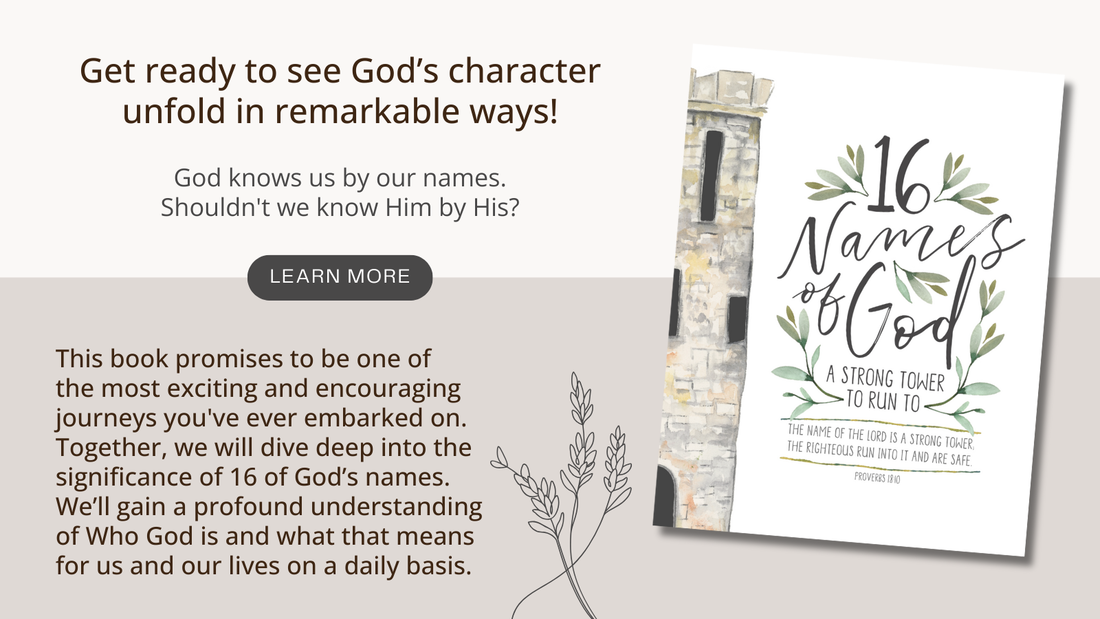
Did you know that God reveals Himself to us through His names? Each name is like a window into His character and nature. Let's dive deep into these 16 names of God in this beautiful new book "16 Names of God: a Strong Tower to Run to." From Creator God—Elohim, found in Genesis, to The Lord Is There—Jehovah Shammah in Ezekiel, we see His awesome character and nature. Let's explore the meaning and significance behind each of these names as we find safety in the Strong Tower.
Reflect These 16 Names of God and Discover His Character.
As Christians, we are called to reflect God's name. His name is great and worthy of our praise (Psalm 8:1; 48:10). His names are like a mighty fortress providing protection for His children. In this new book, "16 Names of God: a Strong Tower to Run to," you will see how you can reflect God's character through your daily life. You'll also discover how His names depict His unmerited love for you.
Embrace These 16 Names of God and Honor His Character.
Are you thirsty to know God better, deeper, and with more passion? Soak up these 16 names of God, and unlock a richer and more in-depth understanding of His character and nature. There is only One true God, but many names describe His attributes. With this inspirational book, you will explore the depth of His love, provision, and healing. You'll also discover that knowing Him by His names is the pathway to trusting Him more.
God knows us by our name (Isaiah 43:1). Shouldn’t we also know Him by His?
Reflect These 16 Names of God and Discover His Character.
As Christians, we are called to reflect God's name. His name is great and worthy of our praise (Psalm 8:1; 48:10). His names are like a mighty fortress providing protection for His children. In this new book, "16 Names of God: a Strong Tower to Run to," you will see how you can reflect God's character through your daily life. You'll also discover how His names depict His unmerited love for you.
Embrace These 16 Names of God and Honor His Character.
Are you thirsty to know God better, deeper, and with more passion? Soak up these 16 names of God, and unlock a richer and more in-depth understanding of His character and nature. There is only One true God, but many names describe His attributes. With this inspirational book, you will explore the depth of His love, provision, and healing. You'll also discover that knowing Him by His names is the pathway to trusting Him more.
God knows us by our name (Isaiah 43:1). Shouldn’t we also know Him by His?
Elohim: Creator God
The name Elohim is intriguing because it is the plural form of El. This is a term borrowed from the Canaanite language. This ancient name is one of the earliest designations for God. It depicts His unique and multifaceted nature.
Elohim: In the Bible
Elohim appears over 2,000 times in the Old Testament, making it a prominent and recurrent name for God. Its first appearance in Genesis 1:1 signifies the dawn of all creation. In the beginning, Elohim created the heavens and the earth. Elohim brings forth light from darkness and land from water. Everything we know and experience is a result of Elohim's creative power and wisdom. Colossians 1:16 reminds us that everything, including us, was created "through Him and for Him." This emphasizes our unique place in God's grand design and the central role of Elohim as our Creator.
Elohim: A Knowable God
Elohim wants us to know Him personally, and the first thing He reveals about Himself is He is our Creator. The doctrine of Creation is the foundation of Christian theology. It's the beginning point of our faith. Without Creation, there would be no Garden of Eden, no Tree of Life, and no need for redemption.
Elohim: The Three-in-One
Genesis 1:26 offers a glimpse into the complexity of Elohim. There we read, "Let Us make man in Our image, after Our likeness." This verse hints at the presence of the Trinity—the Father, the Son (Jesus Christ), and the Holy Spirit. From the very beginning, we see the unity of the Trinity. Yet, it also underscores the truth of One God. We see in Genesis both the divine unity and the complexity of the Trinity. Explaining the concept of the Trinity to finite minds can be challenging. I think of it like an egg: one egg has three parts—the shell, the white, and the yolk. Similarly, Elohim is three-in-One, fully God in the Father, the Son, and the Holy Spirit.
Elohim is eternal, existing before Creation and independent of it. God is the One, true Elohim, and He rules over all creation. As finite creatures, it may be difficult for us to grasp the depth of His sovereignty. However, we can fully trust in His eternal nature and His sovereignty over our lives.
Elohim: Our Sustainer
In times of doubt and uncertainty, we must remember that Elohim is always in control. He sustains us and knows our needs, as highlighted in Isaiah 40:31: "But they who wait for the Lord shall renew their strength; they shall mount up with wings like eagles, run and not be weary, walk and not faint."
Elohim: The Source of Life
Isaiah 42:5 reveals that Elohim is the source of all life, giving breath and spirit to all who walk the earth. "Thus says God, the Lord, Who created the heavens and stretched them out, Who spread out the earth and what comes from it, Who gives breath to the people on it and spirit to those who walk in it." This emphasizes the sanctity of all life and our unique place in God's creation.
Elohim: Our Redeemer
Most importantly, Elohim is not only our Creator but also our Redeemer. He entered His own Creation as a baby but in the form of a King—Jesus Christ. He did this to redeem us from sin and restore our relationship with Him.
Elohim: The Beginning and the End
In closing, remember that everything in this world has a beginning and an end, except Elohim. He alone is eternal. Trust in the eternal Elohim to guide you through daily challenges. Elohim is your Creator, Sustainer, and Redeemer. He is worthy of your trust. As you go about your day, reflect on the name Elohim and what it means in your life. Know that you are a unique creation. You are designed to reflect God's glory and He desires a personal relationship with you. Elohim is the Alpha and Omega, the beginning and the end. He holds your past, present, and future in His loving hands.
Yahweh: LORD Jehovah
The first mention of Yahweh in the Bible is found in Genesis 2:4: "These are the generations of the heavens and the earth when they were created, in the day that the LORD God [Yahweh] made the earth and the heavens." While Yahweh is introduced as the Creator of heaven and earth in this passage, it is in Exodus 3 that God more fully reveals Himself through this name.
Exodus 3:14 – The Revelation of "I Am Who I Am"
In Exodus 3:14, during a profound encounter with Moses at the burning bush, God identifies Himself as Yahweh for the first time in Scripture. When asked by Moses who he should tell the Israelites sent him, God responds with ultimate authority: "I Am Who I Am." This declaration highlights God's eternal nature and His unchanging character. He simply is – Yahweh.
The name Yahweh underscores God's righteousness and holiness. As we read in Psalm 11:7, "For the LORD [Yahweh] is righteous; He loves righteous deeds; the upright shall behold His face." Yahweh is the embodiment of righteousness and holiness, and He must condemn sin because it is contrary to His very nature. Yet, in His great love for His people, Yahweh also provides a path to redemption.
Yahweh: Love and Redemption
Jeremiah 31:3 beautifully portrays Yahweh's love: "The LORD [Yahweh] appeared to him from far away. I have loved you with an everlasting love; therefore, I have continued My faithfulness to you." Yahweh's love is eternal and unchanging, offering forgiveness and redemption to all who turn to Him.
Yahweh: The Covenant
Yahweh is the covenant name of God with His people, a name that signifies His promises and faithfulness. He is the Redeemer Who brought the Israelites out of captivity in Egypt, demonstrating His power to redeem and save. His covenant with His people is a reflection of His enduring love.
Yahweh: In the New Testament
In the New Testament, the name Yahweh is closely related to the concept of redemption. Through Jesus Christ, Yahweh's ultimate plan for redemption is realized. Hebrews 10:18 declares, "Where there is forgiveness of these, there is no longer any offering for sin." Jesus' sacrifice on the cross fulfills what the Old Testament sacrifices could only foreshadow.
El Elyon: Most High God
The first mention of El Elyon occurs in Genesis 14:18-23, during an encounter between Abram (later known as Abraham) and Melchizedek, the king of Salem (Jerusalem). Melchizedek, described as the "priest of God Most High," blesses Abram in the name of El Elyon. This passage sets the stage for understanding God as the Most High, emphasizing His authority and blessing.
El Elyon in the Old Testament
Throughout the Old Testament, El Elyon is mentioned over 200 times, often in the book of Psalms. This name highlights God's supreme authority and majesty. In Psalm 9:2, David sings praises to "the Most High [El Elyon]" and acknowledges the joy of dwelling in His shelter. Psalm 21:7 celebrates El Elyon's strength and the unwavering trust placed in Him.
In Psalm 57:2, David, while hiding in a cave from King Saul, cries out to "God Most High [El Elyon]," emphasizing the need to trust God during difficult times. Psalm 76:2 recognizes Jerusalem as the dwelling place of El Elyon, emphasizing His presence in Zion.
In Psalm 78:35, Israel remembers God as "the Most High God [El Elyon] their Redeemer." This name reflects God's role as the Redeemer of His people, despite their shortcomings and unfaithfulness.
Interestingly, El Elyon is not confined to the Old Testament but is also mentioned in the New Testament. In Mark 5:7 and Luke 8:28, even the demons and possessed individuals recognize Jesus as the "Son of the Most High God [El Elyon]," acknowledging His supreme authority.
Acts 16:17 recounts a woman who proclaimed Paul and his companions as "servants of the Most High God [El Elyon]." This recognition underscores the universal authority of El Elyon.
El Elyon: The Most High God
El Elyon signifies God's preeminence and majesty. The name encapsulates His sovereignty over all creation and events, reflecting His unmatched power, mercy, and sovereignty. Recognizing God as El Elyon requires acknowledging our insufficiency and His sufficiency.
El, borrowed from the Canaanite language, carries connotations of majesty and power. Israel's God, El Elyon, stands apart from all other gods, as His majesty and power are evident throughout the Old Testament. His works and interactions with humanity reveal Him as the Most High God, with unparalleled and unmatched authority.
Adonai: Lord Master
The first mention of "Adonai" occurs in Genesis 15:2, where Abram (later known as Abraham) acknowledges God as his Lord and Master. However, immediately following this confession, Abram expresses his human doubt, questioning how Adonai could fulfill His promise to make Abram a great nation. This pattern of doubt and trust often mirrors our own struggles in faith.
Adonai: The Answer to Doubt
Do you ever doubt God's promises? Like Abram, we may sometimes act as if we doubt Him, especially when faced with circumstances beyond our understanding. Doubt is a part of the human experience, but recognizing God as Adonai helps us overcome doubt. We must, at times, cry out in prayer, "Adonai, help my unbelief!" Acknowledging our doubts is the first step towards deepening our faith.
God's Response to Abram's Doubt
God responds to Abram's doubt by taking him outside and asking him to count the stars. He challenges Abram to grasp the vastness of His creative power, highlighting that nothing is too difficult for Him. The name Adonai reflects God's authority and sovereignty over all creation, making Him the master of every situation.
Understanding Adonai's Lordship
The name Adonai denotes ownership and lordship. God is the Lord and Master over Heaven, earth, and all that resides within. Recognizing Adonai's lordship requires complete submission to His authority. We are not owners of ourselves or our possessions but stewards entrusted with what God has given us.
The word "adon" or "Adonai" can be applied to both humans and God. When referring to God, it is always capitalized, signifying His unique status. Adonai signifies a relationship, similar to that of a husband and wife or Christ and believers. Moses, for example, had a special relationship with Adonai, characterized by dialogue and trust.
Moses' Encounter with Adonai
In Exodus 4, Moses doubts his ability to speak eloquently and effectively convey God's message. He acknowledges his own weakness and incompetence. God's response is a promise: "Now therefore go, and I will be with your mouth and teach you what you shall speak." This promise extends to us, assuring that God equips us for the tasks He assigns.
Adonai: Transforming Weakness into Strength
Moses' reluctance and inadequacy parallel our own feelings of inadequacy at times. Yet, just as God assured Moses, He promises to be with us and teach us what to speak. Adonai loves to use those who recognize their weakness and incompetence, as it allows His power to shine through our lives.

No comments:
Post a Comment