A Believer's Response to Death and Dying
As a human being, a believer's response to his/her own terminal illness or the death of a loved one is the same as any other person's response. However, because of faith in God and trust in Christ, that response goes beyond the mere 5 steps that Kübler-Ross described.
Job's Response to Death and Dying
If we had to examine one person in the Bible who experienced both the threat of terminal illness and the death of loved ones simultaneously -- it would be Job. We are familiar with Job's story:
~He was wealthy and well respected in his community for his goodness, wisdom and piety.
~He had a large family of sons and daughters.
~God permitted Satan to test him in order to see if he would be faithful in trial as he had been in abundance.
~Satan caused Job to lose:
○His wealth
○His children (all were killed at once)
○His reputation
○His health
○The love and support of his wife and his family
Now, after all these things had happened to Job we read that he did not respond like ordinary people do. He did not act like the people Kübler-Ross described in her book. He responded differently than most folks would in a similar situation. Most people after experiencing what Job experienced would go into denial and shock not wanting to accept the reality of the terrible things that have just taken place, or would try to put the events out of their minds as soon as the funeral was over; "life goes on" type thing.
I'm always amazed at how quickly people begin to talk sports or light up a cigarette or gossip after a funeral service. No more than a minute passes after the final prayer at a graveside service and people are in a hurry to get back to "normal." It seems that we want to get the grieving over with as soon as possible. Many times those grieving want to blame God or question God concerning their tragedy. Why now, why this, why me, why them?
Believers, however, are not most people. Their way of dealing with death and dying is different because of the cross that is behind them, the Spirit that is within them and the future that is before them. An example of this is Job's response to the loss of his wealth, children and position, all in the same day. In the book of Job, chapter 1, we see the 5 steps that this believer went through in his experience of death and dying.
Step #1 - Mourning
Then Job arose and tore his robe and shaved his head - Job 1:20a
Job immediately begins to lament the loss of his children as well as the other good things he had enjoyed for so long. Note that he accepts as true the events that have befallen him. That he tears his robe, shaves his head and falls to the ground are natural human and cultural responses to these tragedies. What Job did was the normal and healthy way to deal with tragedy: lamenting and mourning.
In some cultures family members wear black for a year after the death of a close relative. This is a good way to separate oneself for a time of spiritual, emotional and social renewal. In effect it says, ”Don't mind me, I'm in mourning.”
The worse detriment to recovery from a tragedy is to force a time limit for ourselves to "get over" our loss. If you don't weep and mourn when it happens, you'll weep and mourn later.
Many depressions and anxieties are the result of improper time and effort given over to mourning the loss of a loved one, marriage, health or family situation. Mourning was all Job could do at this point, and he did it as a way of saving his sanity.
Step #2 - Worship
and he fell to the ground and worshiped. He said,
“Naked I came from my mother's womb,
And naked I shall return there.
The Lord gave and the Lord has taken away.
Blessed be the name of the Lord."
- Job 1:20b-21
As a believer, once Job could struggle to right himself from the shock, his first thought is to go to God in worship and prayer. It is unfortunate that so many see prayer as a last hope, a grasping at straws when things go wrong. Instead of worship, tragedy leads many to:
•Drink and drugs.
•Excessive eating or abuse of themselves in various ways.
•All kinds of escapist methods to deal with the great pain associated with death and dying.
Of course, the verse here in Job 1:20b does not contain all that he said, doesn't repeat for us every prayer uttered; rather we are given the conclusion of his worship and talking to God. We read about the insight that he first gains as a result of that prayer.
Initial prayer and worship does not always produce such deep insights into the nature of our situation and such clarity about its meaning. However, when the thought of existing one more minute on this earth is too painful to bear - the only place we can and should go is to God in humble worship and prayer. If trouble, pain and death don't drive us to our knees, what will?
It's like being strapped into a roller coaster where we feel powerless to affect anything happening to us or to our feelings. For this reason we need to come closer to the one who does have the power to control all things - including death. This may not change the circumstances, but it does bring us peace and, at times, a certain understanding.
Job did this, and although his situation did not change, through his tears he was rewarded with a crystal clear understanding of the true nature of his life and its ultimate meaning and substance.
Step #3 - Silence
Through all this Job did not sin nor did he blame God.
- Job 1:22
Although later on Job did break his silence, his first and correct impulse was to hold his peace, contemplate his situation and wait upon the Lord. The Bible explains this by saying that Job didn't complain to or blame God. He didn't charge God foolishly. He didn't question God as to the timing, the fairness or the degree of his suffering.
He didn't dwell on the "why" of it all with the suggestion that there may have been a better way, an easier way. He did not substitute a plan of his own for what had happened that might have lessened the blow. He said nothing concerning the events and how they took place. The Bible says that in doing this, he sinned not.
Kübler-Ross described the stages of grieving as denial, anger, bargaining, depression and acceptance. We've come to see these as the normal human progression and response to death and dying. We should also note that for a weak and sinful person these may be normal responses, however,
•To lash out at God in anger.
•To question His actions.
•To try and change His decision or feel sorry for ourselves.
All of these are fleshly, worldly responses born out of our sinful and weak natures. The only spiritual reaction is the final stage, the one of acceptance.
Compare these however, with Job's initial response to death and dying:
1. He mourned and lamented his loss. We see that within his very first reaction, is included most of Kübler-Ross’ normal human responses of denial, anger and depression.
2. He drew near to God in prayer and worship. He didn't bargain with God, he bowed down before God in humility and trust.
3. He remained silent. During this time he contemplated his situation and searched for meaning.
Eventually he developed a life threatening illness, lost the support of his wife and was condemned by his friends as a sinner who had brought all this misery upon himself. These additional burdens led Job to the last two steps in the believer's journey through the experience of grief and dying.
Step #4 - Enlightenment
For nearly 40 chapters in an on-going dialogue with his friends we watch Job as he comes to grips with not simply the reality and meaning of his suffering but the truth that stands behind not only his suffering but the suffering of all men. Job learns that his experience is worth it if it reveals more perfectly the God he believes in. In other words, if your suffering serves to give you a glimpse of God Almighty, then it is a small matter and any complaining was foolish and sinful in comparison to what has been discovered, what has been given to you.
Enlightenment, especially that enlightenment that enables us to see God more clearly is of more value than what we have lost - whatever that is, however we suffer.
Job learned that life as well as death is in God's hands and the painful experience of it is justified if it leads us face to face with God, even if it's for a moment. That one moment is worth all the suffering. The non-believers' best hope is to arrive at that point where they accept reality and learn to cope with it. That reality being that people suffer and die and there is nothing they can do about it except carry on as best they can - this is as good as it gets!
Suffering and death for believers, however, bring them face to face with the ultimate reality that there is a living God who gives life and controls death by His power. The ultimate end therefore is that death and dying can serve to strengthen faith and hope, and consequently loosen the grip of fear and sorrow that these experiences have on our hearts. Only an enlightened person like Paul the Apostle could write these words when facing death,
For to me to live is Christ, and to die is gain
- Philippians 1:21
Paul had seen beyond suffering and death and had a glimpse of God's reality, and this vision was worth all the suffering he had to endure.
Step #5 - Restoration
In the last chapter we learn that God heals Job and restores his family, wealth and position. This didn't change the fact that Job had suffered and lost children and prestige; his suffering was real. You see, God doesn't give us our old lives back; He gives us a new life. Here on earth it is a life we can live and live with. Sometimes it is very different. Sometimes it is harder. But for believers, it is always a life where God is more prominent than before. In the end, He is the reward for persevering.
You may not have a parent, child, spouse, loved one or health any more, but you now have more of Him to make up for it. And in the next world, the great promise for those who have experienced the enlightenment of suffering, is that you will have all of Him all the time because after your death you will leave behind everything that comes between you and Him now.
~~ This lesson compares Job's response to death and dying with the famous five stage response originally stated by Elisabeth Kübler-Ross.
In 1969 Elisabeth Kübler-Ross wrote a groundbreaking book on the subject of death and dying. She noted a pattern of behavior that dying patients exhibited as they themselves approached death from terminal illness, or suffered the death of a loved one. Her 5 "stages" have become famous and often repeated in teaching people on how to cope with serious illness and death. In case you've forgotten, her 5 stages were:
1. Shock / Denial
2. Anger
3. Bargaining
4. Depression
5. Acceptance
She taught that people didn't necessarily go from one stage directly to the other, but rather went from one to another in a cyclical fashion. For example, shock would be followed by anger and then depression and then a measure of acceptance after which one might revert back to bargaining with God for more time (in case of terminal illness). People went from one emotion to another for various amounts of time until, hopefully, they would remain in the acceptance mode for longer and longer periods of time. This became the primary model that explained a person’s reaction to death and dying.
Kübler-Ross was not a Christian and in later years saw herself as a sort of "medium" able to contact the spirit world. Much of her subsequent writings were not taken very seriously for this reason.
I mention this about her because it confirms in my mind the fact that she did not use the Bible as a model for her death and dying theories. Had she used the Bible in developing her ideas she would have discovered a much more complete and satisfying response to death and dying by examining a believer’s response to these traumatic events in life.
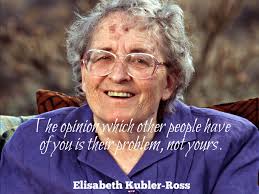
Elisabeth Kübler-Ross (July 8, 1926 – August 24, 2004) was a Swiss-American psychiatrist, a pioneer in near-death studies and the author.

On Death and Dying
Dr. Elisabeth Kübler-Ross And The Five Stages of Grief
Excerpt taken from Dr. Allan Kellehear’s Foreword: “On Death and Dying” – 40th Anniversary Edition
“The book you are about to read, or reread, is one of the most important humanitarian works on the care of the dying written in the Western world. First published in 1969, its descriptions of exchanges between Dr. Kübler-Ross and her patients, about reactions to the impending death, are as fresh and insightful today as they were some 40 years ago. The fundamental value of this work lies in the dialogue between two people discussing the meaning of dying. Most of this book consists of chapters that, page after page, describe simple conversations between doctor and patient about the shock of bad personal news, about the aftermath of bad news, about the mind-games that are deployed to help us come to terms with the news that we will (might?) die. But there are also stories of hope and acceptance. The bioethicist Kuczewski (2004) is right when he observes that the most important and enduring point to these stories is till embodied in the original sub-title: What the dying have to teach doctors, nurses, clergy, and their own families.
I must stress early in this introduction that it is only by overlooking this principle aim of Dr. Kübler-Ross’s book – that of the privileging the voice of the dying – that a whole industry of mythmaking has resulted. It seems the case, especially among academic researchers, that much of the subsequent criticism directed at this work over the last 40 years has not been prevented by clear, early qualifications and provisos articulated by Kübler-Ross herself in her original preface, or by Colin Murray Parkes in his 1969 forward. However, the steady criticism directed at this book (and the five stages) has never succeeded in putting off millions of ordinary men and women looking for some basic understanding and insight into the social and emotional experience of their dying or those of their loved ones. Even today, if one reviews the hundreds of “customer reviews” on the websites such as Amazon.com, one cannot fail to be impressed at how useful this book remains for today’s readers for genuine insights and empathic descriptions of the social and psychological world of the dying.
Kübler-Ross stressed the fact that her book was “not meant to be a textbook on how to manage dying patients”. It was also not “intended as a complete study of the psychology of the dying”.
First, On Death and Dying was never a study of grief and bereavement. It was a discussion of some key emotional reactions to the experience of the dying. Yes, grief was a part of that experience, but it was not the totality of the experience.
Secondly, the so-called “stage theory” that you will read in this book is openly described and discussed as a heuristic device. In other words, these stages are merely a set of categories artificially isolated and separately described so that the author can discuss each of these experiences more clearly and simply. The careful reader will note Kübler-Ross’s own repeated warnings that many of these “stages” overlap, occur together, or even that some reactions are missed altogether. To emphasize this conditional way of taking about stages, the word “stages” was even put in inverted commas to emphasize their tentative nature in the only diagrammatic representation of these ideas in the book.
Thirdly, many of the “stages” of the dying described in the book have been subsequently simplified and publicly caricatured beyond recognition.
Fourthly, and rather inexplicably, On Death and Dying has regularly been mistakenly and mischievously construed as a research study. It is a popular book of description, observation, and reflection based upon a series of dialogues with dying people. The participants were not invited to be part of a research project but instead asked to talk about their experience to assist health professionals to understand their needs better.
However, the central message of On Death and Dying is the importance of listening to what the dying have to tell us about their needs. Dr. Kübler-Ross has noted some of the repeated patterns of the emotional response of hope but also denial, of acceptance but often with conditions. She has offered us words or labels to describe these patterns of response to help us summarize them….” (Full foreword available in the 40th Anniversary Edition of On Death and Dying.)
Finally, On Death and Dying represents a lasting bridge between the in-house scientific/academic conversations about death and dying and the gaping need for information and discussion by the general public….On Death and Dying encourages ordinary men, women and children to converse with their dying, but also to forcefully widen that engagement to include a dialogue with the scientific, academic and clinical elites responsible for modern day caring of the dying. This useful background of public engagement, and this kind of social interface, becomes a basis from which we may ask searching questions of new poles, practices or technologies when these are introduced, remembering that these intervene at the most sensitive and vulnerable time of our lives. As it has in the past, On Death and Dying will continue to stimulate communities to engage our professionals, and other experts, on the ethical and social dilemmas we must all face in the newly emerging and often-complex forms of end of life care being offered to us in the twenty-first century.
Professor Allan Kellehear
Center for Death and Society
University of Bath, UK.
5 Stages Chart 2013

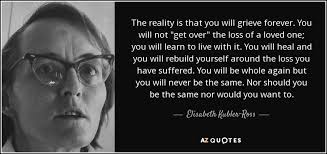
Elisabeth’s Quotes:
"Dying is something we human beings do continuously, not just at the end of our physical lives on this earth."
As a human being, a believer's response to his/her own terminal illness or the death of a loved one is the same as any other person's response. However, because of faith in God and trust in Christ, that response goes beyond the mere 5 steps that Kübler-Ross described.
Job's Response to Death and Dying
If we had to examine one person in the Bible who experienced both the threat of terminal illness and the death of loved ones simultaneously -- it would be Job. We are familiar with Job's story:
~He was wealthy and well respected in his community for his goodness, wisdom and piety.
~He had a large family of sons and daughters.
~God permitted Satan to test him in order to see if he would be faithful in trial as he had been in abundance.
~Satan caused Job to lose:
○His wealth
○His children (all were killed at once)
○His reputation
○His health
○The love and support of his wife and his family
Now, after all these things had happened to Job we read that he did not respond like ordinary people do. He did not act like the people Kübler-Ross described in her book. He responded differently than most folks would in a similar situation. Most people after experiencing what Job experienced would go into denial and shock not wanting to accept the reality of the terrible things that have just taken place, or would try to put the events out of their minds as soon as the funeral was over; "life goes on" type thing.
I'm always amazed at how quickly people begin to talk sports or light up a cigarette or gossip after a funeral service. No more than a minute passes after the final prayer at a graveside service and people are in a hurry to get back to "normal." It seems that we want to get the grieving over with as soon as possible. Many times those grieving want to blame God or question God concerning their tragedy. Why now, why this, why me, why them?
Believers, however, are not most people. Their way of dealing with death and dying is different because of the cross that is behind them, the Spirit that is within them and the future that is before them. An example of this is Job's response to the loss of his wealth, children and position, all in the same day. In the book of Job, chapter 1, we see the 5 steps that this believer went through in his experience of death and dying.
Step #1 - Mourning
Then Job arose and tore his robe and shaved his head - Job 1:20a
Job immediately begins to lament the loss of his children as well as the other good things he had enjoyed for so long. Note that he accepts as true the events that have befallen him. That he tears his robe, shaves his head and falls to the ground are natural human and cultural responses to these tragedies. What Job did was the normal and healthy way to deal with tragedy: lamenting and mourning.
In some cultures family members wear black for a year after the death of a close relative. This is a good way to separate oneself for a time of spiritual, emotional and social renewal. In effect it says, ”Don't mind me, I'm in mourning.”
The worse detriment to recovery from a tragedy is to force a time limit for ourselves to "get over" our loss. If you don't weep and mourn when it happens, you'll weep and mourn later.
Many depressions and anxieties are the result of improper time and effort given over to mourning the loss of a loved one, marriage, health or family situation. Mourning was all Job could do at this point, and he did it as a way of saving his sanity.
Step #2 - Worship
and he fell to the ground and worshiped. He said,
“Naked I came from my mother's womb,
And naked I shall return there.
The Lord gave and the Lord has taken away.
Blessed be the name of the Lord."
- Job 1:20b-21
As a believer, once Job could struggle to right himself from the shock, his first thought is to go to God in worship and prayer. It is unfortunate that so many see prayer as a last hope, a grasping at straws when things go wrong. Instead of worship, tragedy leads many to:
•Drink and drugs.
•Excessive eating or abuse of themselves in various ways.
•All kinds of escapist methods to deal with the great pain associated with death and dying.
Of course, the verse here in Job 1:20b does not contain all that he said, doesn't repeat for us every prayer uttered; rather we are given the conclusion of his worship and talking to God. We read about the insight that he first gains as a result of that prayer.
Initial prayer and worship does not always produce such deep insights into the nature of our situation and such clarity about its meaning. However, when the thought of existing one more minute on this earth is too painful to bear - the only place we can and should go is to God in humble worship and prayer. If trouble, pain and death don't drive us to our knees, what will?
It's like being strapped into a roller coaster where we feel powerless to affect anything happening to us or to our feelings. For this reason we need to come closer to the one who does have the power to control all things - including death. This may not change the circumstances, but it does bring us peace and, at times, a certain understanding.
Job did this, and although his situation did not change, through his tears he was rewarded with a crystal clear understanding of the true nature of his life and its ultimate meaning and substance.
Step #3 - Silence
Through all this Job did not sin nor did he blame God.
- Job 1:22
Although later on Job did break his silence, his first and correct impulse was to hold his peace, contemplate his situation and wait upon the Lord. The Bible explains this by saying that Job didn't complain to or blame God. He didn't charge God foolishly. He didn't question God as to the timing, the fairness or the degree of his suffering.
He didn't dwell on the "why" of it all with the suggestion that there may have been a better way, an easier way. He did not substitute a plan of his own for what had happened that might have lessened the blow. He said nothing concerning the events and how they took place. The Bible says that in doing this, he sinned not.
Kübler-Ross described the stages of grieving as denial, anger, bargaining, depression and acceptance. We've come to see these as the normal human progression and response to death and dying. We should also note that for a weak and sinful person these may be normal responses, however,
•To lash out at God in anger.
•To question His actions.
•To try and change His decision or feel sorry for ourselves.
All of these are fleshly, worldly responses born out of our sinful and weak natures. The only spiritual reaction is the final stage, the one of acceptance.
Compare these however, with Job's initial response to death and dying:
1. He mourned and lamented his loss. We see that within his very first reaction, is included most of Kübler-Ross’ normal human responses of denial, anger and depression.
2. He drew near to God in prayer and worship. He didn't bargain with God, he bowed down before God in humility and trust.
3. He remained silent. During this time he contemplated his situation and searched for meaning.
Eventually he developed a life threatening illness, lost the support of his wife and was condemned by his friends as a sinner who had brought all this misery upon himself. These additional burdens led Job to the last two steps in the believer's journey through the experience of grief and dying.
Step #4 - Enlightenment
For nearly 40 chapters in an on-going dialogue with his friends we watch Job as he comes to grips with not simply the reality and meaning of his suffering but the truth that stands behind not only his suffering but the suffering of all men. Job learns that his experience is worth it if it reveals more perfectly the God he believes in. In other words, if your suffering serves to give you a glimpse of God Almighty, then it is a small matter and any complaining was foolish and sinful in comparison to what has been discovered, what has been given to you.
Enlightenment, especially that enlightenment that enables us to see God more clearly is of more value than what we have lost - whatever that is, however we suffer.
Job learned that life as well as death is in God's hands and the painful experience of it is justified if it leads us face to face with God, even if it's for a moment. That one moment is worth all the suffering. The non-believers' best hope is to arrive at that point where they accept reality and learn to cope with it. That reality being that people suffer and die and there is nothing they can do about it except carry on as best they can - this is as good as it gets!
Suffering and death for believers, however, bring them face to face with the ultimate reality that there is a living God who gives life and controls death by His power. The ultimate end therefore is that death and dying can serve to strengthen faith and hope, and consequently loosen the grip of fear and sorrow that these experiences have on our hearts. Only an enlightened person like Paul the Apostle could write these words when facing death,
For to me to live is Christ, and to die is gain
- Philippians 1:21
Paul had seen beyond suffering and death and had a glimpse of God's reality, and this vision was worth all the suffering he had to endure.
Step #5 - Restoration
In the last chapter we learn that God heals Job and restores his family, wealth and position. This didn't change the fact that Job had suffered and lost children and prestige; his suffering was real. You see, God doesn't give us our old lives back; He gives us a new life. Here on earth it is a life we can live and live with. Sometimes it is very different. Sometimes it is harder. But for believers, it is always a life where God is more prominent than before. In the end, He is the reward for persevering.
You may not have a parent, child, spouse, loved one or health any more, but you now have more of Him to make up for it. And in the next world, the great promise for those who have experienced the enlightenment of suffering, is that you will have all of Him all the time because after your death you will leave behind everything that comes between you and Him now.
~~ This lesson compares Job's response to death and dying with the famous five stage response originally stated by Elisabeth Kübler-Ross.
In 1969 Elisabeth Kübler-Ross wrote a groundbreaking book on the subject of death and dying. She noted a pattern of behavior that dying patients exhibited as they themselves approached death from terminal illness, or suffered the death of a loved one. Her 5 "stages" have become famous and often repeated in teaching people on how to cope with serious illness and death. In case you've forgotten, her 5 stages were:
1. Shock / Denial
2. Anger
3. Bargaining
4. Depression
5. Acceptance
She taught that people didn't necessarily go from one stage directly to the other, but rather went from one to another in a cyclical fashion. For example, shock would be followed by anger and then depression and then a measure of acceptance after which one might revert back to bargaining with God for more time (in case of terminal illness). People went from one emotion to another for various amounts of time until, hopefully, they would remain in the acceptance mode for longer and longer periods of time. This became the primary model that explained a person’s reaction to death and dying.
Kübler-Ross was not a Christian and in later years saw herself as a sort of "medium" able to contact the spirit world. Much of her subsequent writings were not taken very seriously for this reason.
I mention this about her because it confirms in my mind the fact that she did not use the Bible as a model for her death and dying theories. Had she used the Bible in developing her ideas she would have discovered a much more complete and satisfying response to death and dying by examining a believer’s response to these traumatic events in life.
Elisabeth Kübler-Ross (July 8, 1926 – August 24, 2004) was a Swiss-American psychiatrist, a pioneer in near-death studies and the author.
On Death and Dying
Dr. Elisabeth Kübler-Ross And The Five Stages of Grief
Excerpt taken from Dr. Allan Kellehear’s Foreword: “On Death and Dying” – 40th Anniversary Edition
“The book you are about to read, or reread, is one of the most important humanitarian works on the care of the dying written in the Western world. First published in 1969, its descriptions of exchanges between Dr. Kübler-Ross and her patients, about reactions to the impending death, are as fresh and insightful today as they were some 40 years ago. The fundamental value of this work lies in the dialogue between two people discussing the meaning of dying. Most of this book consists of chapters that, page after page, describe simple conversations between doctor and patient about the shock of bad personal news, about the aftermath of bad news, about the mind-games that are deployed to help us come to terms with the news that we will (might?) die. But there are also stories of hope and acceptance. The bioethicist Kuczewski (2004) is right when he observes that the most important and enduring point to these stories is till embodied in the original sub-title: What the dying have to teach doctors, nurses, clergy, and their own families.
I must stress early in this introduction that it is only by overlooking this principle aim of Dr. Kübler-Ross’s book – that of the privileging the voice of the dying – that a whole industry of mythmaking has resulted. It seems the case, especially among academic researchers, that much of the subsequent criticism directed at this work over the last 40 years has not been prevented by clear, early qualifications and provisos articulated by Kübler-Ross herself in her original preface, or by Colin Murray Parkes in his 1969 forward. However, the steady criticism directed at this book (and the five stages) has never succeeded in putting off millions of ordinary men and women looking for some basic understanding and insight into the social and emotional experience of their dying or those of their loved ones. Even today, if one reviews the hundreds of “customer reviews” on the websites such as Amazon.com, one cannot fail to be impressed at how useful this book remains for today’s readers for genuine insights and empathic descriptions of the social and psychological world of the dying.
Kübler-Ross stressed the fact that her book was “not meant to be a textbook on how to manage dying patients”. It was also not “intended as a complete study of the psychology of the dying”.
First, On Death and Dying was never a study of grief and bereavement. It was a discussion of some key emotional reactions to the experience of the dying. Yes, grief was a part of that experience, but it was not the totality of the experience.
Secondly, the so-called “stage theory” that you will read in this book is openly described and discussed as a heuristic device. In other words, these stages are merely a set of categories artificially isolated and separately described so that the author can discuss each of these experiences more clearly and simply. The careful reader will note Kübler-Ross’s own repeated warnings that many of these “stages” overlap, occur together, or even that some reactions are missed altogether. To emphasize this conditional way of taking about stages, the word “stages” was even put in inverted commas to emphasize their tentative nature in the only diagrammatic representation of these ideas in the book.
Thirdly, many of the “stages” of the dying described in the book have been subsequently simplified and publicly caricatured beyond recognition.
Fourthly, and rather inexplicably, On Death and Dying has regularly been mistakenly and mischievously construed as a research study. It is a popular book of description, observation, and reflection based upon a series of dialogues with dying people. The participants were not invited to be part of a research project but instead asked to talk about their experience to assist health professionals to understand their needs better.
However, the central message of On Death and Dying is the importance of listening to what the dying have to tell us about their needs. Dr. Kübler-Ross has noted some of the repeated patterns of the emotional response of hope but also denial, of acceptance but often with conditions. She has offered us words or labels to describe these patterns of response to help us summarize them….” (Full foreword available in the 40th Anniversary Edition of On Death and Dying.)
Finally, On Death and Dying represents a lasting bridge between the in-house scientific/academic conversations about death and dying and the gaping need for information and discussion by the general public….On Death and Dying encourages ordinary men, women and children to converse with their dying, but also to forcefully widen that engagement to include a dialogue with the scientific, academic and clinical elites responsible for modern day caring of the dying. This useful background of public engagement, and this kind of social interface, becomes a basis from which we may ask searching questions of new poles, practices or technologies when these are introduced, remembering that these intervene at the most sensitive and vulnerable time of our lives. As it has in the past, On Death and Dying will continue to stimulate communities to engage our professionals, and other experts, on the ethical and social dilemmas we must all face in the newly emerging and often-complex forms of end of life care being offered to us in the twenty-first century.
Professor Allan Kellehear
Center for Death and Society
University of Bath, UK.
5 Stages Chart 2013
Elisabeth’s Quotes:
"Dying is something we human beings do continuously, not just at the end of our physical lives on this earth."
Genesis 2:16-17 "And the Lord God commanded the man, “You are free to eat from any tree in the garden; but you must not eat from the tree of the knowledge of good and evil, for when you eat from it you will certainly die.”
