The question: “Who Are We?” Perhaps for the first time, we can answer the question more completely than at any time in our past. The answer is in our mysteries. There are now so many discoveries that no longer fit the conventional thinking that they can no longer be ignored. Now we must embrace the discoveries and change our story.— Gregg Braden
MEDIA SPOTLIGHT THE GOD CODE IS GOD’S NAME ETCHED UPON OUR DNA? By Albert James Dager
A BIBLICAL ANALYSIS OF RELIGIOUS & SECULAR M E D I A SPECIAL REPORT
MEDIA SPOTLIGHT
THE GOD CODE
IS GOD’S NAME ETCHED UPON OUR DNA?
By Albert James Dager
A BIBLICAL ANALYSIS OF RELIGIOUS & SECULAR
M E D I A SPECIAL REPORT
What would it mean to discover an ancient language—a literal message—hidden within the DNA of life it self? What we once
believed of our past is about to change.…From The God Code.
Just as an artist signs his works, it has been suggested that God has
signed His work of Creation by encoding within the DNA of all
living things His name according to the ancient Hebrew and Arabic alphabets. A startling discovery if true.
After a 12-year study, New York Times best selling author Gregg Braden claims to have discovered just such a signature—what he calls “the God Code.” How is this possible, and what does it mean to mankind—especially to disciples of Jesus Christ? According
to Braden, it could mean a new era of peace and brotherhood once mankind recognizes that he is more than the product of blind chance—more than a random selection of molecules that formed in some primordial soup eons ago. Braden contends that his discovery proves the existence of an intelligent being who designed and
MEDIA SPOTLIGHT THE GOD CODE IS GOD’S NAME ETCHED UPON OUR DNA? By Albert James Dager
A BIBLICAL ANALYSIS OF RELIGIOUS & SECULAR M E D I A SPECIAL REPORT
MEDIA SPOTLIGHT
THE GOD CODE
IS GOD’S NAME ETCHED UPON OUR DNA?
By Albert James Dager
A BIBLICAL ANALYSIS OF RELIGIOUS & SECULAR
M E D I A SPECIAL REPORT
What would it mean to discover an ancient language—a literal message—hidden within the DNA of life it self? What we once
believed of our past is about to change.…From The God Code.
Just as an artist signs his works, it has been suggested that God has
signed His work of Creation by encoding within the DNA of all
living things His name according to the ancient Hebrew and Arabic alphabets. A startling discovery if true.
After a 12-year study, New York Times best selling author Gregg Braden claims to have discovered just such a signature—what he calls “the God Code.” How is this possible, and what does it mean to mankind—especially to disciples of Jesus Christ? According
to Braden, it could mean a new era of peace and brotherhood once mankind recognizes that he is more than the product of blind chance—more than a random selection of molecules that formed in some primordial soup eons ago. Braden contends that his discovery proves the existence of an intelligent being who designed and
created the universe, then “signed” His creation.
Braden is more than a best selling author. According to Deepak Chopra, author of How to Know God, “Gregg Braden is a rare blend of scientist, visionary, and scholar, with the ability to speak to our minds while touching the wisdom of our hearts.”
GREGG BRADEN
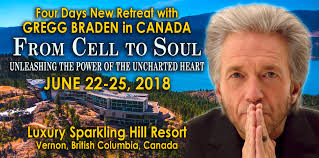
The author and self-proclaimed discoverer of the God Code is a
geologist who also worked as a senior computer systems designer in the aerospace and defense industry until 1990. When not traveling, Braden (50) lives alternately in New Mexico and Florida with his family.
In 1987 he began to look beyond the physical sciences into the realm of spirituality—the relationships between what happens in the unseen worlds of our emotions and our feelings and the physical world around us. Says Braden:
When I was in the industry, I had the opportunity to see direct
evidence of tremendous shifts on our world—changes in the Earth’s magnetic fields, for example. And my first thought was, “Well, if this is happening to the Earth, what does that mean to us? What does it mean to our bodies?” And I would ask my colleagues, geophysicists and highly esteemed seismologists, and I’d say,
“Well, what does this mean to us?” And they would say pretty much, “I’m a geologist, don’t ask me, ask a life scientist.” And I would ask my life science friends and they would say almost apologetically, “You know, my training is with the biology of the human body. We were never really told about how our bodies interface with the world around us.”
And, of course, we know that’s changing now and that there is a direct measurable connection between what happens inside our bodies and the world around us. And it’s a two way connection.
Braden’s spiritual quest for human unity has taken him around the world and has put him in contact with numerous spiritual leaders.
Since 1986, my search has led me into temples, villages, and monasteries hidden in some of the most pristine, isolated, and remote locations remaining on Earth today. In these places, I’ve met dedicated individuals who consider it their duty in life, as well as an honor, to preserve the memories of our species and the history of our world.
Braden has consulted many religious texts as well as the Bible, the Dead Sea Scrolls, and ancient Hebrew and Arabic writings. In them all, he says, he finds an underlying unity in the attempt to answer the oldest question of our existence: “Who are we, and why are we here?” In the process he claims to have discovered that God has given us proof of His existence while at the same time providing the evidence that will bring about a unity of mankind, provided mankind heeds the message God has implanted in our genes.
While believing that the “Big Bang” theory of creation is true, Braden insists that it was not an accident, but the calculated, creative act of an intelligent being. He also believes that, throughout the centuries since the formation of the earth, there has been a hidden truth which, recently revealed through his study, proves his theory.
A remarkable discovery linking the biblical alphabets of Hebrew and Arabic to modern chemistry reveals that a lost code—a translatable alphabet—and a clue to the mystery of our origins, has lived within us all along. Applying this discovery to the language of life, the familiar elements of hydrogen, nitrogen, oxygen, and carbon that form our DNA may now be replaced with key letters of
the ancient languages. In doing so, the code of all life is transformed into the words of a timeless message. Translated, the message reveals that the precise letters of God’s ancient name are encoded as the genetic information in every cell, of every life. (Emphasis Braden’s)
That message is “God/Eternal within the body.” The meaning, says Braden, is that “human kind is one family, united through a common heritage, and the result of an intentional act of creation!”
Not only is every man, woman and child related, regardless of race, religion, heritage, lifestyle, or belief, says Braden, we are also related “to life itself, from a single blade of grass, to vast expanses of uncharted rain forests; from a fruit fly peering at us through the many facets of a compound eye, to the piercing stare from our nearest primate relatives.”
The essence of Braden’s theory is that “all life is made from the chemical equivalent of a single name.” That name, he says, is encoded in our DNA as “YHVH,” the name of the God of Israel as revealed in the Bible.
You may ask how this is possible. And if it is true, why has it been hidden from us until recently—until this one man made his discovery? Surely, someone, some time in antiquity would have known of this remarkable encoding by God. Would He not have revealed this to His prophets?
More important, how does this relate to faith in Jesus? Will it ultimately lead more people to belief in Him, or will it cause more people to reject Him as the only Way to God, which He claimed to be? (John 14:6 reads : Jesus told him, "I am the way, the truth, and the life. No one can come to the Father except through me.") Just as important, will it cause believers to question their faith and to consider the possibility that all religious paths do lead to the same God after all?
We will consider these questions and more as we present Braden’s evidence for his claim. You may be surprised at his conclusions.
THE GOD CODE
How is it possible to decipher the name of YHVH in our DNA? What has God’s name to do with the chemical elements that make up man’s DNA and the DNA of all living things? As complex as this may sound, Braden’s formula is really quite simple. But it has been necessary for man’s science and knowldge of nature to progress to the stage it exists today for him to reach his conclusions. As recently as 30 years ago it would have been
impossible for any one to analyze the DNA of our cells to the extent that any meaningful understanding could lead to such conclusions. The amazing thing is that there is a logic to those conclusions, and that logic may either strengthen one’s faith in the God of the Bible, or may weaken it, depending upon the quality of that faith.
The concept of the God Code is based on certain mathematical realities:
1) the letters of the Hebrew and Arabic alphabets have numeric values attached to them;
2) the atomic mass for the four major elements that make up the DNA of all living things is stated in numeric values;
3) the values for the three Hebrew letters VHY (read from right-to-left and translated to YHV in English) are equal to the values of the atomic mass for the three elements, hydrogen, nitrogen, and oxygen that, along with carbon, form our DNA.
The Hebrew system of numerology is called gematria, and it has both an exoteric (outward) and an esoteric (hidden or secret) application. The ancient Hebrews had no numeric characters. They assigned numeric values to each Hebrew letter. The exoteric application of Hebrew numerology uses those values in order to facilitate mathematics.
The esoteric application is the use of the Hebrew alphabet’s numeric values to find hidden clues in the search for spiritual truth. It is this esoteric application that is utilized to a great degree in the practice of Kabbalah, a medieval system of Jewish theosophy, mysticism, and magic that continues today. Through the use of gematria, it is believed that the secrets of God, creation, and the spiritual realm may be learned and applied to life for the betterment of mankind.
There are no vowels (a.e.i.o.u) in the Hebrew alphabet, only consonants. It is left to context and the traditional pronunciation for those who speak the language to fill in the vowels accordingly.
The numeric values for the name of YHVH (HWHY): H = 5; W = 6; H = 5; Y = 10. The total numeric value is 26. The three letters (YHV) unrepeated form a numeric value thusly: W = 6; H = 5; Y =
10, with a total value of 21.
One of the rules of gematria is that two words related in number are related in nature as well.⁸ An other rule is that the final value of a number may be reduced to one digit.⁹ The final value is attained by reducing the letter that has more than one digit. Thus, the numeric value of W+H+Y yields the following formula: W = 6 + H = 5 + Y = 1 (simplified to one digit from 10 to 1), for a total value of 12.
So, according to the rules of gematria, the final value of the three
Hebrew letters that comprise the name of God is 12.
Braden applied his knowledge of the rules of gematria which he learned through many years of studying ancient Hebrew texts, especially those that formed the basis for Kabbalah:
Some of the most complete, as well as detailed, records of our origins appear to be preserved in the language and traditions of ancient Hebrew.…Perhaps the best-known source of Hebrew knowledge is a collection of mystical writings known collectively as the Kabbalah.
Although referred to as a single name, the Kabbalah is actually a collection of works—some whose origins have been lost since times of antiquity—that form the bulk of Hebrew esoteric tradition. In general, the most important works of the Kabbalah are believed to be the Zohar (the Book of Radiance), the Midrash (the Book of Illumination), and the Sepher Yetzirah (the Book of Formation). Each of the works contributes to the over all understanding of God, human kind, and creation in very different, yet complementary ways.
Historians generally acknowledge that the Sepher Yetzirah is the oldest and perhaps most mysterious aspect of these works. Although its precise origins are unknown, traditional Jewish scholars believe that the text was originally received directly by the patriarch Abraham. If this is the case, then the first versions of the Sepher Yetzirah would date to approximately 3,800 years ago, making it contemporary with some of the earliest mystical texts of other traditions, such as the Vedas of ancient India.
Braden does say that, although the principles contained in the Sepher Yetzirah may have originated so long ago, the book itself is commonly believed to have originated during the first century A.D. Much of Braden’s theory rests upon his understanding of the Sepher Yetzirah which, he says, describes the act of creation through the formation of the first elements of the universe, represented as the Hebrew letters of God’s name. The remaining letters of the Hebrew alphabet formed “all that was ever formed.”
It is a common belief among scientists today that ancient man had certain knowledge of nature that was lost for centuries and is just beginning to be rediscovered today. Braden believes that it is only when science acknowledges the spiritual reality that lies at the root of physical reality that that ancient knowledge will be regained and, once regained, will lead to a more sane approach toward the application of science. He states that the step-by-step process of creation as revealed in the Sepher Yetzirah closely parallels the discoveries of 20th-century science.
The Elements
To understand how, according to Braden, the name of God relates to the elements that make up our DNA, we must understand something about ancient alchemy. While the term 'alchemy' is believed to apply to the medieval speculative science and philosophy that sought to change base metals into gold, treat disease, and prolong life, its roots go back to the beginning of man’s history. It formed the basis for magic and sorcery, applying knowledge of the chemical elements of nature. The fundamentals of alchemy were known to the ancient Sumerians, Phoenicians, Chaldeans, Babylonians, Egyptians, Chinese, Greeks and Romans, as well as virtually every smaller society. The Hebrews gained many of their mystical traditions from having spent 400 years in Egypt prior to the Exodus.
Regardless of the origins of Kabbalah, the fact remains that, as Braden states, “in general, the basis of alchemical studies began with a single tenet stating that our world, and everything in it, is made of three simple
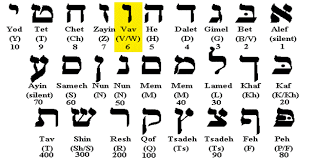
(click here for details to study basic Hebrew Alphabet)
elements. Those elements, well known to students of sacred traditions, are Fire, Air, and Water.” Braden further states:
In the language of the alchemical era, Fire, Air, and Water were known to represent the extremes of polarity and balance.
Relating these to the elements of our DNA, Air equates to nitrogen
which makes up 78 percent of the atmosphere; Water equates to
oxygen, which is approximately 86 per cent of water; and Fire equates to hydrogen, which makes up approximately 71 percent of the sun’s elements. Braden states it this way:
Key Elements of Ancient Alchemy as Modern Chemistry
Alchemy Modern Element
Air Nitrogen
Water Oxygen
Fire Hydrogen
There is a fourth element which applies only to the creation, and not to God: Earth. These four elements form the basis of the mystery which Braden attempts to decipher for us. We will later see how the last one applies to the equation.
Braden associates this representation of polarity and balance with the elements of the atom: proton, electron, and neutron, which carry the trilogy of attributes (positive, negative, and neutral).
The clue to the mystery of creation, says Braden, lies in what is known in the Hebrew alphabet as “the Basics,” the Mothers, or the Mother Letters: Alef (A), Mem (M) ,and Shin (Sh). It is through these letters alone that the mystery of creation may be traced to its origins. They are linked to the alchemical elements of creation: Air, Water, and Fire.
Braden quotes the Sepher Yetzirah on creation: “He chose three letters from among the Elementals [in the mystery of the three mothers Alef Mem Shin]
And He set them in His great Name…”
The significance of these Mother Letters and their link to the name of God is found in the ancient Hebrew belief that the three letters of God’s name (YHV) are actually derived from, and correspond to, the three Mother Letters (AMSh).
Braden states:
In the Kabbalah, a distinction is made between the creation of our
Universe of Order and the universe before ours, the Universe of Chaos. While modern physicists struggle with the dilemma of whether or not anything existed before the time of the Big Bang, for the student of the Kabbalah, the existence of a universe before time is a given, and even required to understand the teachings.
According to the Sepher Yetzirah, the letters of God’s name in our world (YHV) and the Mother Letters from the Universe of Chaos (AMSh) are equal. A (A) = Y (Y); M (M) = H (H); Sh (:) = V (W).
Thus, according to Kabbalistic tradition, the three primary elements of Creation may be stated as either the combination of Aleph, Mem, and Shin, or Yod, Hey, and Vav.
The next step in deciphering the puzzle equating God’s name with the elements of living DNA is the assignment of numeric values to the atomic mass for these three elements.
Braden is more than a best selling author. According to Deepak Chopra, author of How to Know God, “Gregg Braden is a rare blend of scientist, visionary, and scholar, with the ability to speak to our minds while touching the wisdom of our hearts.”
GREGG BRADEN
The author and self-proclaimed discoverer of the God Code is a
geologist who also worked as a senior computer systems designer in the aerospace and defense industry until 1990. When not traveling, Braden (50) lives alternately in New Mexico and Florida with his family.
In 1987 he began to look beyond the physical sciences into the realm of spirituality—the relationships between what happens in the unseen worlds of our emotions and our feelings and the physical world around us. Says Braden:
When I was in the industry, I had the opportunity to see direct
evidence of tremendous shifts on our world—changes in the Earth’s magnetic fields, for example. And my first thought was, “Well, if this is happening to the Earth, what does that mean to us? What does it mean to our bodies?” And I would ask my colleagues, geophysicists and highly esteemed seismologists, and I’d say,
“Well, what does this mean to us?” And they would say pretty much, “I’m a geologist, don’t ask me, ask a life scientist.” And I would ask my life science friends and they would say almost apologetically, “You know, my training is with the biology of the human body. We were never really told about how our bodies interface with the world around us.”
And, of course, we know that’s changing now and that there is a direct measurable connection between what happens inside our bodies and the world around us. And it’s a two way connection.
Braden’s spiritual quest for human unity has taken him around the world and has put him in contact with numerous spiritual leaders.
Since 1986, my search has led me into temples, villages, and monasteries hidden in some of the most pristine, isolated, and remote locations remaining on Earth today. In these places, I’ve met dedicated individuals who consider it their duty in life, as well as an honor, to preserve the memories of our species and the history of our world.
Braden has consulted many religious texts as well as the Bible, the Dead Sea Scrolls, and ancient Hebrew and Arabic writings. In them all, he says, he finds an underlying unity in the attempt to answer the oldest question of our existence: “Who are we, and why are we here?” In the process he claims to have discovered that God has given us proof of His existence while at the same time providing the evidence that will bring about a unity of mankind, provided mankind heeds the message God has implanted in our genes.
While believing that the “Big Bang” theory of creation is true, Braden insists that it was not an accident, but the calculated, creative act of an intelligent being. He also believes that, throughout the centuries since the formation of the earth, there has been a hidden truth which, recently revealed through his study, proves his theory.
A remarkable discovery linking the biblical alphabets of Hebrew and Arabic to modern chemistry reveals that a lost code—a translatable alphabet—and a clue to the mystery of our origins, has lived within us all along. Applying this discovery to the language of life, the familiar elements of hydrogen, nitrogen, oxygen, and carbon that form our DNA may now be replaced with key letters of
the ancient languages. In doing so, the code of all life is transformed into the words of a timeless message. Translated, the message reveals that the precise letters of God’s ancient name are encoded as the genetic information in every cell, of every life. (Emphasis Braden’s)
That message is “God/Eternal within the body.” The meaning, says Braden, is that “human kind is one family, united through a common heritage, and the result of an intentional act of creation!”
Not only is every man, woman and child related, regardless of race, religion, heritage, lifestyle, or belief, says Braden, we are also related “to life itself, from a single blade of grass, to vast expanses of uncharted rain forests; from a fruit fly peering at us through the many facets of a compound eye, to the piercing stare from our nearest primate relatives.”
The essence of Braden’s theory is that “all life is made from the chemical equivalent of a single name.” That name, he says, is encoded in our DNA as “YHVH,” the name of the God of Israel as revealed in the Bible.
You may ask how this is possible. And if it is true, why has it been hidden from us until recently—until this one man made his discovery? Surely, someone, some time in antiquity would have known of this remarkable encoding by God. Would He not have revealed this to His prophets?
More important, how does this relate to faith in Jesus? Will it ultimately lead more people to belief in Him, or will it cause more people to reject Him as the only Way to God, which He claimed to be? (John 14:6 reads : Jesus told him, "I am the way, the truth, and the life. No one can come to the Father except through me.") Just as important, will it cause believers to question their faith and to consider the possibility that all religious paths do lead to the same God after all?
We will consider these questions and more as we present Braden’s evidence for his claim. You may be surprised at his conclusions.
THE GOD CODE
How is it possible to decipher the name of YHVH in our DNA? What has God’s name to do with the chemical elements that make up man’s DNA and the DNA of all living things? As complex as this may sound, Braden’s formula is really quite simple. But it has been necessary for man’s science and knowldge of nature to progress to the stage it exists today for him to reach his conclusions. As recently as 30 years ago it would have been
impossible for any one to analyze the DNA of our cells to the extent that any meaningful understanding could lead to such conclusions. The amazing thing is that there is a logic to those conclusions, and that logic may either strengthen one’s faith in the God of the Bible, or may weaken it, depending upon the quality of that faith.
The concept of the God Code is based on certain mathematical realities:
1) the letters of the Hebrew and Arabic alphabets have numeric values attached to them;
2) the atomic mass for the four major elements that make up the DNA of all living things is stated in numeric values;
3) the values for the three Hebrew letters VHY (read from right-to-left and translated to YHV in English) are equal to the values of the atomic mass for the three elements, hydrogen, nitrogen, and oxygen that, along with carbon, form our DNA.
The Hebrew system of numerology is called gematria, and it has both an exoteric (outward) and an esoteric (hidden or secret) application. The ancient Hebrews had no numeric characters. They assigned numeric values to each Hebrew letter. The exoteric application of Hebrew numerology uses those values in order to facilitate mathematics.
The esoteric application is the use of the Hebrew alphabet’s numeric values to find hidden clues in the search for spiritual truth. It is this esoteric application that is utilized to a great degree in the practice of Kabbalah, a medieval system of Jewish theosophy, mysticism, and magic that continues today. Through the use of gematria, it is believed that the secrets of God, creation, and the spiritual realm may be learned and applied to life for the betterment of mankind.
There are no vowels (a.e.i.o.u) in the Hebrew alphabet, only consonants. It is left to context and the traditional pronunciation for those who speak the language to fill in the vowels accordingly.
The numeric values for the name of YHVH (HWHY): H = 5; W = 6; H = 5; Y = 10. The total numeric value is 26. The three letters (YHV) unrepeated form a numeric value thusly: W = 6; H = 5; Y =
10, with a total value of 21.
One of the rules of gematria is that two words related in number are related in nature as well.⁸ An other rule is that the final value of a number may be reduced to one digit.⁹ The final value is attained by reducing the letter that has more than one digit. Thus, the numeric value of W+H+Y yields the following formula: W = 6 + H = 5 + Y = 1 (simplified to one digit from 10 to 1), for a total value of 12.
So, according to the rules of gematria, the final value of the three
Hebrew letters that comprise the name of God is 12.
Braden applied his knowledge of the rules of gematria which he learned through many years of studying ancient Hebrew texts, especially those that formed the basis for Kabbalah:
Some of the most complete, as well as detailed, records of our origins appear to be preserved in the language and traditions of ancient Hebrew.…Perhaps the best-known source of Hebrew knowledge is a collection of mystical writings known collectively as the Kabbalah.
Although referred to as a single name, the Kabbalah is actually a collection of works—some whose origins have been lost since times of antiquity—that form the bulk of Hebrew esoteric tradition. In general, the most important works of the Kabbalah are believed to be the Zohar (the Book of Radiance), the Midrash (the Book of Illumination), and the Sepher Yetzirah (the Book of Formation). Each of the works contributes to the over all understanding of God, human kind, and creation in very different, yet complementary ways.
Historians generally acknowledge that the Sepher Yetzirah is the oldest and perhaps most mysterious aspect of these works. Although its precise origins are unknown, traditional Jewish scholars believe that the text was originally received directly by the patriarch Abraham. If this is the case, then the first versions of the Sepher Yetzirah would date to approximately 3,800 years ago, making it contemporary with some of the earliest mystical texts of other traditions, such as the Vedas of ancient India.
Braden does say that, although the principles contained in the Sepher Yetzirah may have originated so long ago, the book itself is commonly believed to have originated during the first century A.D. Much of Braden’s theory rests upon his understanding of the Sepher Yetzirah which, he says, describes the act of creation through the formation of the first elements of the universe, represented as the Hebrew letters of God’s name. The remaining letters of the Hebrew alphabet formed “all that was ever formed.”
It is a common belief among scientists today that ancient man had certain knowledge of nature that was lost for centuries and is just beginning to be rediscovered today. Braden believes that it is only when science acknowledges the spiritual reality that lies at the root of physical reality that that ancient knowledge will be regained and, once regained, will lead to a more sane approach toward the application of science. He states that the step-by-step process of creation as revealed in the Sepher Yetzirah closely parallels the discoveries of 20th-century science.
The Elements
To understand how, according to Braden, the name of God relates to the elements that make up our DNA, we must understand something about ancient alchemy. While the term 'alchemy' is believed to apply to the medieval speculative science and philosophy that sought to change base metals into gold, treat disease, and prolong life, its roots go back to the beginning of man’s history. It formed the basis for magic and sorcery, applying knowledge of the chemical elements of nature. The fundamentals of alchemy were known to the ancient Sumerians, Phoenicians, Chaldeans, Babylonians, Egyptians, Chinese, Greeks and Romans, as well as virtually every smaller society. The Hebrews gained many of their mystical traditions from having spent 400 years in Egypt prior to the Exodus.
Regardless of the origins of Kabbalah, the fact remains that, as Braden states, “in general, the basis of alchemical studies began with a single tenet stating that our world, and everything in it, is made of three simple
(click here for details to study basic Hebrew Alphabet)
elements. Those elements, well known to students of sacred traditions, are Fire, Air, and Water.” Braden further states:
In the language of the alchemical era, Fire, Air, and Water were known to represent the extremes of polarity and balance.
Relating these to the elements of our DNA, Air equates to nitrogen
which makes up 78 percent of the atmosphere; Water equates to
oxygen, which is approximately 86 per cent of water; and Fire equates to hydrogen, which makes up approximately 71 percent of the sun’s elements. Braden states it this way:
Key Elements of Ancient Alchemy as Modern Chemistry
Alchemy Modern Element
Air Nitrogen
Water Oxygen
Fire Hydrogen
There is a fourth element which applies only to the creation, and not to God: Earth. These four elements form the basis of the mystery which Braden attempts to decipher for us. We will later see how the last one applies to the equation.
Braden associates this representation of polarity and balance with the elements of the atom: proton, electron, and neutron, which carry the trilogy of attributes (positive, negative, and neutral).
The clue to the mystery of creation, says Braden, lies in what is known in the Hebrew alphabet as “the Basics,” the Mothers, or the Mother Letters: Alef (A), Mem (M) ,and Shin (Sh). It is through these letters alone that the mystery of creation may be traced to its origins. They are linked to the alchemical elements of creation: Air, Water, and Fire.
Braden quotes the Sepher Yetzirah on creation: “He chose three letters from among the Elementals [in the mystery of the three mothers Alef Mem Shin]
And He set them in His great Name…”
The significance of these Mother Letters and their link to the name of God is found in the ancient Hebrew belief that the three letters of God’s name (YHV) are actually derived from, and correspond to, the three Mother Letters (AMSh).
Braden states:
In the Kabbalah, a distinction is made between the creation of our
Universe of Order and the universe before ours, the Universe of Chaos. While modern physicists struggle with the dilemma of whether or not anything existed before the time of the Big Bang, for the student of the Kabbalah, the existence of a universe before time is a given, and even required to understand the teachings.
According to the Sepher Yetzirah, the letters of God’s name in our world (YHV) and the Mother Letters from the Universe of Chaos (AMSh) are equal. A (A) = Y (Y); M (M) = H (H); Sh (:) = V (W).
Thus, according to Kabbalistic tradition, the three primary elements of Creation may be stated as either the combination of Aleph, Mem, and Shin, or Yod, Hey, and Vav.
The next step in deciphering the puzzle equating God’s name with the elements of living DNA is the assignment of numeric values to the atomic mass for these three elements.
Says Braden:
Each of the 118 elements is classified according to traits that set it apart from all others—properties that are described by number—and arranged in the form of a chart. This chart is known as the Periodic Table of the Elements, or simply the Periodic Table, and it continues to grow as additional elements are discovered. By sorting and organizing these traits, scientists determine where each element “fits” within the chart. It is these qualities of number that link the elements of our DNA to the letters of the Hebrew alphabet. This key allows us to read the ancient message coded as the DNA of our cells.
Of the many possible characteristics that describe each element, my 12-year study reveals only one that stands out as a bridge between the four elements of life and the Hebrew alphabet: the quality known as atomic mass. (Emphasis Braden’s)
It is the atomic mass of these elements which allows for equating the Hebrew letters with the chemical elements of creation. The mass for hydrogen is 1.007; the mass for nitrogen is 14; the mass for oxygen is 15.99.
Braden takes these figures and applies the principle of gematria that allows for the simplification of the numbers to one digit by combining the total of both digits left of the decimal point. The final figures, then, are: Hydrogen = 1; Nitrogen = 5 (1+4); and Oxygen = 6 (1+5).
The table below demonstrates this equation.
Alchemy Chemistry Simple Mass
Fire Hydrogen 1
Air Nitrogen 5
Water Oxygen 6
Braden gives a graphic representation of the correlation be tween these numbers and the name of God. (See Table 2) He states that it is a simple matter of matching the numbers to see the direct link the letters of the ancient Hebrew alphabet have with the elements of modern science. He relates how pre-biblical scholars recorded knowledge regarding creation’s secrets from the earliest time of antiquity:
Beyond theory and metaphor, those secrets are now recognized as the details—the actual combinations of elements recognized and verified by today’s science—that are responsible for the process of creation and life it self! In addition to giving credibility to such ac counts, our correlations provide a language that allows us to trans late the old est descriptions of creation with a degree of accuracy never before possible. (Emphasis Braden’s)
Table 2 - Relationships of Values for DNA and Hebrew Letters
Alchemical Element.................... Fire.......... Air........ Water
Elements of Our Body’s DNA ...Hydrogen. Nitrogen Oxygen
....................................................
As Reduced Atomic Mass...........1..............5..............6
As Hebrew Letter Code...............1..............5..............6
Same Elements As Hebrew Letters..Y...H...V
The Fourth Element
But what about the fourth element, Earth? If it is added to the equation does it not tear asunder Braden’s theory? Braden explains:
Through out the history of alchemy, in addition to the three stated building blocks of Fire, Air, and Water, the fourth, or “hidden,”
element was always implied. This was the familiar substance of
“Earth.” In later traditions, while the Earth portion of the code was revealed directly, precisely where it came from remained hidden to all but those initiated in the mystery of creation’s secrets. For students of the Sepher Yetzirah, the key to this mystery is revealed in directly through the text it self.
“From these three (Breath, Fire and Water) He founded His dwelling.”
With a simplicity that is eloquent as well as pro found, we are told that the Creator’s home was formed through the use of only these three substances. This leaves little doubt that, either alone or combined, the elements of Fire; Breath (Air); and Water (hydrogen, nitrogen, and oxygen) are responsible for all the creation that be comes the dwelling of the Creator, the world, and our bodies.
The clue to solving the mystery of the fourth element was that it had to come from elements that were already in existence. To create the new elements, the three existing elements had to interact in some way. It is this union, often described as the “marriage” of Fire, Air, and Water, that be comes the key to understanding our relationship to the world and, ultimately, to the act of creation itself. (Emphasis Braden’s)
Braden is saying that the fourth element in our DNA, Earth, had to be formed out of the three elements available to God at the time of Creation. He states that the number 12 (the combination of the other three elements and the combined number for the three letters of God’s Name) represents the value for the fourth element of Earth:
Next, following the now familiar process of reducing two-digit numbers to a single digit, we add the 1 + 2 of 12 to produce a new value 3. Finally, we use this value to search the Periodic Table for our mystery element.
A brief look at the chemistry of the human body will quickly narrow our search to just a few possibilities. From the 118 elements known to exist, only 4 of those elements account for over 99 per cent of the human body: hydrogen, nitrogen, oxygen, and carbon. Carbon is the only element in this group that has not been accounted for. So we can stream line our search by examining the properties of carbon for a “fit” as a bridge between alchemy and chemistry.
The mass value for carbon is 12.00. Applying the standard process of simplifying this value as 1 + 2, the new value (simple mass) for
carbon is 3. Perhaps not coincidentally, the 3 of carbon is the only value from the 118 possible elements that precisely matches the 3 produced by combining the letters of God’s name:
Y, H, and V (1, 5, and 6).
From the perspective of the Sepher Yetzirah, this makes even greater sense. As we are told that God had only Fire [hydrogen], Air [nitrogen], and Water [oxygen] to
work with, now recognized as col or less and odor less gases, the substance of carbon is the only element of life that makes us solid. In the absence of this fourth physical element, our bodies would not exist!
When the ancients recorded that we are made of Fire, Water, Air, and Earth, in the language of their day they were saying that we are made of hydrogen, nitrogen, oxygen, and carbon—precisely the findings of 20th-century science. In a time before the development of sophisticated test equipment, high-powered microscopes, materials analysis, and the mathematics of chemical equations, our ancestors revealed the com position of our bodies, describing the building blocks of very human cell.
It must be admitted that, if true, this is a remarkable and credible discovery. Did the ancients have such knowledge of the mysteries of Creation?
If so, from where did they get it? We will ex amine these issues later. For now, let us continue with Braden’s theory as he seeks to find the association of ancient alchemy and modern science with the Hebrew alphabet.
Braden states that only one letter of the Hebrew alphabet has the same numeric value as carbon’s simple mass—the fourth letter, Gimel (G), represented by the capital G in English. Thus, Gimel is the carbon of modern science, or “Earth” in ancient alchemy.
Braden states the odds of the four letters of the ancient Hebrew alphabet coinciding with the four elements in the Periodic Table that create human DNA is too great to be coincidence.
What Does It All Mean?
If we add Gimel to the equation, then we do not have the name of God (YHVH) in its pure and whole form within our DNA. Rather, we have YHVG. But Braden does not say that God’s name in its entirety forms our DNA. Rather, he says that the letters of God’s name are found in our DNA, and that the first two letters, YH, are equal to the name of God. He explains:
Exodus re minds us in very specific terms that the name YHVH was revealed as the personal name of God. In equally clear terms, we are shown that human kind is made “in the image” of God. Perhaps in these statements may be found the most direct clue describing our relationship to the source of all that “is.” With a new emphasis, the statement regarding our origins reminds us that we are made only in the image of God, rather than being made as, or equal to, God. Although subtle, this statement suggests that, while we undeniably share in the at tributes of our Creator, we’re also set apart from YHVH by some thing that makes us very different.
Substituting modern elements for the ancient letters, it is clear that although we share in the first three letters representing 75 per cent of our Creator’s name, the fourth and final letter of our chemical name sets us apart from God. While the presence of God is the in visible and in tangible form of the three gases hydrogen, nitrogen, and oxygen, the last letter of our name is the “stuff” that gives us the color, taste, texture, and sounds of our body: carbon. The one letter that sets us apart from God is also the element that makes us “real” in our world.23 (Emphasis Braden’s)
Further, Braden tells us that the name of God in our bodies is not in the full form, YHVH, (Yahweh), but in its contracted form, YH(Yah), which is interchangeable with YHVH according to biblical scholars.
Although the specifics may vary across time and culture, in modern English the meaning of the word eternal clearly implies an existence having no beginning or end and functioning beyond the limitations of time. It is precisely this “eternal” aspect that’s common to both the name of God, YHVH, and the human body, YHVG, as indicated by the underlined letters. Through both the
secret letter codes of antiquity, and the literal translation of DNA as an alphabet, we’re shown that something about our existence remains lasting and eternal. We share that never-ending quality with our Creator through a full 50 per cent of the elements that define our genetic code.
YHVH = the name of God
YHVG = the name of Man
YH (God/Eternal) forms one-half of God’s name and the name coded into our cells.
God In The Body of Man?
Braden carries his hypothesis further, suggesting that the DNA equivalent of God’s name combined with man’s nature demonstrates that God lives within the human body. This is demonstrated by reversing the letters VG to GV which, he says, is an other acceptable rule of gematria. Just as 1 + 2 and 2 + 1 yield the same total, 3, so VG is equal to GV, which translates in the
Hebrew language to the idea of “within.” Thus, YH (Yah), God’s name, is combined with GV, which equates to “within”: God eternal within the body.
This, in a nutshell is the God Code as deciphered by Gregg Braden. There is much more to this than can be stated in this writing, but Braden has certainly done his home work in deciphering the Hebrew alphabet and coupling it with his personal knowledge as a scientist. It must be admitted that it makes sense according to the rules of gematria as applied to Hebrew through the practice of Kabbalah. But is it trust worthy? Is it all true? Or is some of it true? Or is none of it true? These are questions we will consider as we see the philosophical basis for Braden’s beliefs.
The Arabic Alphabet
One of the disturbing aspects of Braden’s belief is his claim that the
message within our DNA reads precisely the same in both the Arabic and Hebrew languages. According to Braden, this proves that YHVH and Allah are the same. Table 3, below, demonstrates the correlation.
Table 3 - Elements and their equivalents in the Hebrew & Arabic alphabets.
DNA As Elements: DNA As Hebrew Letters: DNA As Arabic Letters.
1. Chemistry : Hebrew ; (Value): Arabic ; (Value) .
2. Hydrogen : Yod ; (10) : YA ; (10).
3. Nitrogen ; Hey ; (5) : HA ; (5).
4. Oxygen : Vav ; (6) : WAW (6) .
5. Carbon : Gimel ; (3) : JYM (3) .
6. Combined Value : 6 : 6 .
Based upon the similar patterns in both the Hebrew and Arabic alphabets, Braden says that “the Islamic, Jewish, and Christian names for God appear to stem from the same source, and seem to be equivalents of the same power of creation.”
Further, he asks us to imagine the implications of discovering that “the God of our prayers—the Allah of Islam, the Lord of Judeo-Christian beliefs, the Supreme God of Hindu traditions, and the Great Spirit of the Native Americans—is precisely the same God.”
The discovery of a direct link between the elements responsible for life and the ancient languages of Hebrew and Arabic gives new meaning to more than half of the world’s most deeply held traditions of religion and spirituality. The shared history of the Jewish, Christian, and Islamic traditions, acknowledged by biblical scholars through the patriarch Abraham, suggests that the God of each belief is precisely the same God. Al though the actual name may vary from tradition to tradition, each religion describes our universe as the willful and intentional act of that God. From this perspective, the ancient may be viewed as a precise account of God using the letters of his name (our chemical elements) to produce the universe, the world, and our bodies. Through that understanding, we share God’s essence in the foundation of our genetic code.
The question we must ask is whether or not the fact that the Hebrew and Arabic alphabets assign the same numeric values to the letters that form the name of YHVH prove that YHVH and Allah are the same. To begin, we must understand that Allah
is an invention of Muhammad who founded Islam in the early 7th century—some two hundred years after the formation of the Arabic alphabet:
The Arabic script evolved from the Nabataean Aramaic script. It
has been used since the 4th century AD, but the earliest document, an inscription in Arabic, Syriac and Greek, dates from 512 AD. The Aramaic language has fewer consonants than Arabic, so during the 7th century new Arabic letters were created by adding dots to existing letters in order to avoid ambiguities. Further diacritics indicating short vowels were introduced, but are only generally used to ensure the Qur’an was read aloud with out mistakes.
This alphabet can be traced back to the Nabataean dialect of Aramaic, itself descended from Phoenician (which, among others, gave rise to the Greek alphabet and, thence, to Latin letters, etc.). The first example of a text in the Arabic alphabet appeared in 512 A.D.
Prior to Muhammad the Arabs had many gods, one of whom was named Allah. The name was likely a contraction of the Arabic Alilah, which was the supreme deity of the Quraysh tribe to which Muhammad attached himself. (See our special report, Islam: A Brief History.) So even if the Arabic alphabet related YHVH to Allah (which it doesn’t), it had nothing to do with Muhammad’s Islam or its modern expressions, but with the Allah of the pagan Arabs.
There are many similarities between the Hebrew and Arabic alphabets, which is not surprising since both the Hebrews and Arabs are related as descendants of Abraham.
Both alphabets trace their roots to the Phoenician alphabet. Therefore the commonality of the two should come as no surprise.
The important thing to note is that even in Braden’s application of the two alphabets the numeric values equate to “YHVH.” Neither equate to “ALLAH.” God’s name is not Allah. So Braden’s theory of unification of all man kind regardless of religion falls apart. It devolves to nothing more than wishful thinking on his part.
Even if God’s name were etched upon our DNA regardless of religious beliefs, it would only prove that all mankind is related physically, not spiritually.
NEW AGE INFLUENCES
At the heart of Braden’s theory— and the reason for his research and writing on the hidden name of God in our DNA—is the belief and desire for the unity of man kind in a peaceful society. He recognizes that many of man’s conflicts arise out of religious and philosophical differences. If he can prove that God doesn’t care
about those differences, then he hopes that enough people will believe his new gospel to effect a change in the world—a paradigm
shift in how people relate to one another. This quest for peace is held by many, and is popular among New Age proponents. Braden’s philosophy, if looked at closely, will be revealed as New Age.
At its best, revealing the name of God within all life would provide
powerful new evidence that we are here on purpose, sharing our world as one family. Such a principle could offer a much-needed touch stone of hope in a time when our differences are often viewed as reasons to separate us, rather than the diversity that strengthens us. A message discovered within the chemistry of each body, regardless of religion, lifestyle, race, or be lief, would be a sign
so universal in nature that it could transcend any differences in our
past.
Recent studies suggest that the impact of such a discovery may be
similar to the shock we experience when we receive news that changes our lives in dramatic and unexpected ways. Perhaps we would integrate such news in stages, similar to reconciling the loss of a loved one. In a very real sense, the knowledge that we are the product of intentional creation would invite us to replace our present belief system with one that incorporates our new found knowledge. We may, in effect, find that we mourn the loss of our old beliefs as we redefine our role in creation. In such a scenario, the well accepted stages of loss—shock, denial, rejection, anger, and, ultimately, acceptance—offer a clue as to how deeply such a realization might touch our lives.
Braden validates the reality that prayers as well as meditation, chanting, and other forms of spiritual expression work to heal the body. He believes that they all work because we are “all connected through a shared consciousness”—“the unified field of consciousness that envelops our world and the power of that field to serve as a conduit for prayers of peace.”
This is New Age theory that incorporates the eastern mysticism of Hinduism and Buddhism as its base philosophies. While claiming belief in “God,” it depersonalizes Him and essentially places Him as a servant of man’s religious whims. To bolster his beliefs Braden cites such New Age luminaries as Barbara Marx Hubbard and Jean Houston, as well as deceased astronomer Carl Sagan whose approach to science blended well with New Age thinking.
New Age teaching proposes a soon coming “paradigm shift” and “quantum leap” for mankind which will result in a new reality based upon the melding of science with religion. Such thinking has made great in roads into the religious establishments including myriad Christian churches. Perhaps the greatest tool in achieving those in roads has been the adoption by many churches of psychological theory in their attempts to treat problems of the soul.Within science, the application of human spirituality in testing has revealed that, in deed, there is a correlation between positive out look and good health, as well as other findings. The integration of psychology with religion has opened the minds of religious leaders to believe that “science” offers help in the realm of the spirit. Conversely, the psychological tests by scientists have opened their minds to believe that religion offers help in the physical realm.
Both approaches are bolstering the New Age philosophy that seeks the perfection of man and, ultimately, a utopian society of peace and broth er hood. Braden’s theory of God’s name within our DNA will greatly enhance that New Age philosophy. And it will certainly enhance the drive to ward globalism and the kingdom of the anti-Christ.
With an eye toward man’s ultimate mastery of the physical universe, Braden states:
There appear to be no clear models to show us the way as we engineer the forces of nature and God.
Although we have stepped into uncharted territory with regard to precisely how our new found powers are applied, of one thing we may be certain: From the many lessons that the wars, sickness, environmental disasters, hate, and suffering of the last century taught us, all may be reduced to a single under lying theme.
Each reminds us of the sacred and inter connected nature of life—all life —everywhere.…The God Code has been written with one express purpose in mind: to clearly and simply reveal a single
principle of unity that transcends any separation of the family of human kind based upon our differences. (Emphasis Bradens’)
Man may be able to engineer the forces of nature to some extent, but how do we engineer the forces of God? It becomes obvious that Braden’s concept of God, though called “YHVH,” is not the same as that of the Bible. In truth, he, as do all New Agers, do not consider the Bible as anything more than an ancient text that may hold hidden mysteries that, if discovered, will aid in the formation of a New World Order. The clear teachings of the Bible are ignored while the quest for that hidden
knowledge is pursued with diligence. This be comes obvious in Braden’s quote of the late physicist Heinz Pagels:
Commenting in the early 20th century on the discoveries of light, energy, and life, Pagels stated that we must find a “moral and political order which will ac com mo date these forces or we shall be destroyed. It will try our deep est re sources of reason and compassion.”
No political order will accommodate the forces of nature unless that political order is predicated upon a moral order that comes directly from God. Well, we have that moral order. It’s found in the clear teachings of Scripture. But man has abandoned those clear teachings and seeks rather to find his own an answers within himself. In fact, that’s exactly where Braden says we must look for the answers. In his use of the Sepher Yetzirah as the primary source for his discovery of the God Code, he affirms that ancient philosophical writing’s contention that truth lies within man:
From mysterious passages recorded in the Sepher Yetzirah, the Kabbalah’s ancient Book of Creation, to the original inscription above the entrance to Apollo’s Temple at Delphi,there are references to a universal key—a time capsule of knowledge—holding the long-forgotten answer to nothing less than the identity of our Creator and the origin of our species. Through that key, we are given the means to bridge any differences of be lief, heritage, or history that could ever divide us. The theme of such passages is deceptively simple. With an eloquence that is typical of many time-honored traditions, we are invited to “Know thy self” and “Seek within” for the answers to our deepest mysteries.
Within New Age circles it is hoped that enough people will adopt the methodologies necessary to “seek within” so that the quantum leap into the super-human race will take place. This is why, even though the Bible tells us who we are, New Agers like Braden believe that “we have yet to discover precisely who we are.”
The search for man’s identity is the search for under standing of his purpose in the cos mos. Again, God’s written Word tells us exactly what that purpose is. It will never be found by looking within. God is transcendent above His Creation. His Word is given to us so that we will know precisely how to find Him. His only-begotten Son, Jesus Christ, came to show us the way to Him. It is no mystery available only to those who exhaust them selves, in futile attempts to know the truth through secret teachings.
One of the most profound Scriptures—a passage that speaks eloquently to these deluded people—is found in Isaiah 45:19:
I have not spoken in secret, in a dark place of the earth: I said not unto the seed of Jacob, Seek ye me in
vain: I the LORD speak righteousness, I declare things that are right.
We are to love them who are lost, and we are to try to lead them to Jesus Christ as their Savior and Lord, and we may have unity in the temporal sense (in our work and recreation), but we can have no spiritual unity with them. There is no fellowship of the Spirit.
http://www.mediaspotlight.org/pdfs/THEGODCODE.pdf
Each of the 118 elements is classified according to traits that set it apart from all others—properties that are described by number—and arranged in the form of a chart. This chart is known as the Periodic Table of the Elements, or simply the Periodic Table, and it continues to grow as additional elements are discovered. By sorting and organizing these traits, scientists determine where each element “fits” within the chart. It is these qualities of number that link the elements of our DNA to the letters of the Hebrew alphabet. This key allows us to read the ancient message coded as the DNA of our cells.
Of the many possible characteristics that describe each element, my 12-year study reveals only one that stands out as a bridge between the four elements of life and the Hebrew alphabet: the quality known as atomic mass. (Emphasis Braden’s)
It is the atomic mass of these elements which allows for equating the Hebrew letters with the chemical elements of creation. The mass for hydrogen is 1.007; the mass for nitrogen is 14; the mass for oxygen is 15.99.
Braden takes these figures and applies the principle of gematria that allows for the simplification of the numbers to one digit by combining the total of both digits left of the decimal point. The final figures, then, are: Hydrogen = 1; Nitrogen = 5 (1+4); and Oxygen = 6 (1+5).
The table below demonstrates this equation.
Alchemy Chemistry Simple Mass
Fire Hydrogen 1
Air Nitrogen 5
Water Oxygen 6
Braden gives a graphic representation of the correlation be tween these numbers and the name of God. (See Table 2) He states that it is a simple matter of matching the numbers to see the direct link the letters of the ancient Hebrew alphabet have with the elements of modern science. He relates how pre-biblical scholars recorded knowledge regarding creation’s secrets from the earliest time of antiquity:
Beyond theory and metaphor, those secrets are now recognized as the details—the actual combinations of elements recognized and verified by today’s science—that are responsible for the process of creation and life it self! In addition to giving credibility to such ac counts, our correlations provide a language that allows us to trans late the old est descriptions of creation with a degree of accuracy never before possible. (Emphasis Braden’s)
Table 2 - Relationships of Values for DNA and Hebrew Letters
Alchemical Element.................... Fire.......... Air........ Water
Elements of Our Body’s DNA ...Hydrogen. Nitrogen Oxygen
....................................................
As Reduced Atomic Mass...........1..............5..............6
As Hebrew Letter Code...............1..............5..............6
Same Elements As Hebrew Letters..Y...H...V
The Fourth Element
But what about the fourth element, Earth? If it is added to the equation does it not tear asunder Braden’s theory? Braden explains:
Through out the history of alchemy, in addition to the three stated building blocks of Fire, Air, and Water, the fourth, or “hidden,”
element was always implied. This was the familiar substance of
“Earth.” In later traditions, while the Earth portion of the code was revealed directly, precisely where it came from remained hidden to all but those initiated in the mystery of creation’s secrets. For students of the Sepher Yetzirah, the key to this mystery is revealed in directly through the text it self.
“From these three (Breath, Fire and Water) He founded His dwelling.”
With a simplicity that is eloquent as well as pro found, we are told that the Creator’s home was formed through the use of only these three substances. This leaves little doubt that, either alone or combined, the elements of Fire; Breath (Air); and Water (hydrogen, nitrogen, and oxygen) are responsible for all the creation that be comes the dwelling of the Creator, the world, and our bodies.
The clue to solving the mystery of the fourth element was that it had to come from elements that were already in existence. To create the new elements, the three existing elements had to interact in some way. It is this union, often described as the “marriage” of Fire, Air, and Water, that be comes the key to understanding our relationship to the world and, ultimately, to the act of creation itself. (Emphasis Braden’s)
Braden is saying that the fourth element in our DNA, Earth, had to be formed out of the three elements available to God at the time of Creation. He states that the number 12 (the combination of the other three elements and the combined number for the three letters of God’s Name) represents the value for the fourth element of Earth:
Next, following the now familiar process of reducing two-digit numbers to a single digit, we add the 1 + 2 of 12 to produce a new value 3. Finally, we use this value to search the Periodic Table for our mystery element.
A brief look at the chemistry of the human body will quickly narrow our search to just a few possibilities. From the 118 elements known to exist, only 4 of those elements account for over 99 per cent of the human body: hydrogen, nitrogen, oxygen, and carbon. Carbon is the only element in this group that has not been accounted for. So we can stream line our search by examining the properties of carbon for a “fit” as a bridge between alchemy and chemistry.
The mass value for carbon is 12.00. Applying the standard process of simplifying this value as 1 + 2, the new value (simple mass) for
carbon is 3. Perhaps not coincidentally, the 3 of carbon is the only value from the 118 possible elements that precisely matches the 3 produced by combining the letters of God’s name:
Y, H, and V (1, 5, and 6).
From the perspective of the Sepher Yetzirah, this makes even greater sense. As we are told that God had only Fire [hydrogen], Air [nitrogen], and Water [oxygen] to
work with, now recognized as col or less and odor less gases, the substance of carbon is the only element of life that makes us solid. In the absence of this fourth physical element, our bodies would not exist!
When the ancients recorded that we are made of Fire, Water, Air, and Earth, in the language of their day they were saying that we are made of hydrogen, nitrogen, oxygen, and carbon—precisely the findings of 20th-century science. In a time before the development of sophisticated test equipment, high-powered microscopes, materials analysis, and the mathematics of chemical equations, our ancestors revealed the com position of our bodies, describing the building blocks of very human cell.
It must be admitted that, if true, this is a remarkable and credible discovery. Did the ancients have such knowledge of the mysteries of Creation?
If so, from where did they get it? We will ex amine these issues later. For now, let us continue with Braden’s theory as he seeks to find the association of ancient alchemy and modern science with the Hebrew alphabet.
Braden states that only one letter of the Hebrew alphabet has the same numeric value as carbon’s simple mass—the fourth letter, Gimel (G), represented by the capital G in English. Thus, Gimel is the carbon of modern science, or “Earth” in ancient alchemy.
Braden states the odds of the four letters of the ancient Hebrew alphabet coinciding with the four elements in the Periodic Table that create human DNA is too great to be coincidence.
What Does It All Mean?
If we add Gimel to the equation, then we do not have the name of God (YHVH) in its pure and whole form within our DNA. Rather, we have YHVG. But Braden does not say that God’s name in its entirety forms our DNA. Rather, he says that the letters of God’s name are found in our DNA, and that the first two letters, YH, are equal to the name of God. He explains:
Exodus re minds us in very specific terms that the name YHVH was revealed as the personal name of God. In equally clear terms, we are shown that human kind is made “in the image” of God. Perhaps in these statements may be found the most direct clue describing our relationship to the source of all that “is.” With a new emphasis, the statement regarding our origins reminds us that we are made only in the image of God, rather than being made as, or equal to, God. Although subtle, this statement suggests that, while we undeniably share in the at tributes of our Creator, we’re also set apart from YHVH by some thing that makes us very different.
Substituting modern elements for the ancient letters, it is clear that although we share in the first three letters representing 75 per cent of our Creator’s name, the fourth and final letter of our chemical name sets us apart from God. While the presence of God is the in visible and in tangible form of the three gases hydrogen, nitrogen, and oxygen, the last letter of our name is the “stuff” that gives us the color, taste, texture, and sounds of our body: carbon. The one letter that sets us apart from God is also the element that makes us “real” in our world.23 (Emphasis Braden’s)
Further, Braden tells us that the name of God in our bodies is not in the full form, YHVH, (Yahweh), but in its contracted form, YH(Yah), which is interchangeable with YHVH according to biblical scholars.
Although the specifics may vary across time and culture, in modern English the meaning of the word eternal clearly implies an existence having no beginning or end and functioning beyond the limitations of time. It is precisely this “eternal” aspect that’s common to both the name of God, YHVH, and the human body, YHVG, as indicated by the underlined letters. Through both the
secret letter codes of antiquity, and the literal translation of DNA as an alphabet, we’re shown that something about our existence remains lasting and eternal. We share that never-ending quality with our Creator through a full 50 per cent of the elements that define our genetic code.
YHVH = the name of God
YHVG = the name of Man
YH (God/Eternal) forms one-half of God’s name and the name coded into our cells.
God In The Body of Man?
Braden carries his hypothesis further, suggesting that the DNA equivalent of God’s name combined with man’s nature demonstrates that God lives within the human body. This is demonstrated by reversing the letters VG to GV which, he says, is an other acceptable rule of gematria. Just as 1 + 2 and 2 + 1 yield the same total, 3, so VG is equal to GV, which translates in the
Hebrew language to the idea of “within.” Thus, YH (Yah), God’s name, is combined with GV, which equates to “within”: God eternal within the body.
This, in a nutshell is the God Code as deciphered by Gregg Braden. There is much more to this than can be stated in this writing, but Braden has certainly done his home work in deciphering the Hebrew alphabet and coupling it with his personal knowledge as a scientist. It must be admitted that it makes sense according to the rules of gematria as applied to Hebrew through the practice of Kabbalah. But is it trust worthy? Is it all true? Or is some of it true? Or is none of it true? These are questions we will consider as we see the philosophical basis for Braden’s beliefs.
The Arabic Alphabet
One of the disturbing aspects of Braden’s belief is his claim that the
message within our DNA reads precisely the same in both the Arabic and Hebrew languages. According to Braden, this proves that YHVH and Allah are the same. Table 3, below, demonstrates the correlation.
Table 3 - Elements and their equivalents in the Hebrew & Arabic alphabets.
DNA As Elements: DNA As Hebrew Letters: DNA As Arabic Letters.
1. Chemistry : Hebrew ; (Value): Arabic ; (Value) .
2. Hydrogen : Yod ; (10) : YA ; (10).
3. Nitrogen ; Hey ; (5) : HA ; (5).
4. Oxygen : Vav ; (6) : WAW (6) .
5. Carbon : Gimel ; (3) : JYM (3) .
6. Combined Value : 6 : 6 .
Further, he asks us to imagine the implications of discovering that “the God of our prayers—the Allah of Islam, the Lord of Judeo-Christian beliefs, the Supreme God of Hindu traditions, and the Great Spirit of the Native Americans—is precisely the same God.”
The discovery of a direct link between the elements responsible for life and the ancient languages of Hebrew and Arabic gives new meaning to more than half of the world’s most deeply held traditions of religion and spirituality. The shared history of the Jewish, Christian, and Islamic traditions, acknowledged by biblical scholars through the patriarch Abraham, suggests that the God of each belief is precisely the same God. Al though the actual name may vary from tradition to tradition, each religion describes our universe as the willful and intentional act of that God. From this perspective, the ancient may be viewed as a precise account of God using the letters of his name (our chemical elements) to produce the universe, the world, and our bodies. Through that understanding, we share God’s essence in the foundation of our genetic code.
The question we must ask is whether or not the fact that the Hebrew and Arabic alphabets assign the same numeric values to the letters that form the name of YHVH prove that YHVH and Allah are the same. To begin, we must understand that Allah
is an invention of Muhammad who founded Islam in the early 7th century—some two hundred years after the formation of the Arabic alphabet:
The Arabic script evolved from the Nabataean Aramaic script. It
has been used since the 4th century AD, but the earliest document, an inscription in Arabic, Syriac and Greek, dates from 512 AD. The Aramaic language has fewer consonants than Arabic, so during the 7th century new Arabic letters were created by adding dots to existing letters in order to avoid ambiguities. Further diacritics indicating short vowels were introduced, but are only generally used to ensure the Qur’an was read aloud with out mistakes.
This alphabet can be traced back to the Nabataean dialect of Aramaic, itself descended from Phoenician (which, among others, gave rise to the Greek alphabet and, thence, to Latin letters, etc.). The first example of a text in the Arabic alphabet appeared in 512 A.D.
Prior to Muhammad the Arabs had many gods, one of whom was named Allah. The name was likely a contraction of the Arabic Alilah, which was the supreme deity of the Quraysh tribe to which Muhammad attached himself. (See our special report, Islam: A Brief History.) So even if the Arabic alphabet related YHVH to Allah (which it doesn’t), it had nothing to do with Muhammad’s Islam or its modern expressions, but with the Allah of the pagan Arabs.
There are many similarities between the Hebrew and Arabic alphabets, which is not surprising since both the Hebrews and Arabs are related as descendants of Abraham.
Both alphabets trace their roots to the Phoenician alphabet. Therefore the commonality of the two should come as no surprise.
The important thing to note is that even in Braden’s application of the two alphabets the numeric values equate to “YHVH.” Neither equate to “ALLAH.” God’s name is not Allah. So Braden’s theory of unification of all man kind regardless of religion falls apart. It devolves to nothing more than wishful thinking on his part.
Even if God’s name were etched upon our DNA regardless of religious beliefs, it would only prove that all mankind is related physically, not spiritually.
NEW AGE INFLUENCES
about those differences, then he hopes that enough people will believe his new gospel to effect a change in the world—a paradigm
shift in how people relate to one another. This quest for peace is held by many, and is popular among New Age proponents. Braden’s philosophy, if looked at closely, will be revealed as New Age.
At its best, revealing the name of God within all life would provide
powerful new evidence that we are here on purpose, sharing our world as one family. Such a principle could offer a much-needed touch stone of hope in a time when our differences are often viewed as reasons to separate us, rather than the diversity that strengthens us. A message discovered within the chemistry of each body, regardless of religion, lifestyle, race, or be lief, would be a sign
so universal in nature that it could transcend any differences in our
past.
Recent studies suggest that the impact of such a discovery may be
similar to the shock we experience when we receive news that changes our lives in dramatic and unexpected ways. Perhaps we would integrate such news in stages, similar to reconciling the loss of a loved one. In a very real sense, the knowledge that we are the product of intentional creation would invite us to replace our present belief system with one that incorporates our new found knowledge. We may, in effect, find that we mourn the loss of our old beliefs as we redefine our role in creation. In such a scenario, the well accepted stages of loss—shock, denial, rejection, anger, and, ultimately, acceptance—offer a clue as to how deeply such a realization might touch our lives.
Braden validates the reality that prayers as well as meditation, chanting, and other forms of spiritual expression work to heal the body. He believes that they all work because we are “all connected through a shared consciousness”—“the unified field of consciousness that envelops our world and the power of that field to serve as a conduit for prayers of peace.”
This is New Age theory that incorporates the eastern mysticism of Hinduism and Buddhism as its base philosophies. While claiming belief in “God,” it depersonalizes Him and essentially places Him as a servant of man’s religious whims. To bolster his beliefs Braden cites such New Age luminaries as Barbara Marx Hubbard and Jean Houston, as well as deceased astronomer Carl Sagan whose approach to science blended well with New Age thinking.
New Age teaching proposes a soon coming “paradigm shift” and “quantum leap” for mankind which will result in a new reality based upon the melding of science with religion. Such thinking has made great in roads into the religious establishments including myriad Christian churches. Perhaps the greatest tool in achieving those in roads has been the adoption by many churches of psychological theory in their attempts to treat problems of the soul.Within science, the application of human spirituality in testing has revealed that, in deed, there is a correlation between positive out look and good health, as well as other findings. The integration of psychology with religion has opened the minds of religious leaders to believe that “science” offers help in the realm of the spirit. Conversely, the psychological tests by scientists have opened their minds to believe that religion offers help in the physical realm.
Both approaches are bolstering the New Age philosophy that seeks the perfection of man and, ultimately, a utopian society of peace and broth er hood. Braden’s theory of God’s name within our DNA will greatly enhance that New Age philosophy. And it will certainly enhance the drive to ward globalism and the kingdom of the anti-Christ.
With an eye toward man’s ultimate mastery of the physical universe, Braden states:
There appear to be no clear models to show us the way as we engineer the forces of nature and God.
Although we have stepped into uncharted territory with regard to precisely how our new found powers are applied, of one thing we may be certain: From the many lessons that the wars, sickness, environmental disasters, hate, and suffering of the last century taught us, all may be reduced to a single under lying theme.
Each reminds us of the sacred and inter connected nature of life—all life —everywhere.…The God Code has been written with one express purpose in mind: to clearly and simply reveal a single
principle of unity that transcends any separation of the family of human kind based upon our differences. (Emphasis Bradens’)
Man may be able to engineer the forces of nature to some extent, but how do we engineer the forces of God? It becomes obvious that Braden’s concept of God, though called “YHVH,” is not the same as that of the Bible. In truth, he, as do all New Agers, do not consider the Bible as anything more than an ancient text that may hold hidden mysteries that, if discovered, will aid in the formation of a New World Order. The clear teachings of the Bible are ignored while the quest for that hidden
knowledge is pursued with diligence. This be comes obvious in Braden’s quote of the late physicist Heinz Pagels:
Commenting in the early 20th century on the discoveries of light, energy, and life, Pagels stated that we must find a “moral and political order which will ac com mo date these forces or we shall be destroyed. It will try our deep est re sources of reason and compassion.”
No political order will accommodate the forces of nature unless that political order is predicated upon a moral order that comes directly from God. Well, we have that moral order. It’s found in the clear teachings of Scripture. But man has abandoned those clear teachings and seeks rather to find his own an answers within himself. In fact, that’s exactly where Braden says we must look for the answers. In his use of the Sepher Yetzirah as the primary source for his discovery of the God Code, he affirms that ancient philosophical writing’s contention that truth lies within man:
From mysterious passages recorded in the Sepher Yetzirah, the Kabbalah’s ancient Book of Creation, to the original inscription above the entrance to Apollo’s Temple at Delphi,there are references to a universal key—a time capsule of knowledge—holding the long-forgotten answer to nothing less than the identity of our Creator and the origin of our species. Through that key, we are given the means to bridge any differences of be lief, heritage, or history that could ever divide us. The theme of such passages is deceptively simple. With an eloquence that is typical of many time-honored traditions, we are invited to “Know thy self” and “Seek within” for the answers to our deepest mysteries.
Within New Age circles it is hoped that enough people will adopt the methodologies necessary to “seek within” so that the quantum leap into the super-human race will take place. This is why, even though the Bible tells us who we are, New Agers like Braden believe that “we have yet to discover precisely who we are.”
The search for man’s identity is the search for under standing of his purpose in the cos mos. Again, God’s written Word tells us exactly what that purpose is. It will never be found by looking within. God is transcendent above His Creation. His Word is given to us so that we will know precisely how to find Him. His only-begotten Son, Jesus Christ, came to show us the way to Him. It is no mystery available only to those who exhaust them selves, in futile attempts to know the truth through secret teachings.
One of the most profound Scriptures—a passage that speaks eloquently to these deluded people—is found in Isaiah 45:19:
I have not spoken in secret, in a dark place of the earth: I said not unto the seed of Jacob, Seek ye me in
vain: I the LORD speak righteousness, I declare things that are right.
God does not speak in secret. What He wishes to reveal to us He declares openly. That does not mean He has no secrets. In deed, the secret things belong to God, but the things He chooses to reveal belong to us in order that we may do what He commands of us (Deuteronomy 29: 29). Those who search out hidden meanings in Scripture in order to discover God’s secrets are in a dangerous place. They are defying His Word by ignoring its clear teaching in favor of some hid den mes sage that will bolster their self-esteem. This is nothing less than the sin of pride which brought low Adam and cursed the human race.
The product of this sin of pride is a refusal to know the true God as He has revealed Himself through His written Word. Thinking themselves to be wise, they became fools, and have crafted to themselves a god in their own image—a god whose nature is based on lies.
Says Braden:
Much of our history mirrors our attempt to find grace in the presence of a higher power. The massive temples in the deserts of Egypt, observatories hidden in the jungles of Peru, and great cathedrals of Europe remind us of our efforts throughout history to please and become closer to our ever-changing idea of god.
This is a true statement. Man’s religious history bears the marks of man’s at tempts to please his many concepts of God. But those efforts lead in the wrong direction, simply because that “ever-changing idea of god” is invalid. Since every religion allegedly leads to the same place, and each is considered “true,” then God must be ever-changing. But He tells us in His Word that He does not change (Malachi 3:6).
Knowing God
No religion or philosophy, including New Age philosophy, purports to know God. Braden recounts his childhood when he read The Golden Treasury of Bible Stories—his “first window into the biblical mysteries of creation.” There he saw illustrations of “God” as man’s imagination perceived him. He has rightly rejected those illustrations as being true representations of God. But along with the illustrations he has also rejected the words of the Bible. He says:
In the Judeo-Christian tradition, scientists and scholars have traditionally interpreted such references to God as an attempt to name the un-nameable: a symbol for the source of creation. Even the earliest roots of Western traditions state that it is impossible to know or to represent God directly. The reason is because God exists everywhere and in everything and, by His very nature, cannot be known or described.…
The oldest myths of our past attribute the power to create, sustain, and destroy life itself to the Supreme God of the cosmos, the Creator. By the very nature of His/Her omnipresence, the One or the Eternal is beyond gender, beyond direct name, and is known to the people of Earth only through the miracles that manifest as nature and life.…Perhaps the most direct explanation of our in ability to know God in His entirety may be found in the words of present-day teacher of the Kabbalah, Z’ev ben Shimon Halevi. In the eloquence of a true teacher, he summarizes God’s mystery in three simple words: “God is God.”
How “Profound.” Who couldn’t have come to that conclusion?
This is a sad commentary. Man may indeed know God intimately and personally, but he rejects the one Way
by which that knowledge may be attained: the clear teaching of God’s Word.
The Way to God is Je sus Christ. All attempts to find other ways to Him are doomed to failure:
Thomas saith unto him, Lord, we know not whither thou goest; and how can we know the way? Je sus saith unto him, I am the way, the truth, and the life: no man cometh unto the Father, but by me. If ye had known me, ye should have known my Father also: and
from hence forth ye know him, and have seen him.
(John 14:5-7)
While the world gives lip service to Jesus as a great “teacher,” “prophet,” "healer," etc., it refuses to acknowledge Him as God incarnate, who is Savior and Lord. So it remains always seeking but never able to come to the knowledge of the truth (2Timothy 3:7).
In the case of the God Code, its source of “truth” is the sorcery of Kabbalah—one of the first rebellions against God and His Word.
Kabbalah
Kabbalah claims to be thousands of years old and responsible for the great achievements of mankind. It is considered a universal wisdom, the origin of all teachings. It is said to reveal the spiritual and physical laws that govern the entire cosmos, and explains every emotion and desire within mankind. It also promises to resolve all the problems that burden mankind, and to explain all the eruptions that occur in our universe from the birth of a new star exploding into existence to the explosive arguments that erupt in our lives. Kabbalah does not claim to be a religion, but ac cepts all religions as part of the branch of wisdom which is fully embodied in Kabbalah itself. In many respects it is antagonistic toward religion, seeing religion as the cause of corruption and superstition. Yet Kabbalah seeks to an swer the questions about God that re li gion fails to answer: Who is God? Where is God? What have we to do with God? In the process it also seeks to define God not only as the Creator of all things, but the resident within all things. This is not pantheism in its truest sense (God is everything, or every thing is God), but rather the belief that God inhabits every aspect of His creation and is the unifying source within Creation.
Kabbalah promises to help the practitioner achieve balance in his life —a balance that will result in peace, prosperity and happiness—while bringing understanding of our innermost psyche. This is why it is growing in popularity among Hollywood’s elite.
Kabbalah traces its roots to ancient Hebrew mysticism which in corporated the secret knowledge of Egyptian religion at the time of Israel’s servitude in that nation. It is likely that Moses was schooled in the teachings of the Egyptians
since, almost from birth, he was raised in Pharaoh’s palace. That does not mean he continued in the Egyptian mysteries once he met YHVH face-to-face in the burning bush, but it does suggest that the Hebrews at that time may also have been influenced by those mysteries. This would explain the conflict between Moses and his detractors who attempted to persuade the people to return to Egypt, and who coerced Aaron into building the golden calf.
since, almost from birth, he was raised in Pharaoh’s palace. That does not mean he continued in the Egyptian mysteries once he met YHVH face-to-face in the burning bush, but it does suggest that the Hebrews at that time may also have been influenced by those mysteries. This would explain the conflict between Moses and his detractors who attempted to persuade the people to return to Egypt, and who coerced Aaron into building the golden calf.
Moreover, at the very beginning of man’s history it’s possible that certain knowledge given Adam by God was handed down to Adam’s descendants, in time becoming corrupted by Satan and fallen angels into the ancient mystery religions. Rebellious men used that knowledge for the exaltation of man. Nimrod’s building of Babylon is a notable early effort to that end. This also explains the perplexing accounts in Scripture that seem to lend validity to some of the mystical practices of ancient men such as the Magi who sought out the Lord Jesus because of their understanding the significance of the star that led them. They were practitioners of ancient mystical crafts, but it seems as if God allowed them to know His truths any way. So God may indeed have given Adam and early man certain knowledge of nature in order that man could have dominion on earth, but over time that knowledge became corrupted by Satan’s influence and devolved into the ancient
mysteries of the pagan nations. Today men are seeking to regain that knowledge but without the purity of motives that characterized those to whom God gave that knowledge originally. For the most part knowledge of nature’s mysteries has led to the exaltation of man and to more evil than to any good that glorifies God. Now those who seek that knowledge apart from God’s direct revelation through His Word and the Holy Spirit are delving into forbidden areas.
mysteries of the pagan nations. Today men are seeking to regain that knowledge but without the purity of motives that characterized those to whom God gave that knowledge originally. For the most part knowledge of nature’s mysteries has led to the exaltation of man and to more evil than to any good that glorifies God. Now those who seek that knowledge apart from God’s direct revelation through His Word and the Holy Spirit are delving into forbidden areas.
Is it possible that Gregg Braden has stumbled upon a long-hidden truth relative to God’s name? As a scientist, his understanding of the chemistry of life is credible. Many scientific sources affirm that our DNA is made mostly of the four elements of nitrogen, hydrogen, oxygen and carbon (some adding phosphorous), as Braden says. The rules of gematria as stated by Braden are also reliable according to kabbalistic sources. Thus his conclusions, based upon ancient tradition and modern science, can not be easily dismissed. Nor can Braden’s conclusions on their relationship. How ever, these facts and the fact that the Kabbalah and the Bible both refer to God as YHVH does not detract from the reality that it is wrong to pursue such knowledge. The mere fact that Braden uses kabbalistic teachings to formulate his theory should give us great pause.
The danger in accepting any spiritual teaching apart from the clear
teaching of God’s Word is that, even if that spiritual teaching contains much truth, the errors contained therein may be sufficient to destroy faith in the true God. This, coupled with the credibility that the teacher may amass because of the partial truth he presents, will likely cause most people to place their trust in the rest of the teacher’s belief system. It is critical, therefore, that we not allow our selves to become too enamored of anything—regardless of its appeal to our minds—apart from the inspired Word of God, so that we not be led astray.
In The God Code, Braden utilizes the Kabbalah’s teachings and its esoteric application of gematria to formulate an erroneous hypothesis—that God is dwelling in every living thing, and that the knowledge of this idea will lead to the unity of mankind regardless of religion, or any other factor that separates us.
Disunity does exist where religion and philosophical ideas are concerned but, for the most part, that disunity results in nothing more lethal than angry diatribe. At any sporting event you will find people of diverse religious, philosophical, and cultural traditions giving each other high fives when their favorite team scores. No body cares what the guy next to them thinks as long as they agree that the team they are rooting for is the same. Of course, disunity can some times be come violent even at sporting events. Those who tempt fate by wearing a Yankees cap at Fenway Park in Boston may find that hatred reigns supreme even within the hearts of other wise mild mannered people.
Is it even realistic to think that, even if God’s name were encoded in our DNA, man kind will ever find unity apart from a common faith? According to God’s Word that will never happen until all that are left on the New Earth hold the same common faith, having been resurrected by our Father to live and reign with Jesus for eternity.
Mankind will one day achieve a modicum of religious unity under anti-Christ, but that unity will be limited to those who purposefully take his mark and worship his image. They will be at severe odds against those who refuse to do so. There will be a tremendous disunity between the two factions. Those who do not submit to his religious order will not be allowed to buy or sell the necessities of life; many will be persecuted unto death (Revelation 13:17).
True spiritual unity comes only with a common faith in the true God. Because some one calls their god YHVH does not make their god YHVH. When the Israelites perceived that Moses was a long time coming from the mountain they coerced Aaron to make an idol, then said that it represented the gods that led them out of Egypt. After making the calf, Aaron pro claimed a feast to YHVH (Exodus 32:1-5). But that did not make the calf representative of YHVH, and the true YHVH destroyed those who would not repent.
In the same manner, those who practice Kabbalah may seek to discover truth by hidden meanings within the Scriptures and other ancient Hebrew writings through the use of gematria, and they may say they are seeking unity with YHVH and all mankind, but they do not have the true YHVH.
And there can be no unity with YHVH and all man kind at the same time because mankind is separated from YHVH due to their self-love and their unrepentant sins.
The clear teaching of Scripture declares that there is only one way to YHVH, and that is through repentance from sin and faith in the atoning sacrifice of His only-begotten Son—the
Word of God who became flesh—Jesus of Nazareth. So while Braden and others may think that we all have a common bond through our DNA, that’s as far as it goes. We are all born of flesh, but only those born from above in the spirit have any true unity. We can have no fellowship with darkness.
And this is where Braden’s theory runs into a brick wall. He, as do all practitioners of Kabbalah, focus on the hidden elements they perceive to reside within the numeric attributes of God’s Word for understanding temporal physical life while ignoring the clearly-stated elements that lead to eternal spiritual life. They may not all
be seeking riches in the process, but Jesus’ words apply just as well:
For what shall it profit a man, if he shall gain the whole world, and
lose his own soul? (Mark 8:36)
CONCLUSION
As impressive as the God Code theory may seem, it is not based on science. It is really pseudoscience¾an attempt to integrate some scientific facts with esoteric interpretations of non-scientific resources. Braden’s application of gematria in his search for spiritual “truth” is as good an exercise in mental contortion as any I’ve seen.
On their own, the numbers associated with the physical elements do not match the Hebrew and Arabic numeric values. They had to be manipulated to fit. And it takes the subjective, occult “science” of the Kabbalah to accomplish that task.
By massaging the numbers through such techniques as adding the dig its of compound numbers, ignoring decimal points, and standing on one’s head, one may make a case for just about anything one wants to make credible.
Why should it have taken Braden 12 years to reach his conclusions? It is not unreasonable to assume that he had to try and fail at many attempts to reconcile the discrepancies between his theory and the actual facts relative to DNA and the Hebrew aleph-bet (alphabet). Who knows how many formulas were discarded until he was able to make something work?
Granted, his conclusions are interesting. No matter how much he may have had to contort reason, he does layout a somewhat credible theory. But it does not lend itself to bibli cal truth.
There is a great surge of interest today in spiritual matters. The past few decades that saw the “death” of God have proven unsatisfying to man’s need for fellowship with his Creator. No matter how hard the secularists have tried to convince us that God is dead¾really, that He never existed in the first place¾even the most base of fallen men know that there has to be something more to life than the few miserable years of their existence.
To believe that we are born, we live a rapidly-passing few decades of toil and, for the most part, dissatisfaction with life, then we die, cannot help but cause despair. So the old secular way of thinking is on its way out. In its place is rising a new spirituality that promises to give meaning to one’s life. Unfortunately, this new spirituality is not based on the truths imparted to us by our Creator. Rather, it is based upon human wisdom and a desire for self-fulfilment.
The churches have largely failed to bring the true Gospel to the masses. In place of God’s Word they offer more human wisdom, but couched in biblical terms. Yes, many are growing as a result, but the promise of the Gospel is eluding their congregants.
Let’s face it, the true Gospel, with all its demands for holiness and self-sacrifice, as well as its promise of persecution for those who live by its dictates, is not as palatable as the idea that God accepts all men just as they are, without making any more demand upon them than that they learn to grow inwardly for their own benefit.
So while spirituality is on the rise, the direction in which it leads is within. But what lies within the heart of man?
The heart is deceitful above all
things, and desperately wicked: who
can know it? (Jeremiah 17:9)
The search for truth by the inward path of one’s own being leads no where but to delusion. Man’s own heart deceives him into thinking that he can attain some form of perfection in this life if he will but discover his own inner potential for greatness. This is what the
New Age movement promises. And it is what the God Code promises. The only difference is that the God Code uses a pseudo-scientific method to make it appear as if the physical body it self holds the key to our attainment of spiritual enlightenment. The sad thing is that many Christians will be persuaded to think that such a theory can prove useful to their own spiritual growth.
The God Code is a new phenomenon. It comes at a time when the popularity of other alleged spiritual secrets and hidden “truths” are being touted as means to understanding God and His creation. We are being inundated with “codes” that purport to give us such understanding. The DaVinci Code tells us that Jesus is not who or what the Bible tells us He is. Rather, He is said to be the husband of Mary Magdalene, the son of a Roman soldier, a good man who let the prophecies of Israel’s Messiah convince Him of His role as Savior of Israel. And so-on and-so-on.
The Bible Code promises us the secrets to the future if we can just understand its secret language locked up in the Hebrew Torah. Hidden messages that prophesy after the fact of Itzak Rabin’s assassination, the deaths of Marilyn Monroe and Princess Diana, the war in Iraq, and myriad other major events in human history are supposed to convince us that we can attain truth if we can unlock the secrets of the Bible. It doesn’t matter what one believes, or if he even believes the clearly written words of Scripture; spiritual truth can be his if he works at it. And that is the fallacy that pervades all these popular theories: more truth, and greater truth, is to be found in the hidden mes sages of the Bible than in the clearly stated words given to us by God through His apostles and prophets. Thus, there seems to be a never-ending search for hidden truths¾secret codes¾when God has laid out plainly for us, all the truths He wants us to have.
Rather than receive those truths with their hearts, men think they can attain them with their heads. Truly, the world currently has a “head code,” to which it gives much attention, but its heart is diseased with evil,and it isn't even aware of it.v
All Tables were reproduced from The God Code
http://www.mediaspotlight.org/pdfs/THEGODCODE.pdf


![Holy Bible Names Translated Version Of The Book of Luke by [Plouff, Dan]](https://images-na.ssl-images-amazon.com/images/I/51w%2Bm80OrJL.jpg)