1 Chronicles 16: Lessons From David on the Elements of Spirit-Led Praise For God
Introduction: Upon the return of the ark, David led the Jews in praising God.
From his example, God reveals seven lessons on Spirit-led praise.
These include:
(1) faith in Jesus Christ,
(2) worship,
(3) thanksgiving,
(4) obedience,
(5) dependence,
(6) submission,
and (7) continuity.
First, David began the celebration of the return of the ark with blood sacrifices to atone for the Jews’ sins and to restore fellowship with God. These sacrifices, however, required faith. Today, Spirit-led praise should also include faith and praise for Jesus’ atoning sacrifice.
Second, David then appointed Levites to lead the Jews in joyful worship. From their example, God reveals that Spirit-led praise for God should include joyful worship.
Third, David led the Jews in thanksgiving for all God had done for them. From his example, God reveals that praise for Him should include thanksgiving for His faithfulness.
Fourth, David encouraged the Jews to remember God’s Covenant. Their obedience brought blessings, and their disobedience brought curses. From David’s reminder, God reveals that Spirit-led praise should include obedience.
Fifth, David gave thanks for God’s protection over His anointed ones. That protection was available anytime the Jews submitted to Him. God also wants your worship to include dependence upon His protection.
Sixth, David showed his faith by submitting to and praising the Creator of the universe. Your worship should also include submission to and trust in the power of the Creator to do all things.
Finally, David’s reforms ensured that worship was an ongoing process. Your Spirit-led praise should also be an ongoing process within the Body of Christ.
1. Faith in Jesus: Spirit-Led Praise Begins With Faith in Jesus’ Sacrifice. 1 Chr. 16:1-3.
David leads the Jews in burnt and peace offerings out of gratitude. After celebrating the return of the ark, David placed it in a Tabernacle for worship and used it for its intended purpose to bless God’s people. His dedication of the ark in its new Tabernacle included burnt offerings and peace offerings to atone for the people’s sins and to restore fellowship with God: “1 And they brought in the ark of God and placed it inside the tent which David had pitched for it, and they offered burnt offerings and peace offerings before God. 2 When David had finished offering the burnt offering and the peace offerings, he blessed the people in the name of the Lord. 3 He distributed to everyone of Israel, both man and woman, to everyone a loaf of bread and a portion of meat and a raisin cake.” (1 Chr. 16:1-3; 2 Samuel 6:17-18).
The ark was meant to bring the people into fellowship with God for Him to bless them. Yet, before they could do this, the Jews needed to first restore the sacrificial system that God ordained under Moses. As the King of Israel, this was one of the most important things that David did for God’s people.
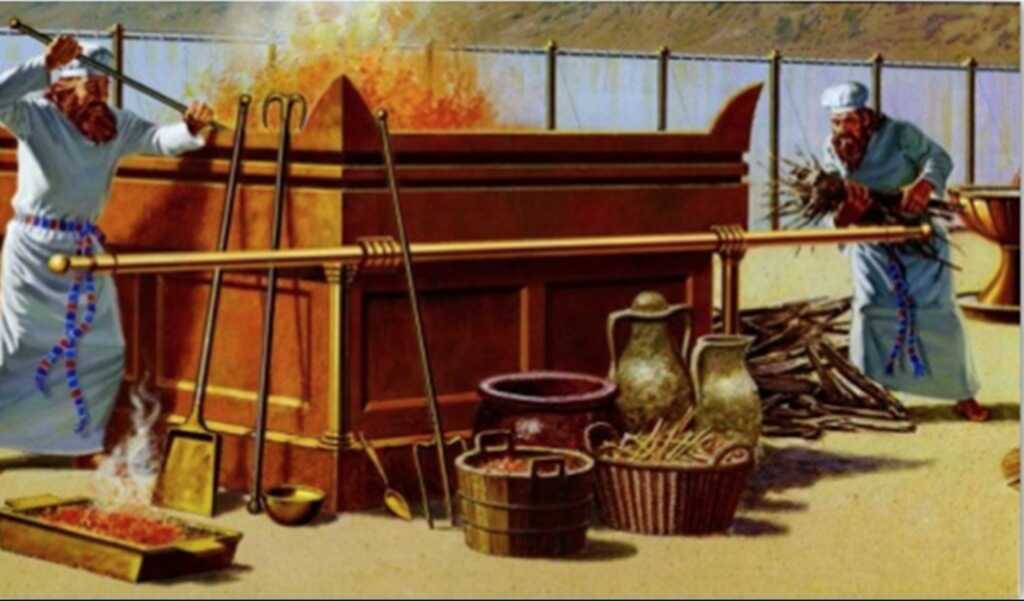
Under David’s leadership, the priests offered burnt offerings and peace offerings
• Without faith in Jesus’ atoning sacrifice, you cannot receive His atonement.
The blood sacrifices were necessary to atone for sin.
‘“For the life of the flesh is in the blood, and I have given it to you on the altar to make atonement for your souls; for it is the blood by reason of the life that makes atonement.”’ (Lev. 17:11; Hebrews 9:22).
But the Jews had to have faith in the sacrifice for it to have any value.
In a similar way, you must have faith in Jesus’ sacrifice for His atoning death to cleanse you of your sins. “and everyone who lives and believes in Me will never die. Do you believe this?” (John 11:26).
“Truly, truly, I say to you, he who believes has eternal life.” (John 6:47).
“He who believes in the Son has eternal life; but he who does not obey the Son will not see life, but the wrath of God abides on him.” (John 3:36).
If you believe, give thanks for His sacrifice for you.
• Thank Jesus by seeking fellowship through His Word.
There are three symbols of God’s fellowship in this account.
First, David celebrated the return of the ark with a “peace” offering (1 Chr. 16:2; 2 Samuel 6:18).
The peace offering was a voluntary offering that symbolized a life of fellowship with God (Lev. Chapter 3).
Second, the contents of the ark included a golden jar with some of the manna that rained down from heaven for 40 years to sustain the Jews in the wilderness (Hebrews 9:4; Exodus 16:32-34).
This symbolized Jesus’ provision and His fellowship. He was the bread of life that rained down on the Jews in the wilderness: “I am the bread of life. Your fathers ate the manna in the wilderness, and they died. This is the bread which comes down out of heaven, so that one may eat of it and not die. I am the living bread that came down out of heaven; if anyone eats of this bread, he will live forever; and the bread also which I will give for the life of the world is My flesh.” (John 6:48-51).
He is also the Word who became flesh (John 1:1, 14).
Third, within the Tent of Meeting near the ark, God commanded that the Jews keep 12 holy loaves of bread (Exodus 25:23-30).
The purpose of the bread was to show God’s desire for fellowship with His people by allowing them to symbolically dine with Him.
Dining together was considered in Jewish culture to be an intimate act of friendship.
Jesus also offers to “dine” with any person who opens the door of their heart to Him (Revelation 3:20).
His bread was meant for you to eat in communion with Him (Revelation 1:6; 5:10).
Are you consuming the bread of life to stay in communion with Jesus?
• Provide for God’s people.
David gave bread to all the people (1 Chr. 16:7; 2 Samuel 6:19).
As symbolized by the 12 loaves, Jesus promises to feed everyone who seeks after Him (Matthew 6:25-34).
These instructions also symbolically apply to all of God’s believers (1 Peter 2:5, 9).
Like the bread that God offered to all His tribes, He wants you to provide for those in need.
Today, Jesus’ “food” is doing God’s will: “Jesus said to them, ‘My food is to do the will of Him who sent Me and to accomplish His work.’” (John 4:34).
Serving God by helping others is also one part of “undefiled religion”. (James 1:27).
Does your worship include helping others?
Or, are you only feeding yourself?
• Use God’s blessings to bless others.
David also used the ark for its intended purpose to bless others: “Then all the people departed each to his house, and David returned to bless his household.” (1 Chr. 16:43).
Most of the great leaders of the Bible gave blessings to their people.
For example, with Noah’s final recorded words, he blessed and gave prophetic words for his children (Genesis 9:24-27).
At a time when Isaac incorrectly thought that he was about to die, he sought to bless his eldest son Esau. Yet, he was tricked into giving that blessing to Jacob (Genesis 27:34-41).
At the end of his life, Jacob blessed and gave prophetic words to each of his 12 sons (Genesis 49).
At Moses’ prompting, Aaron blessed the people in God’s name (Numbers 6:22-27).
In Moses’ final words, he blessed the 12 tribes of Israel in God’s name (Deuteronomy 33:1).
Solomon also blessed the people after he dedicated the Temple: “Then the king faced about and blessed all the assembly of Israel, while all the assembly of Israel was standing.” (1 Kings 8:14, 55).
Jesus also promised a blessing with His final words: “I am with you always, even to the end of the age.” (Matthew 28:20).
Apostle Paul also offered a prayer of blessings to others (2 Corinthians 13:14).
Today, a blessing at the end of a church service is called a prayer of “benediction.”
You should also be looking for ways to bless others.
Believers should also pray for God to bless others.
Your goal should never be to condemn a sinner.
That is what Satan does as the accuser of the brethren (Revelation 12:10).
Instead, your goal should be to restore the person who has sinned: “Brethren, even if anyone is caught in any trespass, you who are spiritual, restores such a one in a spirit of gentleness; each one looking to yourself, so that you too will not be tempted.” (Galatians 6:1).
When was the last time that you prayed for God to bless someone else outside of your immediate family?
2. Worship: Spirit-Led Praise to God Should Include Joyful Worship. 1 Chr. 16:4-6.
• David appoints worship leaders to lead the Jews in worship.
David also selected leaders to lead the Jews in worship: “4 He appointed some of the Levites as ministers before the ark of the Lord, even to celebrate and to thank and praise the Lord God of Israel: 5Asaph the chief, and second to him Zechariah, then Jeiel, Shemiramoth, Jehiel, Mattithiah, Eliab, Benaiah, Obed-edom and Jeiel, with musical instruments, harps, lyres; also Asaph played loud-sounding cymbals, 6 and Benaiah and Jahaziel the priests blew trumpets continually before the ark of the covenant of God.” (1 Chr. 16:4-6).
Within the three clans of Levi, each had an important worship leader or leader of a temple choir.
Within the clan of Kohath, this was Heman (1 Chr. 6:33-38).
Within the clan of Gershon, this was Asaph (1 Chr. 6:39-43).
Within the clan of Merari, this was Ethan (1 Chr. 6:44-47).
These three leaders appointed persons as worship leaders, singers, musicians, and possibly dancers (1 Chr. 15:16-24; 16:4-43; 25:1).
Everyone has a role in worship.
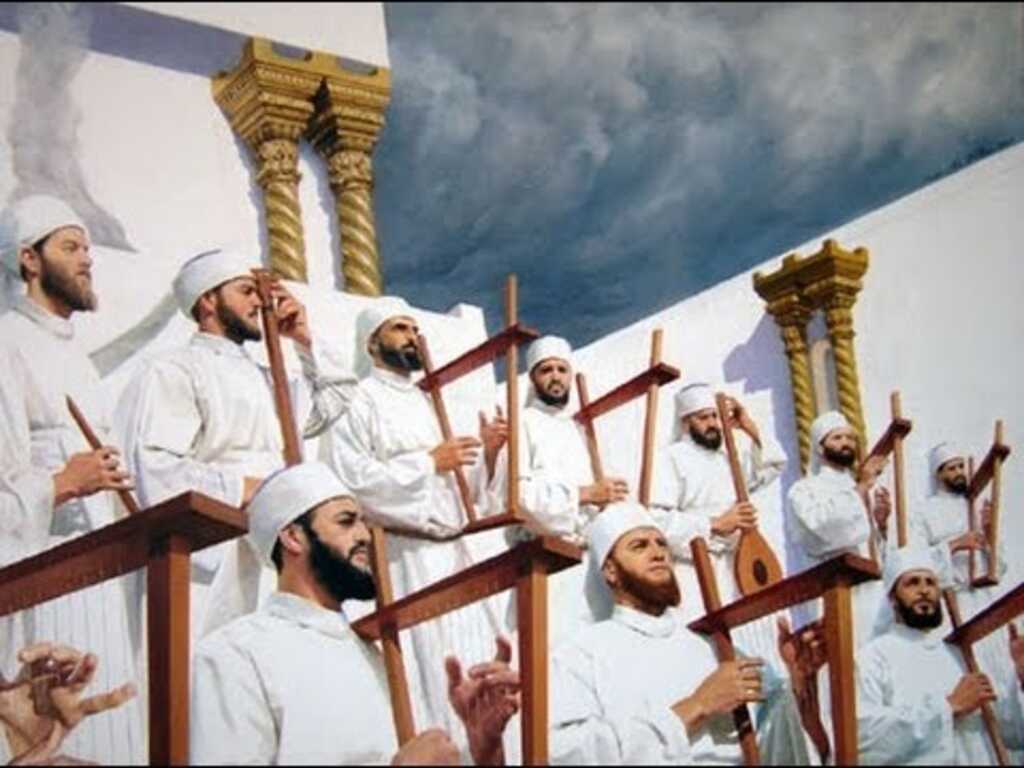
Under David’s leadership, the Levites led
the Jews in worship
• Worship is important for your relationship with God.
Worship plays an important role in preparing your heart to receive the Word.
David understood the importance of worship.
Thus, he “spoke to the chiefs of the Levites to appoint their relatives the singers, with instruments of music, harps, lyres, loud-sounding cymbals, to raise sounds of joy.” (1 Chr. 15:16).
“The priests stood at their posts, and the Levites also, with the instruments of music to the LORD, which King David had made for giving praise to the LORD—‘for His lovingkindness is everlasting’ -- whenever he gave praise by their means, while the priests on the other side blew trumpets; and all Israel was standing.”’ (2 Chr. 7:6).
He had four thousand Levites assigned to perform worship services (1 Chr. 16:31; 23:5).
• Be filled with joyful worship.
Worship can also bring you joy and prepare your heart to praise God: “Then those who sing as well as those who play the flutes shall say, ‘All my springs of joy are in you.’” (Psalm 87:7; 126:2; Job 8:21; Psalm 51:14).
“Through Him then, let us continually offer up a sacrifice of praise to God, that is, the fruit of lips that give thanks to His name.” (Hebrews 13:15).
Is there joy in your worship?
• Dancing can also be a part of worship.
Dancing was also meant to be part of worship (Psalm 30:11).
When God delivered the Jews from Pharaoh’s army, Miriam included both song and dance as part of her celebration (Exodus 15:20-21).
Solomon also wrote that there is a time for celebration that includes dancing (Ecclesiastes 3:4).
God gave us the rhythm to dance to worship Him.
Thus, in heaven, our songs of praise will likely be accompanied by dancing.
Sadly, Satan has corrupted most forms of dance.
• Give thanks for your redemption that Jesus made possible.
The priests also blew trumpets of silver: “Make yourself two trumpets of silver, of hammered work you shall make them; and you shall use them for summoning the congregation and for having the camps set out.” (Numbers 10:2).
Silver was a sign of redemption.
For example, silver shekels foreshadow the ransom price that Jesus paid as a ransom for our broken vows before God (Matthew 26:14-16).
Trumpets will also herald Jesus’ return (1 Thessalonians 4:13-18).
Your worship should include gratitude for your redemption that Jesus made possible.
3. Thanksgiving: Praise Includes Thanksgiving for God’s Faithfulness. 1 Chr. 16:7-13.
• David prepares a psalm of thanksgiving.
After leading the Jews in restoring the sacrifices and worship celebrations that God ordained, David then led the Jews in a psalm of thanksgiving for God’s mighty and faithful words: “7 Then on that day David first assigned Asaph and his relatives to give thanks to the Lord. 8 Oh give thanks to the Lord, call upon His name; make known His deeds among the peoples. 9 Sing to Him, sing praises to Him; speak of all His wonders. 10 Glory in His holy name; let the heart of those who seek the Lord be glad. 11 Seek the Lord and His strength; seek His face continually. 12 Remember His wonderful deeds which He has done, His marvels and the judgments from His mouth, 13 O seed of Israel His servant, sons of Jacob, His chosen ones!” (1 Chr. 16:7-13).
David’s psalm had several components.
This part celebrated God’s faithfulness and His mighty works.
God made a covenant with the Jews through Abraham, Isaac, and Jacob.
God proved Himself faithful to always keep His Word.
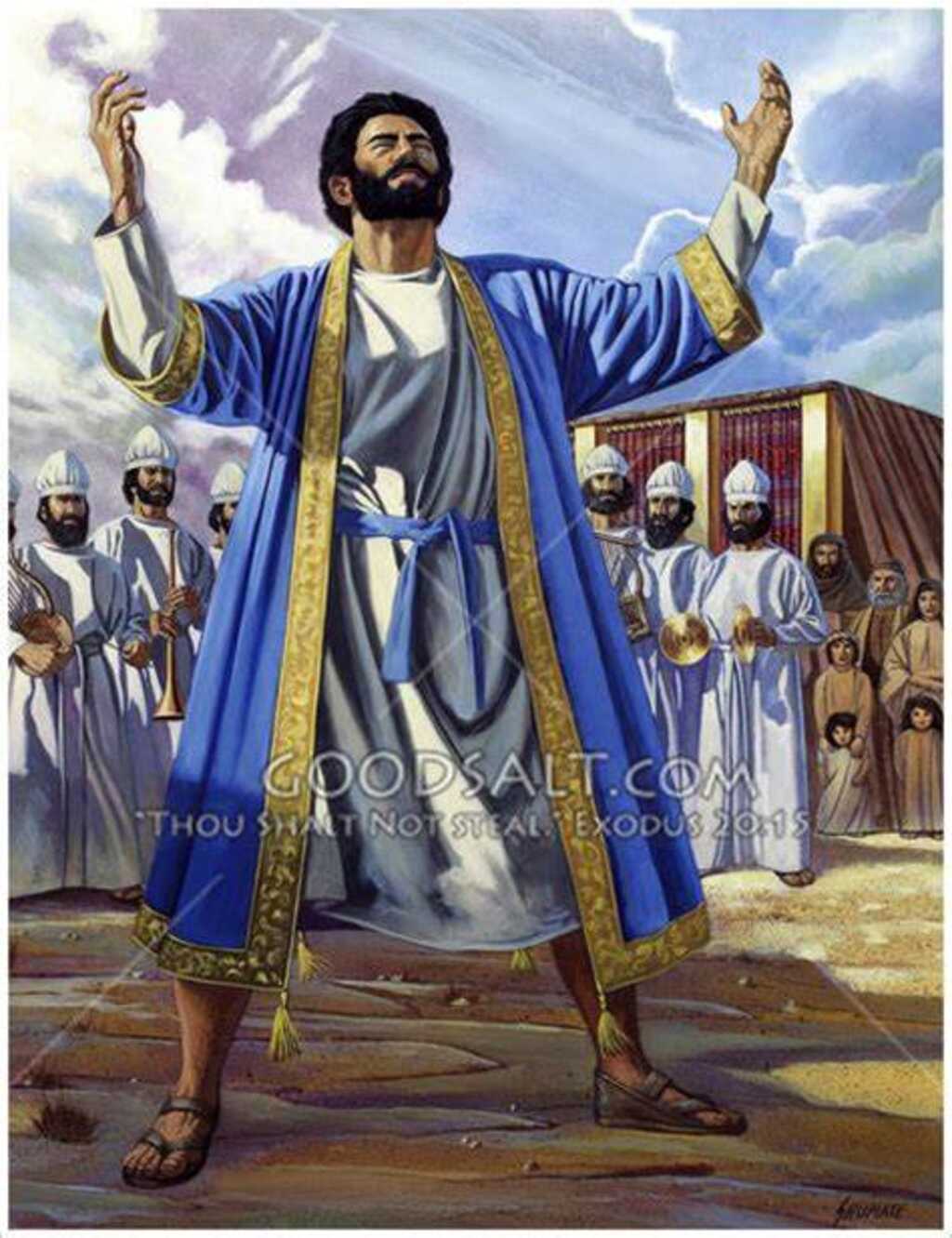
(David led the Jews in giving thanks to God)
Be grateful for God’s faithfulness and His miracles. As an example for believers to follow, the psalmists praised God for all His mighty works for His people: “Oh give thanks to the LORD, call upon His name; make known His deeds among the peoples.” (Ps. 105:1). “One generation shall praise Your works to another, and shall declare Your mighty acts . . . To make known to the sons of men Your mighty acts and the glory of the majesty of Your kingdom.” (Ps. 145:4, 12). “Who can speak of the mighty deeds of the LORD, or can show forth all His praise?” (Ps. 106:2). Isaiah also sang a similar song of praise: “And in that day you will say, ‘Give thanks to the LORD, call on His name. Make known His deeds among the peoples; make them remember that His name is exalted.’” (Is. 12:4). Job also sang a similar song of praise: “Remember that you should exalt His work, of which men have sung.” (Job 36:24). Your gratitude should include thanks for God’s many acts of deliverance and miracles in your life.
• Be grateful that God is faithful even when you are not.
God’s faithfulness is a sign of His grace.
The Jews did nothing to deserve it.
You also can celebrate that God is faithful even when your faith fails you and you disobey God: “If we are faithless, He remains faithful, for He cannot deny Himself.” (2 Timothy 2:13).
Thus, your gratitude should include thanksgiving for God’s forgiveness for your sins.
• Be grateful that God is faithful to strengthen you when you call upon Him.
David exhorted the people to “Seek the Lord and His strength; seek His face continually.” (1 Chr. 16:11).
Today, you can turn to Jesus Christ whenever you need strength: “I can do all things through Him who strengthens me.” (Philippians 4:13).
“that He would grant you, according to the riches of His glory, to be strengthened with power through His Spirit in the inner man,” (Ephesians 3:16).
“I thank Christ Jesus our Lord, who has strengthened me, because He considered me faithful, putting me into service,” (1 Timothy 1:12).
• Record God’s works in your life and repeat them to others.
The Jews studied the Old Testament to remind themselves of God’s great works from Genesis through their return from exile.
God has also likely done incredible things in your life or in the lives of those you care about.
Celebrate God’s works by recording them and sharing them with others.
• Respond to God’s faithfulness by being faithful.
If you are grateful for God’s faithfulness, show your gratitude by being faithful to Him.
Jesus bought your body for a terrible price.
Thus, you should glorify Him with your body (1 Corinthians 6:20; 7:23).
4. Obedience: Spirit-Led Praise to God Should Include Obedience. 1 Chr. 16:14-19.
David exhorts the Jews to remember God’s covenant.
After giving thanks for God’s faithfulness, David called upon the Jews to remember God’s covenant: “¹⁴ He is the Lord our God; His judgments are in all the earth. ¹⁵ Remember His covenant forever, the word which He commanded to a thousand generations, ¹⁶ the covenant which He made with Abraham, and His oath to Isaac. ¹⁷ He also confirmed it to Jacob for a statute, to Israel as an everlasting covenant, ¹⁸ saying, “To you I will give the land of Canaan, as the portion of your inheritance.” ¹⁹ When they were only a few in number, very few, and strangers in it,” (1 Chr. 16:14-19).
God was faithful to keep His Covenant with the Jews.
He built them into a mighty nation.
Under the leadership of first Joshua and later David, God gave the Jews all of the Promised Land.
Yet, the author of Chronicles records this to remind the Jews that God’s Covenant also included His warnings of judgment if the Jews disobeyed Him.
The Jews were warned not to repeat their mistakes.
• God was faithful to keep His Covenant with the Jews.
On seven occasions, God promised Abraham that His Covenant would include making a great nation out of him with countless future descendants:
(1) Genesis 12:3(b);
(2) Genesis 13:16;
(3) Genesis 15:5;
(4) Genesis 16:10;
(5) Genesis 17:4-5;
(6) Genesis 18:18;
(7) Genesis 22:18.
At Beersheba, God affirmed this same covenant with Isaac (Genesis 26:23-25).
In a quote that Jacob (Israel) attributed to God, Isaac promised that Israel’s descendants would become a great nation. “May God Almighty bless you and make you fruitful and multiply you, that you may become a company of peoples.” (Genesis 28:3).
At Bethel, God also confirmed His Covenant with Jacob (Israel). (Genesis 28:13-15).
Jacob (Israel) later left the Promised Land for Egypt with a tribe of the 70 descendants (Genesis 46:27; Exodus 1:5; Deuteronomy 10:22).
When the Jews left from Egypt 400 years later, there were 603,550 men of fighting age (Numbers 1:46) and a general population that would have been more than twice that amount.
Before the Jews entered the Promised Land, Moses celebrated God’s faithfulness to keep His Covenant: “God was faithfulness in keeping His promises to Abraham: ‘Know therefore that the LORD your God, He is God, the faithful God, who keeps His covenant and His lovingkindness to a thousandth generation with those who love Him and keep His commandments;”’ (Deuteronomy 7:9).
Through Joshua and then David, God was faithful to give the Jews the Promised Land (2 Samuel 8:1-15).
David, however, warned that: “His judgments are in all the earth.” (1 Chr. 16:14).
The Jews ignored these and many other warnings.
They were not faithful to keep God’s Covenant.
God warned that their disobedience would result in their defeat, exile, and population collapse (Deuteronomy 28:15-68).
And that was exactly what happened to the Jews.
The author of Chronicles wanted the Jews to celebrate God’s faithfulness in bringing them back from exile. But he did not want the Jews to repeat their mistakes.
• You can also trust in Jesus’ Covenant with you. Jesus created a New Covenant with His sacrifice at the cross (Luke 22:20).
You can also trust Jesus’ faithfulness to keep His Covenant with you. “Faithful is He who calls you, and He also will bring it to pass” (1 Thessalonians 5:24).
“God is faithful, through whom you were called into fellowship with His Son, Jesus Christ our Lord.” (1 Cor. 1:9).
You can respond by staying faithful to Him.
• Obedience shows that your worship and gratitude to Jesus is sincere.
A believer may proclaim Jesus as Lord.
Yet, Jesus is not your Lord if you disobey Him: “Not everyone who says to Me, ‘Lord, Lord,’ will enter the kingdom of heaven, but he who does the will of My Father who is in heaven will enter.” (Matthew 7:21).
“Why do you call Me, ‘Lord, Lord,’ and do not do what I say?” (Luke 6:46).
“But prove yourselves doers of the word, and not merely hearers who delude themselves.” (James 1:22).
“Therefore everyone who hears these words of Mine and acts on them, may be compared to a wise man who built his house on the rock.” (Matth 7:24).
“Everyone who hears these words of Mine and does not act on them, will be like a foolish man who built his house on the sand.” (Matth 7:26).
Is your faith evidenced through your obedience to Jesus’ Word?
5. Dependence: Worship Should Include Depending on God’s Protection. 1 Chr. 16:20-22.
• God’s protection for His anointed ones.
David’s gratitude included appreciation for God’s protection for His appointed people.
Yet, this protection was only available when the Jews put their trust and dependence on Him: “²⁰ and they wandered about from nation to nation, and from one kingdom to another people, ²¹ He permitted no man to oppress them, and He reproved kings for their sakes, saying, ²² ‘Do not touch My anointed ones, and do My prophets no harm.’” (1 Chr. 16:20-22).
The Jews wandered through many hostile nations on their way to the Promised Land.
Whenever they put their trust and dependence upon God, God protected them from their enemies.
The author of Chronicles wanted the Jews who returned from exile to know that God had not abandoned them. Instead, they had abandoned God.
They failed to put their trust and dependence in Him.
As a result, He removed His hand of protection over them.
• God protects those who speak on His behalf.
For those who speak God’s Word, He promises to protect them: “Do not touch My anointed ones, and do My prophets no harm.” (Psalm 105:15).
When you speak God’s Word to others, He will also protect you.
• God also protects those who put their trust and dependence upon Him. When you are in need of deliverance, cry out to God as part of your regular worship: “O LORD, how my adversaries have increased! Many are rising up against me. Many are saying of my soul, ‘There is no deliverance for him in God.’ Selah. But You, O LORD, are a shield about me, My glory, and the One who lifts my head. I was crying to the LORD with my voice, and He answered me from His holy mountain. Selah. I lay down and slept; I awoke, for the LORD sustains me. I will not be afraid of ten thousands of people who have set themselves against me round about.” (Psalm 3:1-6; 25:2).
• When you trust in God and do His will, you have no reason to fear your enemies.
Because God was David’s rock and his refuge, he never feared his enemies: “I will not be afraid of ten thousands of people who have set themselves against me round about.” (Psalm 3:6).
“Though a host encamp against me, my heart will not fear; though war arise against me, in spite of this I shall be confident.” (Psalm. 27:3).
When Goliath approached David, David charged at him without fear: “Then it happened when the Philistine rose and came and drew near to meet David, that David ran quickly toward the battle line to meet the Philistine.” (1 Samuel 17:48).
If you are walking in faith in Jesus Christ, you have no reason to fear your enemies.
“And has raised up a horn of salvation for us in the house of David His servant—” (Luke 1:69).
If you fear any enemy, give that fear to Jesus.
• Depend upon Jesus as your only Saviour.
Throughout the Jews’ history, God had repeatedly delivered them. He was their only deliverer: “I, even I, am the LORD, and there is no savior besides Me.” (Isaiah 43:11).
“Thus says the LORD, the King of Israel and his Redeemer, the LORD of hosts: ‘I am the first and I am the last, And there is no God besides Me.”’ (Isaiah 44:6).
“Do not tremble and do not be afraid; have I not long since announced it to you and declared it? And you are My witnesses. Is there any God besides Me, or is there any other Rock? I know of none.” (Isaiah 44:8; Hos. 13:4).
Jesus is also your only savior (1 John 4:14; Luke 2:11; John 3:16).
He wants you to depend upon Him.
6. Submission: Worship Should Include Submission to Your Creator. 1 Chr. 16:23-36.
• Praise for God the Creator.
David’s praise included submission to the Creator of the universe: “²³ Sing to the Lord, all the earth; proclaim good tidings of His salvation from day to day. ²⁴ Tell of His glory among the nations, His wonderful deeds among all the peoples. ²⁵ For great is the Lord, and greatly to be praised; He also is to be feared above all gods. ²⁶ For all the gods of the peoples are idols, but the Lord made the heavens. ²⁷ Splendor and majesty are before Him, strength and joy are in His place. ²⁸ Ascribe to the Lord, O families of the peoples, ascribe to the Lord glory and strength. ²⁹ Ascribe to the Lord the glory due His name; bring an offering, and come before Him; worship the Lord in holy array. ³⁰ Tremble before Him, all the earth; indeed, the world is firmly established, it will not be moved. ³¹ Let the heavens be glad, and let the earth rejoice; and let them say among the nations, “The Lord reigns.” ³² Let the sea roar, and all it contains; let the field exult, and all that is in it. ³³ Then the trees of the forest will sing for joy before the Lord; for He is coming to judge the earth. ³⁴ O give thanks to the Lord, for He is good; for His lovingkindness is everlasting. ³⁵ Then say, “Save us, O God of our salvation, and gather us and deliver us from the nations, to give thanks to Your holy name, and glory in Your praise.” ³⁶ Blessed be the Lord, the God of Israel, from everlasting even to everlasting. Then all the people said, “Amen,” and praised the Lord.” (1 Chr. 16:23-36).
Many of David’s praises are repeated in Psalm 96:1-13.
David encouraged the Jews to submit to the Creator of the universe.
• Submit to and trust the power of the Creator of the universe.
David reminded the Jews that the other gods were worthless idols in comparison to the power of the Creator of the universe (1 Chr. 16:26).
Jesus created the universe with His Word: “For by Him all things were created, both in the heavens and on earth, visible and invisible, whether thrones or dominions or rulers or authorities-- all things have been created through Him and for Him.” (Colossians 1:16; John 1:3; Genesis 1:1).
Jesus then stretched out the heavens with His hands: “Who alone stretches out the heavens and tramples down the waves of the sea;” (Job 9:8; Psalm 104:2; Isaiah 40:22; 51:13; Jeremiah 10:12; 51:15).
When you have a need and cry out to Him through your worship, there is nothing that is beyond His power.
• Show God reverent respect in your worship.
David told the Jews to “Tremble before Him” (1 Chr. 16:30).
Other psalms also refer to the Jews’ reverent fear toward God’s awesome power: “The earth quaked; the heavens also dropped rain at the presence of God; Sinai itself quaked at the presence of God, the God of Israel.” (Psalm 66:8).
Moses used similar terms to describe God’s mighty power when He appeared at Mount Horeb/Sinai: “Now Mount Sinai was all in smoke because the LORD descended upon it in fire; and its smoke ascended like the smoke of a furnace, and the whole mountain quaked violently. When the sound of the trumpet grew louder and louder, Moses spoke and God answered him with thunder.” (Exodus 19:18-19).
The judge Deborah also used similar words in her song of deliverance to describe God: “LORD, when You went out from Seir, when You marched from the field of Edom, the earth quaked, the heavens also dripped, even the clouds dripped water. The mountains quaked at the presence of the LORD, this Sinai, at the presence of the LORD, the God of Israel.” (Judges 5:4-5).
“Mountains quake because of Him and the hills dissolve; indeed the earth is upheaved by His presence, the world and all the inhabitants in it.” (Nahum 1:5; Isaiah 64:1; Habakkuk 3:3-15).
God further uses His power to protect His people: “Now Samuel was offering up the burnt offering, and the Philistines drew near to battle against Israel. But the LORD thundered with a great thunder on that day against the Philistines and confused them, so that they were routed before Israel.” (1 Samuel 7:10).
God also wants your reverent worship.
Seek out His help by reverently submitting to Him and trusting in His power.
• Sing praises to God’s power to boost your faith in times when it is weak.
Like David, God wants you to trust in His absolute power by submitting to Him.
He also wants you to boost your faith by including similar praises for His mighty power in your prayers and praises (Romans 10:17).
‘“Ah Lord GOD! Behold, You have made the heavens and the earth by Your great power and by Your outstretched arm! Nothing is too difficult for You,’ . . . ‘Behold, I am the LORD, the God of all flesh; is anything too difficult for Me?”’ (Jeremiah 32:17, 27).
“And looking at them Jesus said to them, ‘With people this is impossible, but with God all things are possible.”’ (Matthew. 19:26; Genesis 18:14).
If God does not respond to your prayer request, it may be because you are asking amiss or it is not His will.
Yet, if He does not respond, it will never be because He lacks the power to do so.
• Have faith that there is nothing God cannot do. When you have faith in God’s power, there is nothing that He cannot do for you: “I can do all things through Him who strengthens me.” (Philippians 4:13).
“I thank Christ Jesus our Lord, who has strengthened me, because He considered me faithful, putting me into service,” (1 Timothy 1:12).
The next time you feel that you have an unsolvable challenge, meditate on God’s awesome power.
7. Continuity: Spirit-Led Praise Should be Ongoing Within the Body. 1 Chr. 16:37-43.
• David institutionalized worship to ensure that it remains ongoing.
David did more than celebrate God as a one-time celebration.
He appointed capable people to ensure that worship was an ongoing process amongst the Jews: “³⁷ So he left Asaph and his relatives there before the ark of the covenant of the Lord to minister before the ark continually, as every day’s work required; ³⁸ and Obed-edom with his 68 relatives; Obed-edom, also the son of Jeduthun, and Hosah as gatekeepers. ³⁹ He left Zadok the priest and his relatives the priests before the tabernacle of the Lord in the high place which was at Gibeon, ⁴⁰ to offer burnt offerings to the Lord on the altar of burnt offering continually morning and evening, even according to all that is written in the law of the Lord, which He commanded Israel. ⁴¹ With them were Heman and Jeduthun, and the rest who were chosen, who were designated by name, to give thanks to the Lord, because His lovingkindness is everlasting. ⁴² And with them were Heman and Jeduthun with trumpets and cymbals for those who should sound aloud, and with instruments for the songs of God, and the sons of Jeduthun for the gate. ⁴³ Then all the people departed each to his house, and David returned to bless his household.” (1 Chr. 16:37-43).
David’s reforms ensured that the Jews continued to worship God when future kings succeeded him.
Although many kings would turn from God, worship eventually brought the people back.
David further did more than lead the Jews in worship on one occasion.
As one commentator observes: “At the end of this spectacular day of celebration, David established an enduring institution of worship and commemoration at the ark of the covenant. It wasn’t to be a one-day high, but an ongoing ministry unto God.” (David Guzik on 1 Chr. 16) (italics in original).
• Heman and Asaph made contributions to worship that remain with us today.
David’s Spirit-led appointment of Heman and Asaph benefited generations of future believers.
Heman is mentioned several times as a Temple worship leader (1 Chr. 15:17-19; 16:41-42; 25:1-7; 2 Chr. 5:12-13).
More importantly, Psalm 88 is attributed to him.
Within the clan of Gershon, Asaph was also important (1 Chr. 6:39-43).
Asaph is mentioned several times in Chronicles for his worship (1 Chr. 15:17-19; 16:5, 7, 17; 25:6).
Furthermore, no less than eleven chapters of Psalms are attributed to him (Psalms 50, 73-83).
Because of his influence, many future worship leaders were called “sons of Asaph” (2 Chr. 20:14; 29:13; Ezra 2:41; 3:10; Nehemiah 7:44; 11:17).
These two men together left behind 12 chapters of psalms of worship and praise to guide believers for all the ages.
• Worship can also be used to express your sorrow.
Heman’s contribution (1 Chr. 6:33-38) is also important because he showed that your worship can include pouring out your burdens to God: “ . . . A maskil of Heman the Ezrahite. O LORD, the God of my salvation, I have cried out by day and in the night before You. Let my prayer come before You; Incline Your ear to my cry! For my soul has had enough troubles, and my life has drawn near to Sheol.” (Psalm 88:2-3, 13).
You can also give your burdens to Jesus Christ.
• Ensure continuity in your worship through regular church attendance.
David appointed Spirit-led men to ensure that worship continued on after the initial joy of the ark’s arrival.
You can also take steps to ensure that your worship is not limited to one-time events when God intervenes in your life.
This includes regular worship within the Body of Christ: “not forsaking our own assembling together, as is the habit of some, but encouraging one another; and all the more as you see the day drawing near.” (Hebrews 10:25).
Don’t limit your worship to your times of need or deliverance.
Instead, make your worship an ongoing walk with Jesus Christ through regular Church attendance.
TO GOD BE THE GLORY ( click here )

No comments:
Post a Comment