Saturday, June 24, 2017

Jesus, the Ark of Salvation!

If Christ came to bring peace on earth, goodwill toward men (Luke 2:14), why is the earth groaning with strife and suffering?
Listening to the news reports of violence, scandals, and natural disasters makes the ringing of Christmas carols seem like childish naiveté. How could the angels have proclaimed peace on earth at the time of Christ’s birth while there was so much death and destruction?
Since Adam and Eve’s fall, mankind has inherited a sin-cursed world. Genesis reports how wickedness prevailed in Noah’s time. The parallels between Noah’s day and ours show the reality of judgment, the reach of grace, and the remedy of salvation.

Judgment Is Coming!

God did not overlook the corruption in Noah’s day: “Then the Lord saw that the wickedness of man was great in the earth, and that every intent of the thoughts of his heart was only evil continually” (Genesis 6:5). In judgment for sin, God promised to send a Flood to destroy man and the earth (Genesis 6:13, 17).
Most people today would agree society is also corrupt, filled with school shootings, business scandals, and crime. Yet they would blame the problem on poverty, government, or a lack of education. The average person sees himself as pretty decent. Surely on Judgment Day, God would allow such a “good” person into heaven, right? Jesus, however, said no one is good except God (Mark 10:18; Romans 3:10–12). Paul’s list of serious sins, such as loving self, money, and pleasure more than God, accurately describes our world today (2 Timothy 3:1–5).
We’re all born dead in our sins, following Satan to pursue selfish desires as “children of wrath” (Ephesians 2:1–3). We deserve God’s wrath (Matthew 10:28; Romans 3:23, 6:23). While God promised never to send a worldwide Flood again, He is going to send a consuming fire (2 Peter 3:1–13).

God Gives Grace

If all have sinned and deserve judgment, why is anyone alive today? Not even Noah deserved to be saved from the Flood. “But Noah found grace in the eyes of the Lord” (Genesis 6:8).
Grace is an undeserved gift. We cannot earn God’s saving grace by doing good works like serving in a soup kitchen, going to church, or trying to keep the Ten Commandments.
God has given everyone grace by showing Himself in creation and man’s conscience (Acts 14:16–17; Romans 1:18–22, 2:14–16). Because everyone is dead in sin, sinners need the Lord’s saving grace (Ephesians 2:1–10). The God of grace made one way of salvation that He revealed in His Word—the Bible.

Enter God’s One Way of Salvation.

God made one way to save Noah from the Flood. Noah believed God. His faith proved genuine by his obedience in building and entering the Ark (Hebrews 11:7). Still by grace through faith alone, God saves sinners today who flee His wrath against sin by turning to His one way of salvation. The Christmas account unfolds God’s salvation plan.
Like Noah, Mary “found favor [grace] with God” (Luke 1:30). Like all other sinners, Mary needed God’s grace. She realized this and sang praise to God her Savior (Luke 1:47).
SAVIOR SHOWS JESUS CAME TO SAVE SINNERS, CHRIST SHOWS HIS POSITION AS THE PROMISED MESSIAH, AND LORD SHOWS HIS POWER AS GOD IN THE FLESH.
Angels announced Jesus’ birth to shepherds, calling Him “Savior, who is Christ the Lord” (Luke 2:11). These titles have tremendous significance: Savior shows Jesus came to save sinners, Christ shows His position as the promised Messiah, and Lord shows His power as God in the flesh.
Jesus lived a perfect life, teaching and doing miracles that showed He was the Son of God. As the perfect sacrifice, Jesus took the punishment for sin—death—by dying on the Cross in the believer’s place. He proved His victory over sin and death by rising from the dead.
God has made Jesus the one way of salvation (Acts 4:12). As Noah believed God by entering the Ark, sinners believe God’s one way of salvation by entering into Jesus, the Door of Salvation (John 10:9). God saves repentant sinners from the penalty and power of sin through faith in Jesus as Savior and Lord.
Noah’s salvation from the Flood through the Ark pictures the believer’s salvation through Jesus (1 Peter 3:18–22). Just as the waters of judgment fell on the Ark instead of Noah, God’s wrath against sin fell on Christ at the Cross instead of the believer (John 3:36).
Sinners must not postpone turning to Jesus. As God finally closed the door of the Ark and sent the Flood, the Lord promised to again send His wrath, a surprise to people living as those in Noah’s day—unprepared, unrepentant, unregenerate (Genesis 7:16–17; 2 Peter 3:1–13). After the fire of judgment consumes unbelievers with the earth, the Lord will reign over believers in a new heaven and earth of peace (2 Peter 3:10–13; Revelation 21).
So, this Christmas, remember that peace on earth comes only through Jesus. His sacrifice on the Cross made peace between God and believing sinners (Colossians 1:20; Romans 5:1). One day, after judgment, His peace will reign forever.
Enter into Jesus, the Ark of Salvation!

Savior, who is Christ the Lord

Savior, who is Christ the Lord

These titles have tremendous significance: 
Savior shows Jesus came to save sinners, 
Christ shows His position as the promised Messiah, and 
Lord shows His power as God in the flesh.

SAVIOR SHOWS JESUS CAME TO SAVE SINNERS, CHRIST SHOWS HIS POSITION AS THE PROMISED MESSIAH, 
AND LORD SHOWS HIS POWER AS GOD IN THE FLESH.

Luke 2:11
For unto you is born this day in the city of David a Savior, who is Christ the Lord.


a.Isaiah 9:6 For to us a child is born,
to us a son is given; and the government shall be upon his shoulder, and his name shall be called Wonderful , Counselor, Mighty God,
Everlasting Father, Prince of Peace.

b. Luke 2:4  And Joseph also went up from Galilee, from the town of Nazareth, to Judea, to the city of David, which is called Bethlehem, because he was of the house and lineage of David,

c. Matthew 1:21 She will bear a son, and you shall call his name Jesus, for he will save his people from their sins.

John 4:42 They said to the woman, “It is no longer because of what you said that we believe, for we have heard for ourselves, and we know that this is indeed the Savior of the world.”

d. Acts 2:36 Let all the house of Israel therefore know for certain that God has made him both Lord and Christ, this Jesus whom you crucified.”

Acts 10:36 As for the word that he sent to Israel, preaching good news of peace through Jesus Christ (he is Lord of all),

Luke 23:2  And they began to accuse him, saying, “We found this man misleading our nation and forbidding us to give tribute to Caesar, and saying that he himself is Christ, ga king.”

Matthew 1:17 So all the generations from Abraham to David were fourteen generations, and from David to the deportation to Babylon fourteen generations, and from the deportation to Babylon to the Christ fourteen generations.

e. Luke 1:43 And why is this granted to me that the mother of my Lord should come to me? 

The Creation of Adam:

The Creation of Adam: Unique Revelation or Ancient Myth?

Abstract

It is popular for many people to think that the account of Adam’s creation is just another myth from the ancient world. Many evangelical scholars today accept that the biblical account reflects the worldview of the ancient Near East. They accept this, believing that these other accounts of the creation of man pre-date Genesis. Of course, this brings the Bible’s authority into question.

Abstract
It is popular for many people to think that the account of Adam’s creation is just another myth from the ancient world. Many evangelical scholars today accept that the biblical account reflects the worldview of the ancient Near East. They accept this, believing that these other accounts of the creation of man pre-date Genesis. Of course, this brings the Bible’s authority into question.

Introduction

It is widely known that the early chapters of Genesis do not stand alone in the history of the ancient Near East (ANE). Other texts parallel the biblical account of creation and the existence of similarities between Genesis, and ANE literature has led critical scholars to conclude that Genesis was dependent upon the Mesopotamian texts.1
Today, however, there are many professing evangelical scholars who argue that the early chapters of Genesis were influenced by these ANE myths.
THE SIMILARITIES BETWEEN THESE ANE TEXTS AND GENESIS 1–2HAVE CONVINCED MANY OF THESE SCHOLARS THAT ADAM NEVER EXISTED.
The points of similarity between Genesis 1–2 and other ANE accounts have led these evangelical scholars to conclude that Genesis is not historical but “is an ancient Near Eastern form of science.”2In other words the role of these texts in the ANE was, as John Walton explains, “like science in our modern world—it was their explanation of how the world came into being and how it worked. . . . Mythology is thus a window to culture.”3 The connection then, for these scholars, between the biblical and the ANE worlds is that, just as with ANE literature, so Genesis 1–2 helps us “see how Israelites thought about themselves, their world, and their God.”4 The similarities then are associated with the fact that the biblical and ANE accounts “share a conceptual world,”5 which is why Genesis 1–2 is seen as “ancient cosmology.”6 The similarities between these ANE texts and Genesis 1–2 have convinced many of these scholars that Adam never existed7 or that he is anything other than the first human, who was supernaturally created.8 These scholars believe their view of Adam is based on careful analysis of the ANE context of Genesis 1–2. For example, after describing several ANE texts about the creation of man, such as Atrahasis and Gilgamesh Epics, Denis Lamoureux states,
Clearly, these last three examples of the de novo creation of humans are similar to Genesis 2:7, where the Lord acts like a craftsman and forms Adam from the dust of the ground. . . . So what exactly am I saying about Adam? Adam’s existence is based ultimately on an accident conceptualization of human origins: de novo creation. To use technical terminology, Adam is the retrojective conclusion of an ancient taxonomy. And since ancient science does not align with physical reality, it follows that Adam never existed.9
There are three questions that need answering. First, although the texts have similarities, what about the differences? Second, how can we account for the similarities without conceding the uniqueness of the Genesis creation account? Thirdly, how should we understand the biblical and ANE worldviews?

The Creation of Adam and the Atrahasis Epic

As we have seen, certain scholars believe the similarities between Genesis 2:7 and other ANE accounts, such as the Atrahasis Epic, show that Genesis was influenced by these myths. The Atrahasis Epic, for example, says of the creation of man
We-ila (a god), who had personality,
They slaughtered in their assembly.
From his flesh and blood
Nintu mixed clay. . . .
After she had mixed that clay
She summoned the Anunnaki, the great gods.
The Igigi, the great gods,
Spat upon the clay.
Mami opened her mouth
And addressed the great gods,
You have commanded me a task, I have completed it;
You have slaughtered a god together with his personality.
I have removed your heavy work,
I have imposed your toil on man.10
THE SIGNIFICANCE OF THE DIFFERENCES BETWEEN GENESIS AND THE ANE ACCOUNTS OF THE CREATION OF MAN SHOULD LEAD US TO CONCLUDE THAT GENESIS IS NOT DEPENDENT ON THEM.
It is important to note that many of these scholars put much emphasis on the similarities between the ANE accounts, like Atrahasis, without highlighting the significance of the differences. There is much dissimilarity between the ANE accounts and the Bible. For example, the Atrahasis Epic has humans made from both material and divine elements, and there is no suggestion of the gods breathing into man the breath of life, as Genesis 2:7 describes. Whereas, it is the flesh of a slain god that is the source for the “spirit” of man in the Atrahasis Epic. Furthermore, in the Atrahasis Epic, “man is created to relieve the gods of heavy work.”11 This is not why God created man in the biblical account of creation, because “God’s actions serve the needs of the man and woman by providing the idyllic Eden.”12 Although, some argue that the differences can be explained by the fact that the biblical writers used a process of demythologizing so that the author of Genesis “substituted God’s breath for either divine spit or blood.”13 However, “the differences are monumental and are so striking that they cannot be explained by a simple Hebrew cleansing of myth.”14 Therefore, the significance of the differences between Genesis and the ANE accounts of the creation of man should lead us to conclude that Genesis is not dependent on them.

Why the Similarities?

These similarities raise the very important question of what exactly the relationship is between the ANE texts and Genesis. Several suggestions have been made for how to understand the common elements between the accounts:
  1. Babylonians borrowed from the Hebrew account.
  2. The Hebrew account is dependent on the Babylonian account.
  3. Both [accounts] are descended from a common original.15
The argument that similarities indicate borrowing is based on the common fallacy that if B resembles A, therefore B has borrowed from A. The dependency fallacy occurs when scholars believe that the Genesis account was borrowed from or was dependent upon the ANE accounts. This fallacy has dominated comparative mythology and religion studies for many years. The fact that two documents have similarities does not mean that the younger is dependent on the older. There are other explanations; for example, they could come from a common source16 or a common universal memory.17 Since the events of creation, the Flood, and the dispersion at Babel occurred in history, we should not be surprised to find some reference to these in and throughout the ANE. Old Testament scholar John Currid explains this well:
If the Biblical stories are true, one would be surprised not to find some references to these truths in extra-biblical literature. And indeed in ancient Near Eastern myth we do see some kernels of historical truth. However, pagan authors vulgarized . . . those truths—they distorted fact by dressing it up with polytheism, magic, violence, and paganism. Fact became myth. From this angle the common references would appear to support rather than deny the historicity of the biblical story.18
Because of the fallen nature of humanity and their suppression of the truth, it is understandable why the ANE texts are corrupted and distorted (Romans 1:18–32). This does not mean that the ANE texts are untrue but that they make false statements, whereas the Scriptures give a true, historical account of the event through the inspiration of the Holy Spirit (2 Peter 1:21). The creation account is not unique because it speaks of a unique culture but because it was given by God and gives witness to the coming Savior (Genesis 3:15). The similarities then are different accounts and explanations of the same event.
Another Old Testament scholar, Jeffery Niehaus, accounts for the similarities in terms of “revealed truth in the Old Testament and the Bible, and distorted truth in the ancient Near East.”19 Niehaus believes that the distortion came about through demonic revelation.20 These ANE texts from pagan idolatrous nations are demonically distorted versions of the truth. Genesis is not a modified version of the pagan myths. There is no biblical evidence that God ever uses myths as a basis for teaching truth. On the contrary, Scripture clearly distinguishes truth from myth (2 Timothy 4:4; 1 Timothy 1:4; Titus 1:14; 2 Peter 1:16).

Biblical vs. ANE Worldview

Not only the differences between accounts but also the differences in worldviews rule out the creation account’s dependence on the ANE accounts. In his book The Bible Among the Myths, John Oswalt shows that the ANE texts myth reflect a worldview that contains several fundamental elements, some of which are polytheism, eternity of chaotic matter, a low view of the gods, conflict as the source of life, low view of humanity, no single standard of ethics, and a cyclical concept of existence.21 These fundamental elements of the ANE worldview, however, are completely absent from the Genesis account of creation. Oswalt argues that
When we compare the characteristics…with what we find in the Bible, it becomes clear that on every one of these points the biblical worldview differs – and not merely slightly, but diametrically . . . beneath any possible surface similarities are radically different ways of thinking about reality.22
The polytheism, the theogony (creation of the various gods), the cosmic wars, and the magic that is at the center of these ANE texts are not found in the Bible. By using ANE literature, scholars are going outside the Bible, committing eisegesis—reading meanings “into” the biblical text as opposed to “out of” the biblical text exegesis, in order to substantiate what they want the Bible to say to accommodate those views. The Scriptures, on the other hand, give a true historical, chronological account of the event. These scholars come to the biblical account, read all the ostensible associated ANE creation parallels, and then interpret the passage in the light of the parallels. The parallels then dictate what the passage must mean because all those parallels show the worldview, the frame of reference in which this is operating, thereby reading the parallels into the text. Evangelical scholars, such as Lamoureux and Longman, are guilty of reading Genesis in light of ANE texts.23 The revelation of God, however, says something completely different from those ANE texts. Far from being domesticated by the background of the ANE texts, Genesis confronts, revises, and challenges the background of those other texts.
FAR FROM BEING DOMESTICATED BY THE BACKGROUND OF THE ANE TEXTS, GENESIS CONFRONTS, REVISES, AND CHALLENGES THE BACKGROUND OF THOSE OTHER TEXTS.
Many evangelical scholars today are unnecessarily dependent on ANE literature to interpret Genesis 1–2. While the worldview of the ANE can inform the background to our understanding of the Bible, it should not dictate its meaning. The problem with understanding Genesis as ancient cosmology means that it “is culturally descriptive rather than revealed truth.”24 Ultimately, this downplays the supernatural revelatory nature of Scripture (2 Timothy 3:16). What is more, Israel was told not to be like the other nations (Exodus 23:20–33; Deuteronomy 18:9–14). If Israel was to reject the thinking of the other nations, then why would God give them an account of creation containing a worldview they were told to reject? The worldview God gave Israel was a revealed one which would mean a revealed cosmology and a revealed account of the supernatural creation of Adam (Exodus 20:11, 31:17–18; cf. Deuteronomy 4:3225).

Conclusion

A growing number of evangelical scholars today are undermining Scripture by uncritically accepting the conclusions of critical scholarship. As Christians we need to stand on the God-breathed truth of Scripture and “contend for the faith that was once for all delivered to the saints” (Jude 3).

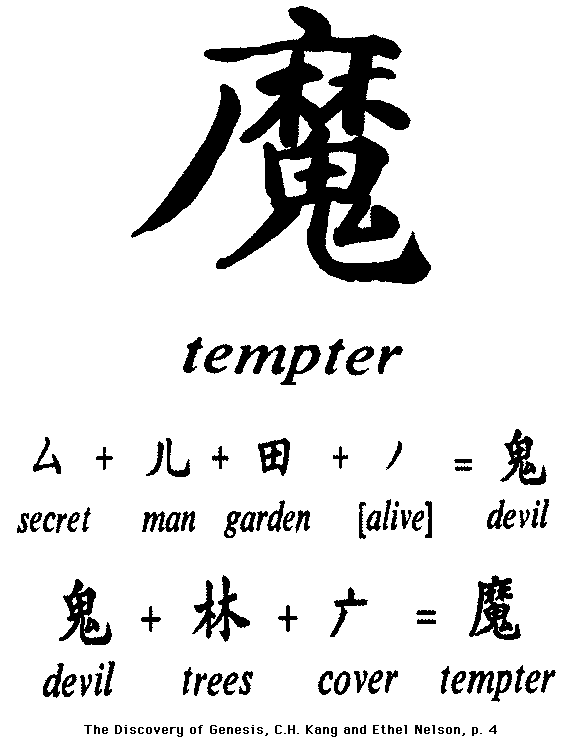
Chinese Characters

Here are seven Chinese Characters that show that the ancient Chinese knew the Gospel message found in the book of Genesis. In the book God’s Promise to the Chinese by Ethel R. Nelson and Richard E. Broadberry, hundreds more are revealed.

Find out:

Do the mysterious, ancient Chinese characters have a biblical meaning little understood before?
What was the meaning of the 4,000-year-old Border Sacrifice that the Chinese emperors observed annually?
Who was Shang Ti, worshiped in the Border Sacrifice?
Painstaking analysis of the most ancient forms of Chinese writing reveals the original thoughts and beliefs of their inventor.

Using many examples, the authors show that the inventor of the original Chinese characters knew and believed the account of creation as well as the promise of the Savior to come. Shang Ti, worshiped at the Border Sacrifice, is the True God.

Large Boat

Large Boat
Large Boat
Large Boat
Large Boat

To Covet, Desire

To Create

Complete, Finish

Forbidden

Garden

Tempter


Saturday, December 22, 2012

Things Your Son Loves to Hear

Some parents might grit their teeth and bemoan the drama of the adolescent years, but I can’t think of anything more fun than hanging out with teens. I liken the teen years to a roller coaster. Once you’re on it, there’s no getting off until the ride’s over, so you might as well stay positive and enjoy it. After all, having teens at home probably means you can have kitchen karaoke parties, or someone who pretends your home is an Indian takeout restaurant when he answers the phone.

Of course surging hormones and adolescent angst can sometimes cause your teen to explode. He might know how to push your buttons better than anyone else, but positive communication that affirms your teen can improve your relationship and help lessen conflict.


Here are 10 things our teens love and need to hear from us:

1. I love you no matter what.
In an effort to encourage our kids to do their best, we can inadvertently communicate that we’d love them more if they got better grades, cleaned their rooms, or worked harder. Our teens need to hear, “I love you. I will love you even if you leave the kitchen a mess, fail your test, wreck the car, or lose your job.”

Our kids face challenges, and they need the security of parents who love them no matter what. So let’s say, “I love you” often.

2. I'm proud of you.
Many young people have told me the words, “I’m proud of you,” mean the world to them. Our children desperately want to know we’re pleased with them. No matter what struggles he is navigating or mistakes he made, look for your son’s positive qualities and talents. As well as telling his specific accomplishments that make you proud, let him know you’re proud of the person he’s becoming. 

3. I love _________ about you.
Your teen is God’s handiwork, fearfully and wonderfully crafted. Yet many voices in the world can tear him down -- thoughtless comments by peers or teachers, bullying, or social media slamming. Remember you as a parent are the most powerful force in helping your son build a positive self-esteem. Your opinion about him matters more to your son than anyone else’s, and you can help him combat the negative voices he might hear in the world.


Tell him often what you like about him. “I love your optimism.” “I appreciate how you played with the kids at the party.” “You’ve got a great sense of humor.”

4. You are beautiful/handsome.
Adolescents often wrestle insecurity or low self-esteem, and today’s teens face more social pressure than previous generations because of social media. Just the other day, my daughter, who happens to be beautiful, received this hate message on Instagram: “You’re way too ugly to post selfies.” It crushed her. I could barely get my mind around the fact that she believed that message even for a minute, yet she needed reassurance.


Girls have a deep need to know they’re beautiful, inside and out. Guys also need to know they’re handsome, beautiful people.

5. What do you think?
Our sons want to know we value their opinions. Let’s ask what they think about the news, politics, and social issues. This lets them know we believe they have important things to say and contribute. It can also encourage them to think for themselves instead of going along with the crowd.


Our sons also appreciate having a voice in family decisions. Even though parents carry the ultimate responsibility for decision-making, we need to honor our kids’ growing sense of autonomy by asking for and considering their opinions. 

6. I'm ready to listen.
Children will experience many crises as they ride the hormonal roller coaster, navigate social pressure, and struggle with their studies. As parents, our first urge is to try to fix their problems. Sometimes we do have helpful suggestions they hadn’t considered, but perhaps most of all, sons need us to listen long and well, even if it means staying up past our bedtimes. 


Here’s our chance to practice James 1:19: “Everyone should be quick to listen, slow to speak and slow to become angry.”

7. I believe in you.
Our young sons want to know we have confidence in them and their abilities. They yearn for the encouragement that comes from hearing things like this: 

“I know you have what it takes for this project.” 

“It may be hard, but keep working! You’ve got this.”

"You’d make a great engineer/nurse/therapist/entrepreneur.” 

“Maybe you didn’t get the grade you wanted, but this doesn’t define you. You have a lot going for you.”

8. I can't wait to see what your future holds.
As he gets older, your son will face stressful choices regarding his future. Reassure him that he can relax instead of worry. Scripture tells us why: “‘For I know the plans I have for you,’ declares the Lord, ‘plans to prosper you and not to harm you, plans to give you hope and a future.’” (Jeremiah 29:11)

This promise reminds our sons their future doesn’t depend only on them. They can be confident that God will open the right doors for them. They don’t have to fear making the wrong decision about where to go to college or what to study. If a decision doesn’t work out, they can always change it later. As they follow God step by step, He will bless them.

9. I enjoy you.
You can build your son’s self-esteem by letting her know you enjoy not only being with her, but you also enjoy her as a person. Express delight in her creativity, her wit, or her hard work. Laugh often when you’re together. Let her know you have fun talking and spending time together.

10. Can we do something fun together?
The thing about teenagers is we need to love and enjoy them as best we can because we don’t have many years left with them at home. Every opportunity is golden. Whether it’s watching a favorite TV series, walking to the ice cream shop, going out to dinner, or taking a road trip, time together enhances our relationships and builds fun into our family culture. 


Let’s face it: our teens may take more interest in spending time with their friends than with us. Still, if parents seek out opportunities to spend time together, they’ll usually respond. When we make time for fun together, our teens know we enjoy them, and we have a chance to tell them what they need to hear from us.

2012 EMPOWER NETWORK PART 6

Prayer for Healing

Are you facing a difficult disease, illness or malady and want to cry out to God for healing but don't know what to pray? If you feel scared, alone, unsure of the future, or don't understand how healing works, pray these words below in faith today! Below is a prayer for healing, explaining how we should pray for healing, and some of our favorite Bible verses on healing.


God tells us that through prayer, He can speak to us and use us to work miracles for His glory. When you use this prayer for healing you are coming to God completely surrendered and expectant to let His Holy Spirit work in and through you. I pray that you will find miraculous healing as you seek God's plan for your life - His plan to prosper you and to give you a hope and future!

"Father God, you know me so well. You created me. You know the number of hairs on my head, and you even know the thoughts conceived in my heart before I ever vocalize them. You've told us to come to you and ask for every need of life. You are Jehovah-Rapha, the God who heals, and you have the final word on my destiny, the number of years I'll live and serve you on earth.


I'm coming to you today as your child, longing to hear from you and asking for your divine healing. There's so much I don't understand about life. But I do know that with one touch, one word, you can make me whole. Please forgive me of my sins, cleanse me of my unrighteousness, and begin your healing from the inside out.

I don't always know what your will is Lord, especially in times like now, when I desperately seek your face. I offer you no promises, no bargains, no deals to exchange for my health. I simply bow my heart before you to tell you the desire of my heart: that I want to spend as many years as I can loving you here, loving others, and wanting to become more like you. However you choose to accomplish that is up to you—and okay with me. If you use doctors to provide healing, give them wisdom to know what to do. Regardless of how you accomplish it, the healing you give is always miraculous. And you deserve all the praise.
I absolutely believe you have the power to heal. You demonstrated that on earth, and you still heal in miraculous ways today. Even when my faith is weak, you say it is enough, and my love for you is strong. And I know you already hold my heart and life in your hands. It's up to you. If I can bring you more glory through healing, then that's what I ask for. That's what I desire.
But if your answer is no, or not now, I know that your grace is sufficient for me. Ultimately, I want your will to be my will. I look forward to spending an eternity with you. But Lord, if you have planned still more for me to do here on this earth, I not only need and want your physical healing, Lord, but a thorough, deep-down cleansing and strengthening—a whole-hearted renewal of all that I am. Because all that I am is yours. Use this trial to strengthen me from a "what-if" faith to a "no-matter-what" faith. And no matter what, I choose to honor you and give you glory.

In Jesus's name, Amen.

2012 EMPOWER NETWORK PART 5

Healing Bible Verses

Bible Verses About Healing - The Bible speaks often of miraculous healing through the work of Jesus Christ and through faith in God. Find Scripture that will encourage you and help you focus on finding comfort through the healing of Christ both spiritually and physically.

Prayer has healing power. If you are unsure of how to pray and ask God for healing, use our prayer for healing and experience the strength and peace that only God can give.

Isaiah 41:10
 10 So do not fear, for I am with you; do not be dismayed, for I am your God. I will strengthen you and help you; I will uphold you with my righteous right hand.

James 5:14
 14 Is anyone among you sick? Let them call the elders of the church to pray over them and anoint them with oil in the name of the Lord.

Matthew 11:28
 28 “Come to me, all you who are weary and burdened, and I will give you rest.

Philippians 4:19
19 And my God will meet all your needs according to the riches of his glory in Christ Jesus.

Proverbs 4:20-22
20 My son, pay attention to what I say; turn your ear to my words. 21 Do not let them out of your sight, keep them within your heart; 22 for they are life to those who find them and health to one’s whole body.

Exodus 15:26
 26 He said, “If you listen carefully to the LORD your God and do what is right in his eyes, if you pay attention to his commands and keep all his decrees, I will not bring on you any of the diseases I brought on the Egyptians, for I am the LORD, who heals you.”

Psalm 107:19-21
 19 Then they cried to the LORD in their trouble, and he saved them from their distress. 20 He sent out his word and healed them; he rescued them from the grave. 21 Let them give thanks to the LORD for his unfailing love and his wonderful deeds for mankind.

Exodus 23:25
 25 Worship the LORD your God, and his blessing will be on your food and water. I will take away sickness from among you,

Psalm 30:2
 2 LORD my God, I called to you for help, and you healed me.

Isaiah 53:4-5
 4 Surely he took up our pain and bore our suffering, yet we considered him punished by God, stricken by him, and afflicted. 5 But he was pierced for our transgressions, he was crushed for our iniquities; the punishment that brought us peace was on him, and by his wounds we are healed.

Psalm 103:2-4
2 Praise the LORD, my soul, and forget not all his benefits— 3 who forgives all your sins and heals all your diseases, 4 who redeems your life from the pit and crowns you with love and compassion,

Psalm 41:2-3
 2 The LORD protects and preserves them— they are counted among the blessed in the land— he does not give them over to the desire of their foes. 3 The LORD sustains them on their sickbed and restores them from their bed of illness.

Psalm 147:3
 3 He heals the brokenhearted and binds up their wounds.

Jeremiah 17:14
14 Heal me, LORD, and I will be healed; save me and I will be saved, for you are the one I praise.

Matthew 8:5-17
 5 When Jesus had entered Capernaum, a centurion came to him, asking for help. 6 “Lord,” he said, “my servant lies at home paralyzed, suffering terribly.” 7 Jesus said to him, “Shall I come and heal him?” 8 The centurion replied, “Lord, I do not deserve to have you come under my roof. But just say the word, and my servant will be healed. 9 For I myself am a man under authority, with soldiers under me. I tell this one, ‘Go,’ and he goes; and that one, ‘Come,’ and he comes. I say to my servant, ‘Do this,’ and he does it.” 10 When Jesus heard this, he was amazed and said to those following him, “Truly I tell you, I have not found anyone in Israel with such great faith. 11 I say to you that many will come from the east and the west, and will take their places at the feast with Abraham, Isaac and Jacob in the kingdom of heaven. 12 But the subjects of the kingdom will be thrown outside, into the darkness, where there will be weeping and gnashing of teeth.” 13 Then Jesus said to the centurion, “Go! Let it be done just as you believed it would.” And his servant was healed at that moment. 14 When Jesus came into Peter’s house, he saw Peter’s mother-in-law lying in bed with a fever. 15 He touched her hand and the fever left her, and she got up and began to wait on him. 16 When evening came, many who were demon-possessed were brought to him, and he drove out the spirits with a word and healed all the sick. 17 This was to fulfill what was spoken through the prophet Isaiah: “He took up our infirmities and bore our diseases.”

Matthew 9:35
35 Jesus went through all the towns and villages, teaching in their synagogues, proclaiming the good news of the kingdom and healing every disease and sickness.

Mark 5:34
 34 He said to her, “Daughter, your faith has healed you. Go in peace and be freed from your suffering.”

Luke 8:43-48
 43 And a woman was there who had been subject to bleeding for twelve years, but no one could heal her. 44 She came up behind him and touched the edge of his cloak, and immediately her bleeding stopped. 45 “Who touched me?” Jesus asked. When they all denied it, Peter said, “Master, the people are crowding and pressing against you.” 46 But Jesus said, “Someone touched me; I know that power has gone out from me.” 47 Then the woman, seeing that she could not go unnoticed, came trembling and fell at his feet. In the presence of all the people, she told why she had touched him and how she had been instantly healed. 48 Then he said to her, “Daughter, your faith has healed you. Go in peace.”

Luke 8:49-56
 49 While Jesus was still speaking, someone came from the house of Jairus, the synagogue leader. “Your daughter is dead,” he said. “Don’t bother the teacher anymore.” 50 Hearing this, Jesus said to Jairus, “Don’t be afraid; just believe, and she will be healed.” 51 When he arrived at the house of Jairus, he did not let anyone go in with him except Peter, John and James, and the child’s father and mother. 52 Meanwhile, all the people were wailing and mourning for her. “Stop wailing,” Jesus said. “She is not dead but asleep.” 53 They laughed at him, knowing that she was dead. 54 But he took her by the hand and said, “My child, get up!” 55 Her spirit returned, and at once she stood up. Then Jesus told them to give her something to eat. 56 Her parents were astonished, but he ordered them not to tell anyone what had happened.

Revelation 21:4
 4 ‘He will wipe every tear from their eyes. There will be no more death’ or mourning or crying or pain, for the old order of things has passed away.”

James 5:16
 16 Therefore confess your sins to each other and pray for each other so that you may be healed. The prayer of a righteous person is powerful and effective.

1 Peter 2:24
 24 “He himself bore our sins” in his body on the cross, so that we might die to sins and live for righteousness; “by his wounds you have been healed.”

Various Translations: 

American Standard Version
Exodus 23:25 (ASV) And ye shall serve Jehovah your God, and he will bless thy bread, and thy water; and I will take sickness away from the midst of thee.

The Bible in Basic English
Exodus 23:25 (BBE) And give worship to the Lord your God, who will send his blessing on your bread and on your water; and I will take all disease away from among you.

Common English Bible
Exodus 23:25 (CEB) If you worship the LORD your God, the LORD will bless your bread and your water. I'll take sickness away from you,

Common English Bible w/ Apocrypha
Exodus 23:25 (CEBA) If you worship the LORD your God, the LORD will bless your bread and your water. I'll take sickness away from you,

The Complete Jewish Bible
Exodus 23:25 (CJB) "You are to serve ADONAI your God; and he will bless your food and water. I will take sickness away from among you.

Holman Christian Standard Bible
Exodus 23:25 (CSB) Worship the Lord your God, and He will bless your bread and your water. I will take away your illnesses.

The Darby Translation
Exodus 23:25 (DBY) And ye shall serve Jehovah your God; and he shall bless thy bread and thy water; and I will take sickness away from thy midst.

English Standard Version
Exodus 23:25 (ESV) You shall serve the LORD your God, and he will bless your bread and your water, and I will take sickness away from among you.

Good News Translation
Exodus 23:25 (GNT) If you worship me, the Lord your God, I will bless you with food and water and take away all your sicknesses.

Good News Translation w/ Apocrypha
Exodus 23:25 (GNTA) If you worship me, the Lord your God, I will bless you with food and water and take away all your sicknesses.

GOD'S WORD Translation
Exodus 23:25 (GW) You must serve the LORD your God, and he will bless your food and water. I will take away all sickness from among you.

Hebrew Names Version
Exodus 23:25 (HNV) You shall serve the LORD your God, and he will bless your bread and your water, and I will take sickness away from your midst.

Jubilee Bible 2000
Exodus 23:25 (JUB) But ye shall serve the LORD your God, and he shall bless thy bread and thy water; and I will take all sickness away from the midst of thee.

King James Version

Exodus 23:25 (KJV) And ye shall serve the LORD your God, and he shall bless thy bread, and thy water; and I will take sickness away from the midst of thee.

Lexham English Bible
Exodus 23:25 (LEB) And you will serve Yahweh your God, and he will bless your bread and your water, and I will remove sickness from among you.